Tokyo Shotengai: Sunamachi and Togoshi Ginza Prices
Prices checked September 22, 2026 against the official pages. Every figure links to its source.

Published: September 22, 2026
This page contains an affiliate link. If you book through it, we may earn a commission at no extra cost to you. It does not change our numbers. See our disclosure.
Prices checked on September 22, 2026.
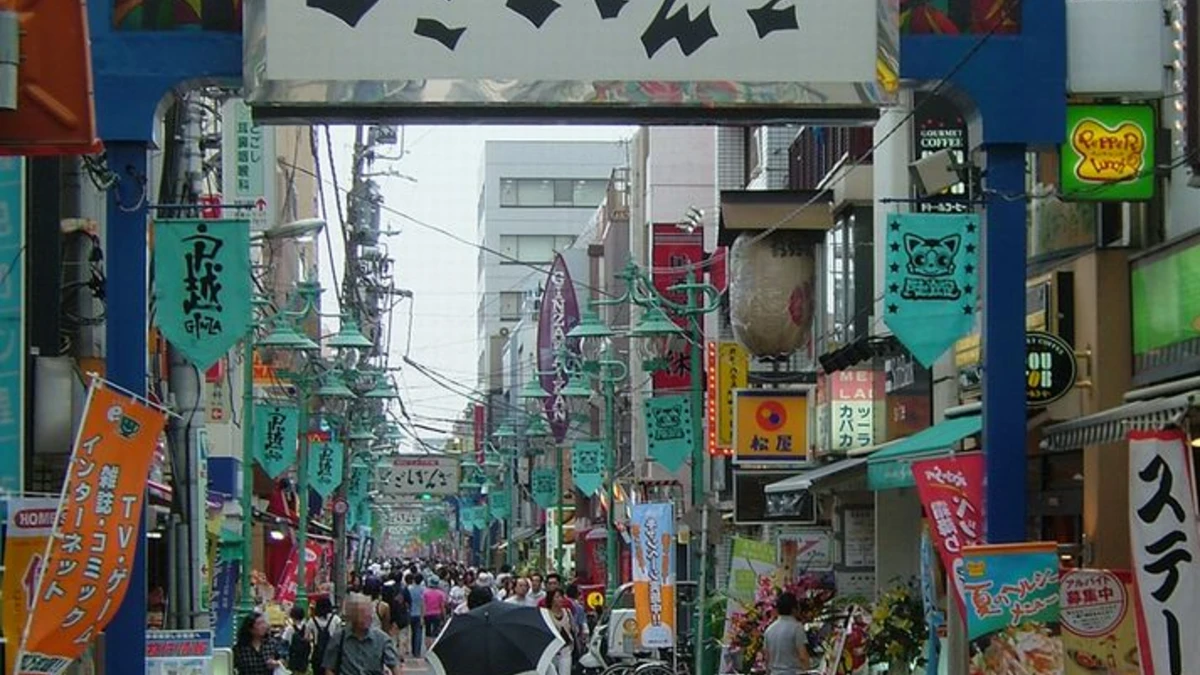
Togoshi Ginza shopping street (shotengai, Japanese for a covered or open-air shopping street) runs about 1.3 km through Shinagawa, with close to 400 shops and, on a typical weekend, nearly 10,000 visitors passing under its blue entrance arch, according to the street's own English-language page. About 20 of those shops compete with their own recipe for Togoshi Ginza Korokke, a specialty shared across the street rather than any single shop's secret. Across town in Koto City, Sunamachi Ginza covers a shorter stretch, about 670 meters; Koto City's own Japanese-language page describes it as a street rooted in local residents' daily lives, and it holds a bargain sale called the Baka-ne Ichi on the 10th of every month.
The short answer: a plain croquette costs about the same everywhere, roughly 100 yen, whether you buy it in Sunamachi Ginza, Togoshi Ginza, or Asakusa. The price gap opens up on each street's named specialty item, and it opens even wider on access: Togoshi Ginza sits right at its own train station, while Sunamachi Ginza's official access page routes visitors onto a bus. The numbers below break down both, as of September 22, 2026.
The short answer
- Plain snacks cost about the same everywhere. A plain croquette runs roughly 30 to 110 yen in Sunamachi Ginza (several shops, per local media), 100 yen in Togoshi Ginza (Katabami Meat Shop's potato croquette, official Shinagawa Tourist Association price), and about 100 yen in Asakusa (general reporting), as of September 22, 2026.
- The gap opens on named specialty items. Togoshi Ginza's oden croquette is 100 yen, officially confirmed. Asakusa's well-known cheese menchi-katsu is reported at 350 to 500 yen, though the shop's own site does not list a price.
- The bigger difference is access. Togoshi Ginza sits right next to Tokyu Ikegami Line's own "Togoshi Ginza" station. Sunamachi Ginza's official access page instead directs visitors onto a bus from the nearest subway stations.
All prices in this article are as of September 22, 2026 and can change; check with each shop or operator before you go.
Jump to food tours and getting there →
The numbers: what things cost at Sunamachi Ginza and Togoshi Ginza
This section compares two kinds of food: the plain, everyday item you'd find at almost any butcher's counter, and the named "specialty" item each street is known for. Splitting the two turns out to matter more than which shopping street you're in.
Plain snacks cost about the same everywhere
| Place | Item | Price | Source |
|---|---|---|---|
| Sunamachi Ginza | Plain croquette (several shops, price varies) | 30 to 110 yen | Local media, checked September 22, 2026 |
| Togoshi Ginza | Potato croquette, Katabami Meat Shop | 100 yen | Shinagawa Tourist Association, official |
| Asakusa | Plain croquette, butcher shops (general) | About 100 yen | General reporting |
Plain croquettes are priced similarly across all three areas. The bigger price differences show up in each shotengai's named specialty items, below.
Named specialty items are where the price gap shows
| Place | Item | Price | Source |
|---|---|---|---|
| Sunamachi Ginza | Clam (asari) croquette | 250 yen | Local media |
| Sunamachi Ginza | Tuna mince (maguro-menchi) croquette | 300 to 330 yen | Local media |
| Togoshi Ginza | Oden croquette, Goto Kamaboko | 100 yen | Shinagawa Tourist Association, official |
| Asakusa | Cheese menchi-katsu, Kuroge Asakusa Kaminarimon | 350 to 500 yen | Local media, shop's own site lists no price |
| Tsukiji Outer Market | Salmon cutlet / corn fritter, Aji no Hamato | 400 yen / 450 yen | Local media, reference only, different ingredients |
Most of these prices come from individual shops that don't publish prices on their own websites, so we've used local media and review sites, each checked on September 22, 2026, rather than calling any of them "the" official price. We're not calling this "tourist-area price-gouging." Some of it comes down to the ingredients and branding of each named item rather than the location alone. The Tsukiji items above use different, pricier ingredients (salmon, corn), so they're listed for reference rather than as a direct comparison.
Togoshi Ginza Korokke: from about ¥50 to ¥60 in 2009 to about ¥100 in 2026
When Togoshi Ginza first branded its "Togoshi Ginza Korokke" in March 2009, Shinagawa Keizai Shimbun, a local business news site, reported that seven participating shops sold their croquettes for 50 to 60 yen each. Goto Kamaboko's oden croquette specifically sold for 60 yen (50 yen during a launch promotion), the same report said.
As of September 22, 2026, the Shinagawa Tourist Association's own page lists Katabami Meat Shop's potato croquette at 100 yen and Goto Kamaboko's oden croquette at 100 yen, roughly double the 2009 launch price. That 100 yen figure is the official listed price for those two shops; the other roughly 20 shops set their own price for their own version. If you read an older travel write-up quoting 50 to 60 yen for Togoshi Ginza Korokke, it's likely repeating the 2009 launch price.
Highlights: what makes these shotengai worth visiting
The numbers above are about what you'll pay. This section is about why locals keep coming back, food stalls with a fanbase, a public bath you can duck into between shops, a centuries-old shrine down a side street, and two very different kinds of street life.
Twenty shops, one competitive croquette
Togoshi Ginza's food-walking culture centers on its namesake croquette. The Shinagawa Tourist Association describes roughly 20 shops as offering their own take on Togoshi Ginza Korokke, each with a different recipe: Katabami Meat Shop's plain potato version, Goto Kamaboko's oden croquette, and others along the street. It's less a single famous snack than a running competition between neighbors, which is part of why the street draws food walkers rather than just people running errands.
That competitive spirit is also why the "Togoshi Ginza Korokke" name doesn't point you to one storefront. Walking the 1.3 km street, you pass one butcher or delicatessen after another, each with its own version of the same idea, so tasting your way from one end to the other means trying several different recipes rather than queueing once at a single famous shop.
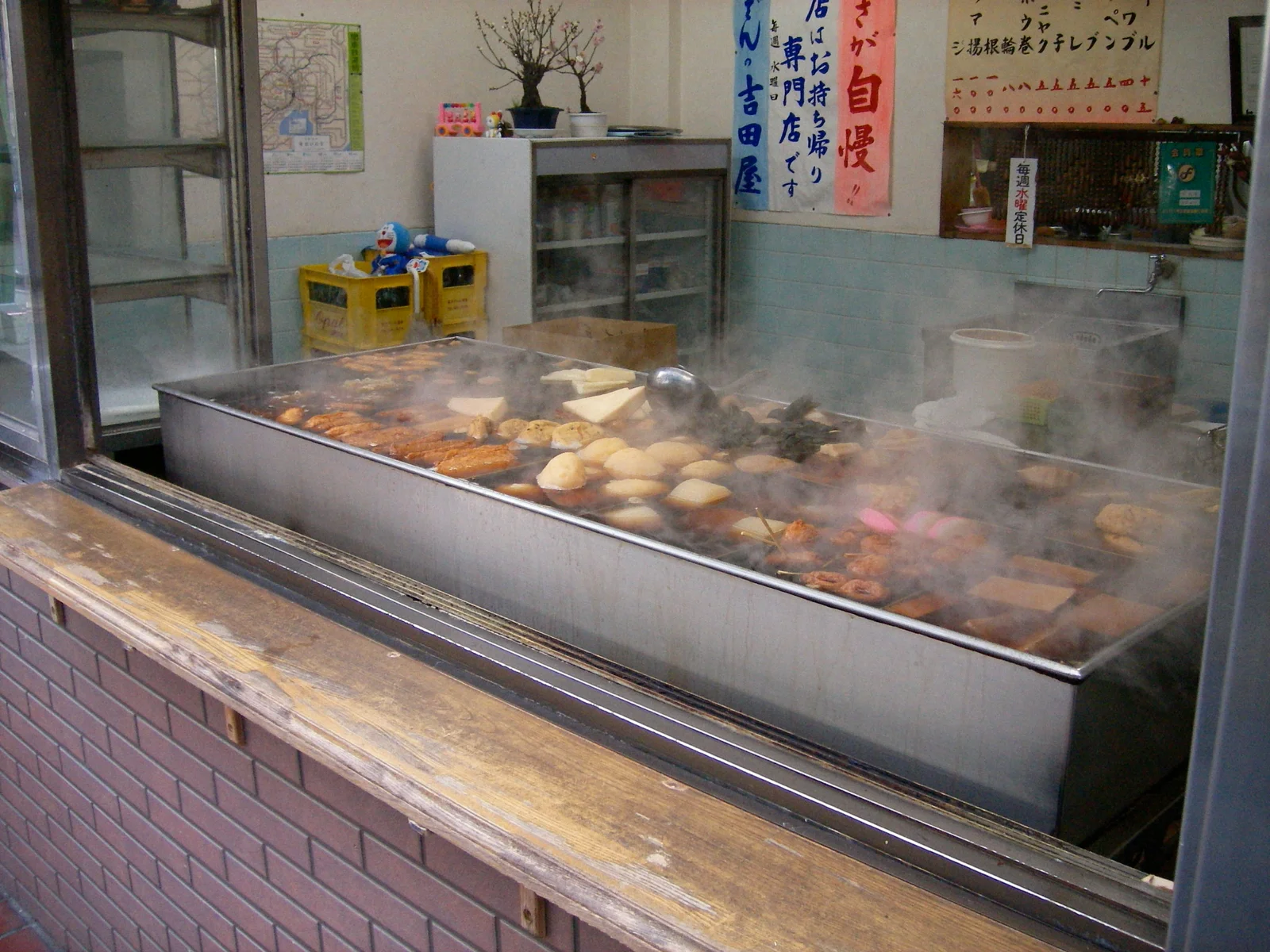
Sunamachi Ginza takes a different approach. Tokyo Shimbun Digital, a regional newspaper, describes it as a street thick with delicatessen shops (sozai-ya) selling croquettes, oden, and grilled skewers, a "food-walking Ginza" in its own right. Where Togoshi Ginza's food identity is built around one item done many ways, Sunamachi Ginza's is built around many different shops each doing their own thing, from oden simmering in steel trays to grilled chicken skewers.
A streetscape that still feels like Showa-era Tokyo
Tokyo Shimbun Digital, a regional newspaper, describes Sunamachi Ginza (in Japanese) as a nostalgic shopping street where the Showa era still runs deep, a description that lines up with the street's own history. Koto City's Japanese-language official page notes that the street took roughly its current form around 1963, in the later years of the Showa era (1926 to 1989), and describes it as a street rooted in local residents' daily lives.
Part of that feeling comes from what Sunamachi Ginza doesn't have: it's not built around a train station exit the way many newer shopping streets are, which is one reason it hasn't become a stop on the standard tourist route through central Tokyo. We go into the specific walking and bus times in the "How far is it, really?" section below.
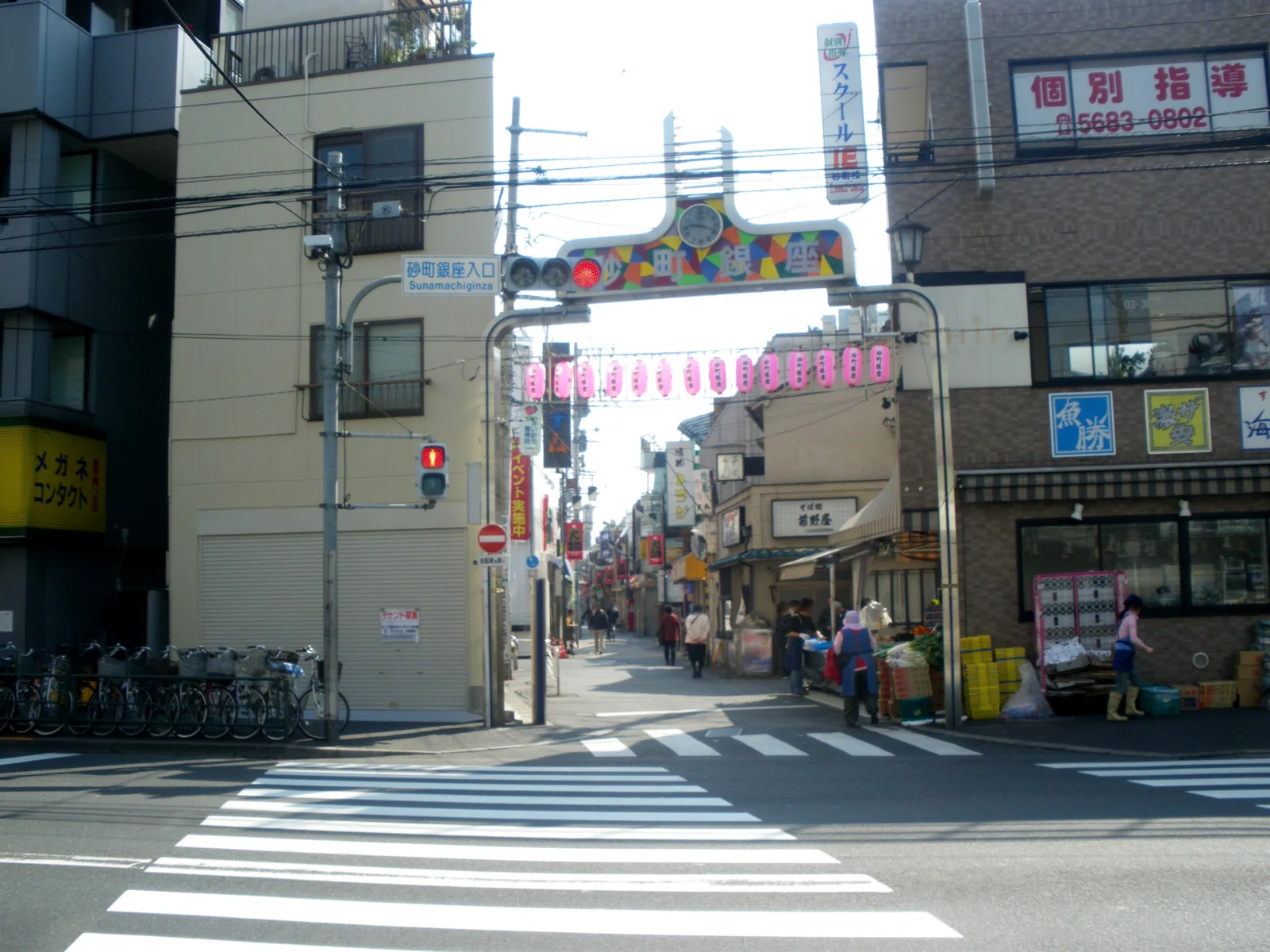
That photo above is from 2009. We're using it because it's the clearest licensed image of the street's entrance we could confirm, but individual shop signage has likely changed since it was taken; treat it as a sense of the entrance, not a current storefront guide.
A public bath built into the shopping street
Togoshi Onsen, a public bathhouse, sits directly on the Togoshi Ginza shopping street. Togoshi Ginza's own English-language page describes it plainly: "For 460 yen you can enjoy indoor bath or outdoor bath, a Jacuzzi, and even a sauna." It's an easy way to break up a few hours of food-walking, and it's the kind of neighborhood facility that doesn't usually make it onto an Asakusa or Tsukiji itinerary.
A 15th-century garden and a shrine founded in 1526
A short walk from the shopping street, Togoshi Park holds a garden that Togoshi Ginza's own page traces to the 15th century, complete with a pond and a small waterfall. Nearby, Togoshi Ginza Shrine was founded in 1526, per the same official page. Neither site charges admission, and both sit close enough to the shotengai that they fit into the same afternoon without a separate trip.
Streets that clear for pedestrians
Togoshi Ginza officially closes to car traffic for three hours every afternoon, according to its own English-language page: "Togoshi Ginza streets are closed to cars for 3 hours every afternoon." The official site doesn't list exact clock times, but several secondary sources agree on roughly 15:00 to 18:00 on weekdays and Saturdays, and 14:00 to 19:00 on Sundays and public holidays. During that window, the street effectively becomes a pedestrian zone from end to end, which is when the crowds and the food stalls feel busiest. We go into more detail on timing the visit in the "How locals plan it" section below.
A newer mix of shops alongside the old ones
Alongside its longtime butchers and produce stands, Sunamachi Ginza has more recently picked up a wider mix of shops, including some serving Chinese-style prepared foods and South Asian curry, per general search results rather than an official shop list. Think of this as "there's more variety than a purely traditional street" rather than a guide to any particular shop.
Festivals that take over the whole street
Both streets hold an annual festival that shuts down ordinary shopping in favor of a block party. Sunamachi Ginza's 75th annual Tanabata Matsuri (Star Festival) ran August 7 to 9, 2026, with a prize lottery at Sunagin Plaza (12:00 to 17:00, total prizes worth 1.5 million yen, guaranteed win), a main stage program from 15:00 to 21:00, and a children's festival area at Kitasuna Park from 12:00 to 15:00, per Koto City's official announcement. Togoshi Ginza holds its own Furusato Festa twice a year, once in summer and once in autumn; the 2026 summer edition ran July 4, per the shopping street's own site. More dates for both streets are in the "When to go" section below.
How far is it, really? Getting to Sunamachi Ginza and Togoshi Ginza
Fares and travel details below are as of September 22, 2026. If you're coming in from Narita Airport earlier in your trip, see our guide to getting from Narita to central Tokyo first.
Togoshi Ginza sits right at its own station. Its own access page names two options: Tokyu Ikegami Line's "Togoshi Ginza" station, reached by taking the JR Yamanote Line to Gotanda and then riding the Ikegami Line two stops, and Toei Asakusa Line's "Togoshi" station, whose exit sits a few minutes' walk from the shopping street. From Gotanda to Togoshi Ginza on the Ikegami Line, Tokyu Corporation's official fare page prices the two-stop ride at 140 yen. A direct ride on the Toei Asakusa Line from Asakusa to Togoshi runs 280 yen by ticket or 272 yen by IC card, based on Toei's official distance-band fare table for that route length, which lines up with the fare shown by a third-party route search site we checked for consistency.
Sunamachi Ginza is a different story. Its own access page doesn't lead visitors to a nearby train station at all; it leads them to a bus. From Tozai Line's Toyocho Station, the official guidance is Toei Bus route 07 for about 12 minutes to the "Kitasuna 2-chome" stop. From Toei Shinjuku Line's Nishi-Ojima Station, the same bus route takes about 4 minutes to the same stop. If you'd rather walk the whole way, Tozai Line's Minamisunamachi Station is the nearest option, at roughly 15 to 19 minutes on foot per real-estate and neighborhood guide sites (Sunamachi Ginza's own page doesn't publish a walking-time figure).
| Route | Operator / line | Fare (ticket / IC) | Note |
|---|---|---|---|
| Gotanda to Togoshi Ginza (2 stops) | Tokyu Corporation, Ikegami Line | 140 / 140 yen | Official Tokyu fare page |
| Asakusa to Togoshi (through service) | Toei Subway, Asakusa Line | 280 / 272 yen | Official distance-band fare table; matches a secondary fare-search site |
| Otemachi to Minamisunamachi | Tokyo Metro, Tozai Line | About 210 yen | Consistent with the official distance-band fare table; multiple secondary sources agree on ¥210 |
| Toei Bus, flat fare within the 23 wards (general routes) | Toei Bus | 210 yen adult / 110 yen child (IC: 210 / 105 yen) | Multiple secondary sources agree on ¥210 |
A note on both of these figures: Tokyo Metro's own PDF of "Fares and Actual Travel Times for Major Sections" (current as of April 1, 2026) lists dozens of station pairs from Otemachi, but Minamisunamachi isn't one of them. Tokyo Metro's general distance-band fare table prices the relevant distance band at 210 yen by ticket, and a fare-search site shows the same 210 yen for this exact pair, so the number is consistent even without a station-to-station listing on Tokyo Metro's own page.
The Toei Bus flat fare within the 23 wards is 210 yen for adults and 110 yen for children (IC: 210 and 105 yen) on general routes, per multiple secondary sources.
Put the access picture together and the asymmetry is clear. Togoshi Ginza is a short, simple trip from central Tokyo with no bus required. Sunamachi Ginza takes an extra step, whether that's a 12-minute (or 4-minute, depending on your starting subway line) bus ride or a 15-to-19-minute walk. There's no direct route from Asakusa to Sunamachi Ginza at all; you'd need to change trains and likely take the bus, while Asakusa to Togoshi is a single ride on the Toei Asakusa Line.
Calculator: what the same snacks would cost at each place
Pick how many plain snacks and how many named specialty items you'd buy, and compare the total at Sunamachi Ginza, Togoshi Ginza, and Asakusa side by side.
- Choose how many plain snacks (like a plain croquette) you'd buy, then adjust each area's price if you know a specific shop's price.
- Choose how many named specialty items (like a mentaiko or oden croquette) you'd buy, and adjust those prices the same way.
- The calculator totals both categories for each of the three areas.
What this calculator leaves out: access fares and travel time (see the table above), Tsukiji items (different ingredients, not a fair comparison), unconfirmed item prices (like Asakusa Menchi's or Tsukiji Yamacho's), and children's prices.
Scenarios: three snack budgets compared
Totals for one person, as of September 22, 2026. Prices are representative figures from the sources in this article; edit them in the calculator above if you know a specific shop's price.
| Scenario | Sunamachi Ginza | Togoshi Ginza | Asakusa | What it shows |
|---|---|---|---|---|
| S1: Two plain snacks only | 140 yen | 200 yen | 200 yen | Barely any gap, just 60 yen |
| S2: Three plain snacks plus one specialty item | 510 yen | 400 yen | 725 yen | Adding a specialty item makes Asakusa clearly the most expensive |
| S3: One plain snack plus two specialty items | 570 yen | 200 yen | 1,100 yen | With specialty items dominating the order, the gap is largest |
Two plain snacks only
If all you're buying is a plain item, like a basic croquette, from each street, the totals barely separate: 140 yen in Sunamachi Ginza against 200 yen in both Togoshi Ginza and Asakusa. That 60-yen gap is well within normal shop-to-shop variation, not a sign that any one area overcharges for everyday food.
Three plain snacks plus one specialty item
Once a named specialty item enters the order, the picture changes. Sunamachi Ginza's tuna mince croquette and Asakusa's cheese menchi-katsu push their totals well above Togoshi Ginza's oden croquette, which is still priced at 100 yen. Here Asakusa comes out most expensive, mostly because its specialty item's reported price is more than four times Togoshi Ginza's.
One plain snack plus two specialty items
Weight the order even more heavily toward specialty items, and the spread grows further: Togoshi Ginza stays at 200 yen while Asakusa reaches 1,100 yen. This isn't a verdict that Asakusa is "ripping off" visitors; its named item uses different ingredients and branding. It does mean that the specialty item you choose, more than the neighborhood you're in, decides most of what you'll spend on Tokyo street food.
How locals plan it: the buying-hours rule and the monthly sale
Togoshi Ginza's own English-language page confirms that its streets are "closed to cars for 3 hours every afternoon," a window locals and the shopping street itself treat as the best time to walk it end to end without dodging traffic. Togoshi Ginza's own site doesn't list exact clock times, but multiple secondary sources place the window at roughly 15:00 to 18:00 on weekdays and Saturdays, and 14:00 to 19:00 on Sundays and public holidays. If those times hold on the day you visit, arriving toward the start of the window gives you the longest stretch of car-free browsing before the street reopens to traffic.
Sunamachi Ginza runs on a different rhythm: the Baka-ne Ichi, a bargain sale held on the 10th of every month. The shopping street's own site and multiple local outlets confirm the date is fixed, so if your trip lines up with the 10th, that's when discounts across the street are most likely to be in effect.
One thing we looked into but can't confirm either way: whether Tokyo shotengai visitors are expected to eat while walking or to stop in front of the shop before eating a snack. Several travel guides describe the second habit as typical in food-walking areas like Asakusa, but neither Togoshi Ginza's nor Sunamachi Ginza's official pages state a rule on this, so we're not presenting it as settled etiquette. If in doubt, watching what other customers at the same stall do is a reasonable guide.
When to go: festivals and sales at Sunamachi Ginza and Togoshi Ginza in 2026
| When | Sunamachi Ginza | Togoshi Ginza |
|---|---|---|
| 10th of every month | Baka-ne Ichi bargain sale | — |
| March (exact date not yet announced) | — | "Hana Matsuri" parade, mentioned on the official site |
| July 4, 2026 (Saturday) | — | Summer Furusato Festa, official |
| August 7 to 9, 2026 | Tanabata Matsuri (75th edition), official | — |
| October 10, 2026 (Saturday), from 15:00 | — | Autumn Furusato Festa, official |
| December (exact date not yet announced) | Illumination display | — |
As of September 22, 2026, the 2027 dates for Togoshi Ginza's Furusato Festa events and both streets' other yearly events have not been announced. We plan to recheck this table around June 2027, when the following year's summer festival dates are typically confirmed.
On crowding: Togoshi Ginza's own page states weekday visitor traffic runs over 10,000 people, with more domestic and international visitors on weekends. For Sunamachi Ginza, a Japanese-language source (not an official one) puts weekday visits at around 15,000 and weekend visits at around 20,000.
How to buy: food tours and getting there
Getting there: tickets and IC cards
Both streets are reachable with an ordinary IC card (Suica or PASMO) or paper tickets; neither requires a special pass. For the IC card and ticket options for getting around central Tokyo more broadly, see our guide to the Tokyo subway ticket and Suica. If you're also shopping for goods, not food, while you're in Tokyo, see our guide to Japan's tax-free shopping rules for how the refund works.
Guided food tours of the shotengai
Togoshi Ginza itself is the subject of a guided food tour listed on GetYourGuide, built specifically around the shotengai. We're not repeating the tour operator's own description, photos or pricing here; check the current listing on GetYourGuide's site for what's included and its price before booking. Separately, Klook lists a Tsukiji culture and food tour, a natural add-on if you're also comparing Tsukiji's prices with the ones in this article; again, check Klook's own listing for details and current pricing rather than relying on a summary here.
Browse toursAffiliate link
Either street rewards the same simple plan: show up hungry, follow the smell of whatever's frying, and let the 100-yen items decide the route.
Common questions
How much is a croquette at Togoshi Ginza?
Katabami Meat Shop's potato croquette, part of the official Togoshi Ginza Korokke lineup, is 100 yen, per the Shinagawa Tourist Association, checked September 22, 2026. Back in 2009, when the branding launched, croquettes across the street's seven participating shops sold for 50 to 60 yen; the 100 yen figure is the official listed price for that one shop, and the roughly 20 shops selling their own version set their own price.
How many shops are at Sunamachi Ginza?
Sources mostly agree, but not entirely. Sunamachi Ginza's own site and Koto City's official page both state about 180 shops along the 670-meter street. Japanese-language Wikipedia is the outlier, putting the number closer to 140. Treat the shop count as roughly 180, with one source citing a lower number around 140.
How do I get to Sunamachi Ginza from central Tokyo?
There's no direct train: from Tozai Line's Toyocho Station, hop on Toei Bus route 07 for about 12 minutes to the "Kitasuna 2-chome" stop, or catch the same bus from Toei Shinjuku Line's Nishi-Ojima Station for a 4-minute ride. Prefer to walk? Tozai Line's Minamisunamachi Station is roughly 15 to 19 minutes away on foot.
Is Sunamachi Ginza or Togoshi Ginza more touristy?
We're not going to rank one as more or less "touristy." What we can show you is the difference in the numbers: Togoshi Ginza sits right at its own station, runs about 1.3 km, and has around 400 shops; Sunamachi Ginza requires a bus or a 15-to-19-minute walk from the nearest station, runs about 670 meters, and has about 180 shops per its own site and Koto City's official page (one other source puts it closer to 140).
Sources and data date
All prices and details in this article were checked on September 22, 2026, unless a different date is noted. Prices can change; check with the shop or operator before you go.
- Togoshi Ginza Shopping Street, official site: top page (Japanese), Highlights, English, access (Japanese), Summer Furusato Festa 2026, July 4 (Japanese), Autumn Furusato Festa 2026, October 10 (Japanese)
- Shinagawa Tourist Association, official (Japanese): Togoshi Ginza Shopping Street, Katabami Meat Shop
- Sunamachi Ginza Shopping Street, official site (Japanese): top page, access
- Koto City, official (Japanese): Sunamachi Ginza Shopping Street, Tanabata Matsuri announcement
- Tokyu Corporation, official (Japanese): fares
- Tokyo Metropolitan Bureau of Transportation (Toei), regular bus fares (Japanese): operator's own fare page — unavailable on September 22, 2026; the ¥210 flat fare in this article comes from secondary sources
- Tokyo Metro, official: Fares and Actual Travel Times for Major Sections PDF, as of April 1, 2026
- Shinagawa Keizai Shimbun (local business news), 2009: Togoshi Ginza Korokke launch (Japanese)
- Tokyo Shimbun Digital (regional newspaper): Sunamachi Ginza feature (Japanese)
- Japanese-language Wikipedia: Sunamachi Ginza Shopping Street (Japanese)
- Wikimedia Commons: Togoshi-ginza_street.JPG, Oden_shop_by_ivva_in_Sunamachi_Ginza,_Tokyo.jpg, Sunamachi_ginza_shopping_street_koto_tokyo_2009.JPG