Nikko Day Trip From Tokyo: Is the Pass Worth It?
Prices checked September 22, 2026 against the official pages. Every figure links to its source.

Published: September 22, 2026
This page contains an affiliate link. If you book through it, we may earn a commission at no extra cost to you. It does not change our numbers. See our disclosure.
Fares checked on September 22, 2026.
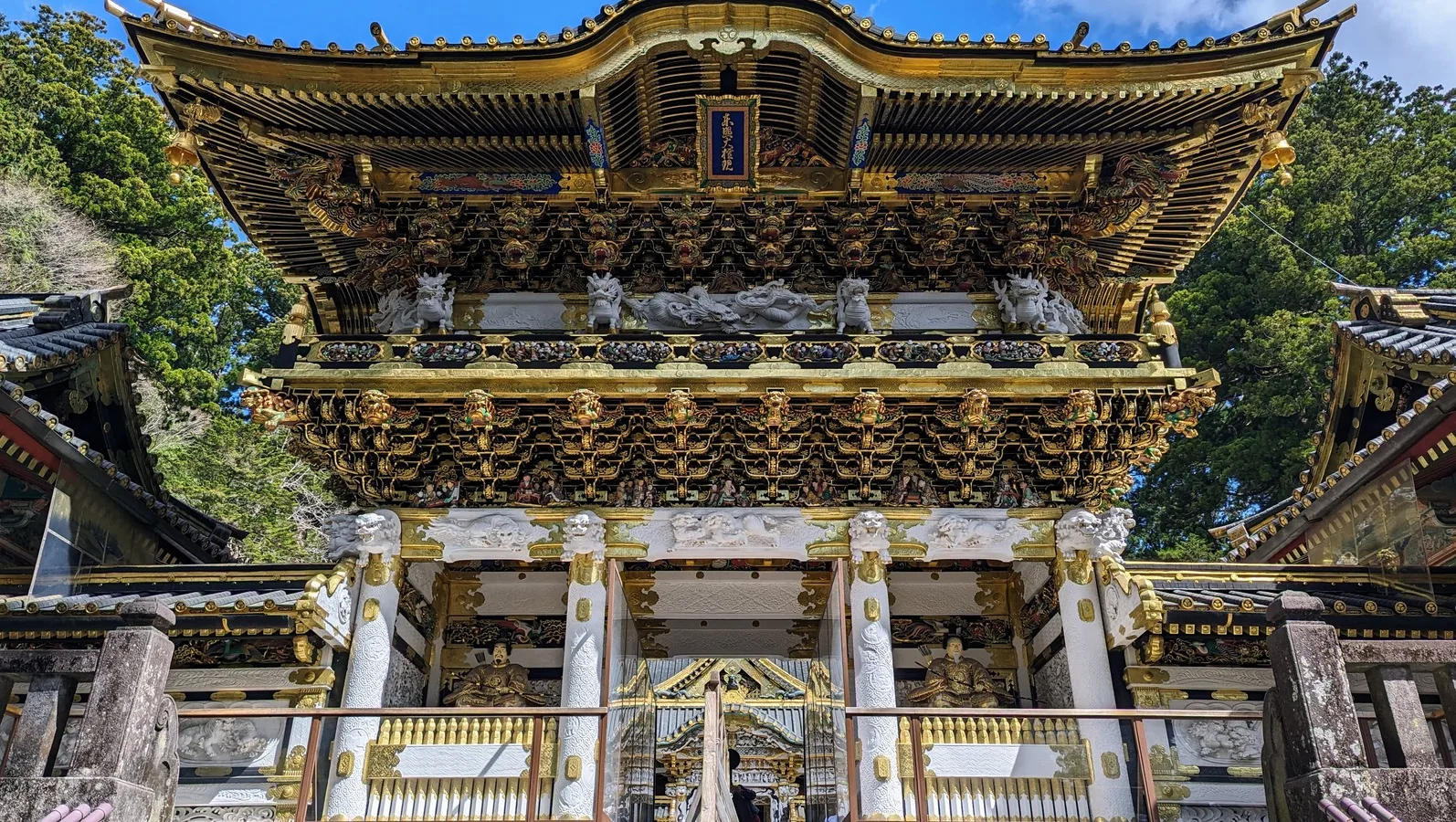
Above the gilded Yomeimon Gate at Nikko Toshogu, carved dragons and lions climb toward the roofline. In a corridor around the corner, a small carving of a sleeping cat, Nemuri-neko, watches over a passage that once led to the shrine's founder. Clap your hands under the painted ceiling of nearby Honjido and the echo is said to sound like a dragon's cry. Behind the shrine, a 37-km avenue of cedar trees, planted starting around 1625, still lines the roads into town.
Tobu Railway sells two different passes just to get you there and around: the NIKKO PASS all area (8,000 yen) and the NIKKO PASS world heritage area (3,000 yen). Neither one includes admission to the shrines themselves.
This article checks whether either pass beats buying a plain train ticket and paying for buses as you go, using fares confirmed against official pages and two independent fare-search tools on September 22, 2026.
The short answer
A Nikko day trip from Tokyo does not need a pass to break even.
The plain round-trip train ticket between Asakusa and Tobu Nikko is 2,800 yen (as of September 22, 2026). Add a couple of local bus rides, and the total usually comes out about the same as, or less than, either NIKKO PASS.
The 3,000 yen World Heritage Area Pass starts to pay off once you take the local bus more than twice. The 8,000 yen All Area Pass rarely paid for itself on transport alone in the combinations we tested below — and it has risen about 74% in price since 2018. It also bundles a hot spring soak and a Lake Chuzenji cruise that we could not put a cash value on.
Shrine and temple admission is separate either way. Toshogu, Rinnoji and Futarasan together add up to at least 2,800 yen, since the combination ticket that once covered all three is not on sale as of September 22, 2026 (see below).
If you're flying into Narita and routing through Asakusa on your way to Nikko, see Narita Airport to Tokyo: Fares by Hotel Area and Time. Nikko is one of several classic day trips with its own pass debate; for a similar comparison see Is the Hakone Free Pass Worth It?
Adult, ordinary fares, as of September 22, 2026. Totals are for one person.
What the NIKKO PASS covers — and what it does not
Tobu Railway sells NIKKO PASS in two versions, and both cover transport only. Neither includes the entry fees for Toshogu, Rinnoji, Futarasan, Tobu World Square or Edo Wonderland Nikko Edomura.
One rule applies to both: "NIKKO PASS is only available to foreign travelers. However, Japanese nationals accompanying foreign travelers can also purchase the pass," according to Tobu's official pass pages.
If you're weighing a wider-coverage rail pass instead, note that the JR Tokyo Wide Pass includes JR routes toward Nikko, but it does not cover the Tobu Railway line from Asakusa that this article uses.
Getting there: the train ticket between Asakusa and Tobu Nikko
Tobu's own English pages do not publish a fare table for the Asakusa–Tobu Nikko route; the route search tools on its site hand this off to outside fare-search services. We checked two of them.
| Item (adult / child) | Fare | Source |
|---|---|---|
| Ordinary ticket, one way | 1,400 yen / 700 yen | ekitan.com fare search, based on Tobu Railway's official fare data |
| Ordinary ticket, round trip | 2,800 yen (calculated) | same |
| IC card fare, one way | 1,393 yen | Yahoo! Transit fare search |
Both figures were confirmed on September 22, 2026. The 7-yen gap between the ticket fare (1,400 yen) and the IC card fare (1,393 yen) fits the usual pattern on Japanese railways: ticket fares round up to the nearest 10 yen, while IC card fares are charged to the yen. If you tap an IC card (Suica, Pasmo and similar), you pay a few yen less each way than a paper ticket costs.
The limited express (Kegon) needs a separate reserved-seat ticket. Tobu's official brochure (effective from October 1, 2025) gives "1,450 yen and up" one way between Asakusa and Tobu Nikko or Kinugawa Onsen, and says the price varies by peak and off-peak season. The same ekitan.com search that gave us the 1,400 yen ticket fare shows 1,850 yen for the one-way limited express ticket.
Treat the limited express fare as a range — roughly 1,450 yen and up — rather than one fixed number, and check the official page for your exact train and date before booking. Either way, this supplement costs the same whether or not you hold a NIKKO PASS, so it is not part of the calculator below.
NIKKO PASS all area (8,000 yen)
| Item | Detail |
|---|---|
| Price | 8,000 yen adult / 4,000 yen child |
| Valid | 1 to 4 consecutive days |
| Covers | One round trip, Asakusa to Shimo-Imaichi (ordinary train); unlimited travel between Shimo-Imaichi and Tobu Nikko / Shin-Fujiwara; all Tobu Bus routes in the Nikko area; the Edo Wonderland Nikko Edomura shuttle bus; the Nikko-Kinugawa line bus (weekends and holidays only); the low-emission bus to Senjogahara (mid-April to November 30); one hot spring visit at the Nikko Astraea Hotel; one Lake Chuzenji cruise (mid-April to November 30); 4 ski lift rides at Nikko Yumoto Ski Area (winter only); discounts at about 70 facilities |
| Does not cover | The limited express ticket, reserved seats on the SL/DL Taiju steam train, and admission to the shrines, Tobu World Square or Nikko Edomura |
NIKKO PASS world heritage area (3,000 yen)
| Item | Detail |
|---|---|
| Price | 3,000 yen adult / 1,500 yen child |
| Valid | 1 to 2 consecutive days |
| Covers | The same Asakusa–Shimo-Imaichi round trip and Shimo-Imaichi–Tobu Nikko/Shin-Fujiwara unlimited travel, plus Tobu Bus routes inside the World Heritage Area only (buses toward Lake Chuzenji, Yumoto Onsen and Kirifuri Highland are not included) |
| Does not cover | Everything the All Area Pass excludes, plus the hot spring visit, the boat cruise and the ski lift rides |
One more note on both passes: the Akechidaira Ropeway, one of the discount-eligible facilities, is closed for construction from January 16, 2026 to August 31, 2027, with a possible extension. Neither pass can save you money on it during the closure.
Source: Tobu Railway, NIKKO PASS all area, NIKKO PASS world heritage area, brochure (English PDF, effective October 1, 2025).
Nikko's shrine and temple admission adds up — and the three-shrine combination ticket is not for sale
Seeing Toshogu, Rinnoji and Futarasan costs separate admission at each site. None of the NIKKO PASS options include it.
| Ticket | Individual (adult / elementary-junior high) |
|---|---|
| Toshogu, single admission | 1,600 yen / 550 yen |
| Rinnoji ticket (Sanbutsudo + Taiyuin) | 900 yen / 400 yen |
| Futarasan Shrine, sacred garden admission | 300 yen / 100 yen |
| Minimum three-site total | 2,800 yen |
Add the Treasure Hall to Rinnoji's ticket (a 3-building combined ticket at 1,000 yen instead of 900 yen), and the three-site total becomes 2,900 yen.
As of September 22, 2026, Rinnoji's official site says the combination ticket that once covered all three sites is suspended: sales are "stopped for the time being, due to various circumstances," with no start or end date given. There is no official way to bring this total below 2,800 yen.
Two optional extras sit outside this total: crossing the red Shinkyo Bridge costs 500 yen, and climbing Mt. Nantai during its open season (April 25 to November 11) costs 1,000 yen. Neither is required to see the shrines.
Source: Nikko Toshogu, admission (Japanese), Nikko Rinnoji, information (Japanese), Futarasan Shrine (Japanese).
Calculator: is a Nikko pass worth it for your day trip?
Use the calculator to compare the plain train ticket (plus any bus rides you plan) against both NIKKO PASS options.
- Choose how many one-way bus rides you'll take inside the World Heritage Area (around Toshogu, Rinnoji and Futarasan). Pick 0 if you plan to walk.
- Choose whether you're also heading beyond the World Heritage Area, to Lake Chuzenji, Kegon Falls, Yumoto Onsen or Kirifuri Highland.
- The result compares the total for one adult against both NIKKO PASS options.
- Shrine and temple admission, the limited express supplement, and child fares are not included here (see the tables above).
What the calculator does not include:
- The limited express supplement (roughly 1,450 yen and up, one way, on top of the ordinary ticket).
- Shrine and temple admission (2,800 yen or more; see the table above). It is the same whichever option you pick.
- Tobu World Square and Edo Wonderland Nikko Edomura admission. The All Area Pass discounts these, but the discount amount is not stated on the pass pages.
- Child fares and IC card fares (we used adult ticket fares throughout).
- The All Area Pass's own extras: one hot spring visit, one Lake Chuzenji cruise, and winter ski lift tickets. They don't come with a stated cash value, so they're not priced into the numbers here.
In the combinations we tested, the All Area Pass didn't come out cheapest in any of them — those bundled extras carry a real value that just isn't priced anywhere. If your day would actually use several of them, the pass may still be worth it for you; that part of the trade-off is yours to weigh, not ours to price.
What makes visiting Nikko's shrines and forest worth it
Toshogu: the Yomeimon Gate, the sleeping cat and the crying dragon
Toshogu was registered as a UNESCO World Heritage Site in 1999, and the paid viewing route runs from the main gate through the gilded Yomeimon Gate to the main hall, the stone chamber, the east corridor and the inner shrine, ending at Honjido.
The Yomeimon Gate is a National Treasure, two stories tall and covered in carved figures picked out in gold leaf. Along the east corridor, a small carving above a passageway shows a sleeping cat, Nemuri-neko, one of Toshogu's best-known details. At the sacred stable nearby, three carved monkeys cover their eyes, ears and mouth — the origin of the "see no evil, hear no evil, speak no evil" image.
Inside Honjido, a painted dragon covers the ceiling. Stand beneath it and clap two wooden blocks together, and the sound is said to echo back like a dragon's roar — a trick of the room's acoustics that staff demonstrate for visitors.
The route from the main gate to Honjido is a climb up stone stairs through several courtyards rather than a flat walk, but none of it needs special gear. Together, the gate, the sleeping cat and the crying dragon are the three details most visitors remember, even though the shrine has dozens of individually named buildings and carvings beyond them.
The cedar avenue leading into the mountains
Planting of Nikko's cedar avenue began around 1625, as a dedication to Tokugawa Ieyasu. About 12,500 trees remain along a route with a total length of roughly 37 km, and it is registered as both a Special Historic Site and a Special Natural Monument of Japan; it has also been listed in Guinness World Records. Nearly 50 trees are lost to age or storm damage most years, and local preservation efforts, including a tree-sponsorship program, keep replanting to hold the avenue together.
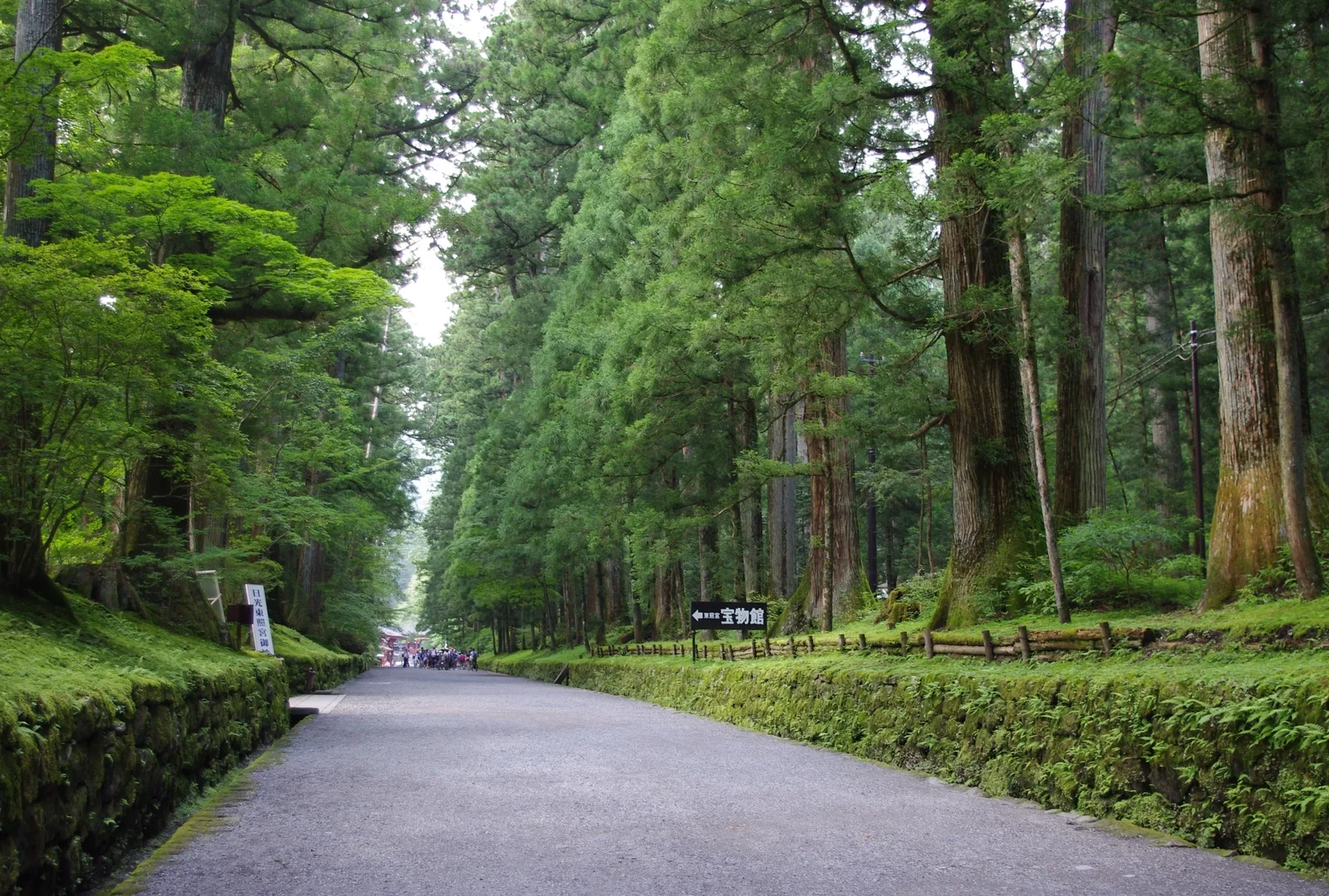
Walking even a short stretch of the avenue is a change of pace from the shrine crowds: the trees close overhead, and the road noise from town fades quickly. After the density of gold leaf and carving inside Toshogu, the plain green corridor outside can feel like a different place entirely.
Rinnoji's Daiyuin and the Three Buddhas Hall
Rinnoji's Taiyuin is the mausoleum of Tokugawa Iemitsu, the third shogun, and a visit takes about 30 minutes to an hour. Its color scheme is quieter than Toshogu's gold: black lacquer set against gold trim, in a more restrained style.
Sanbutsudo, the Three Buddhas Hall, is the largest building in Nikko. It houses three large seated figures: a thousand-armed Kannon, an Amida Buddha and a horse-headed Kannon, lined up together in one open hall rather than spread across separate rooms, so all three are visible in a single sweep.
Rinnoji's grounds sit within easy walking distance of Toshogu, so both fit into the same morning or afternoon without a taxi or bus ride between them.
Futarasan Shrine and climbing Mt. Nantai
Futarasan Shrine's sacred garden includes a short "three-shrine walk," visiting the Okuni-den, Choyu-jinja and Hie-jinja shrines within the grounds, each associated with a different blessing: relationships, wisdom and health. Unlike Toshogu's single large complex, Futarasan's garden is small enough to see in one loop, making it an easy add-on rather than a separate destination.
The shrine's sacred mountain, Mt. Nantai, opens to climbers only from April 25 to November 11, with the gate opening at 6:00 a.m. each day during that window. The round trip takes about 6 to 7 hours, and the summit looks out over Lake Chuzenji and the surrounding Nikko mountains. It is a serious hike, not a side trip you add on casually to a day at the shrines — if you want it, plan a full day (or more) around it rather than folding it into a Toshogu visit.
Kegon Falls: free to view, or ride the elevator down
Kegon Falls drops about 97 meters into a gorge below Lake Chuzenji, according to the elevator operator's own site. Seeing it from the observation deck above is free.
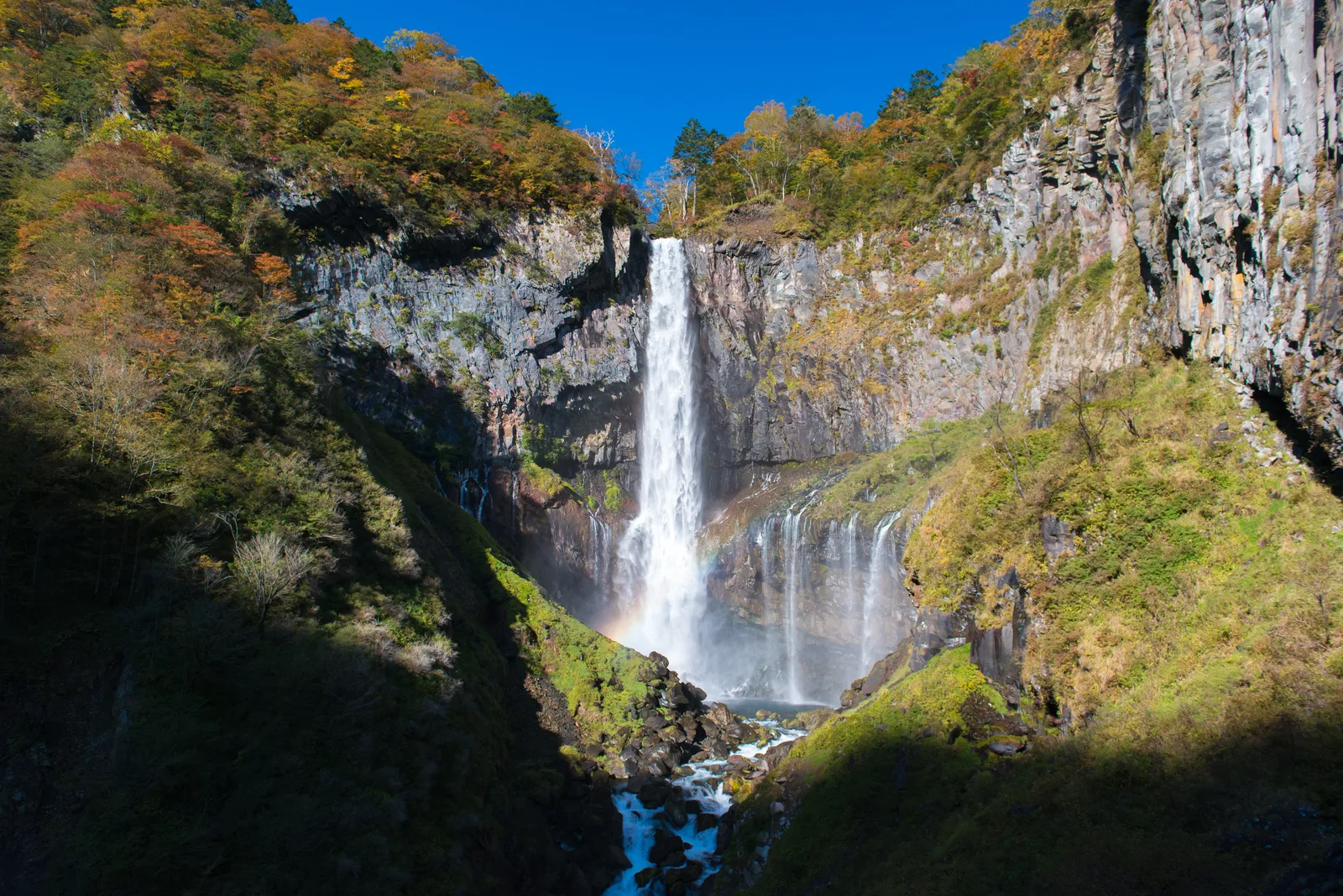
The only paid part is the elevator that descends about 100 meters to a viewing platform closer to the base of the falls, which costs 600 yen round trip. On a clear day with enough water flow, the spray at the bottom can throw a rainbow, as in the photo above, and the surrounding gorge turns the same colors in autumn.
The Spacia and Spacia X limited express trains
The Spacia and Spacia X limited express trains run direct from Asakusa to Tobu Nikko in about 1 hour 50 minutes. Seat pitch is 1,100 mm, more legroom than a typical commuter seat, and car 6 has a four-person private compartment for groups or families who want their own space. Cars 1, 4 and 6 have onboard toilets and a diaper-changing table.
Taking the limited express does not change your NIKKO PASS cost — the reserved-seat supplement is paid separately either way — but it does change how the ride itself feels, trading a same-fare transfer at Shimo-Imaichi for one seat the whole way. For a family or small group, the compartment in car 6 turns the ride into a private space rather than a row of shared seats, which is worth knowing if that matters more to you than a few hundred yen either way.
Sources (checked September 22, 2026): Nikko Toshogu, admission and viewing route (Japanese), Nikko Toshogu, cedar avenue (Japanese), Nikko Rinnoji, information (Japanese), Futarasan Shrine (Japanese), Kegon Falls elevator, information (Japanese), Tobu Railway, Spacia limited express.
Local favorites: where Japanese visitors eat and walk near Tobu Nikko Station
These three spots came up in Japanese review sites rather than in English-language travel guides. We're recording the review counts and scores as they stood on September 22, 2026, not making a claim about which is "best."
| Spot | Type | Rating (Japanese review sites) | Notes |
|---|---|---|---|
| Meiji no Yakata | Western-style restaurant, near Tobu Nikko Station and Toshogu | Tabelog 3.65 (shown as 3.6), 1,705 reviews | Selected for Tabelog's "Yoshoku Hyakumeiten EAST 2025" list. Housed in a registered tangible cultural property, a stone building originally built as the villa of F. W. Horn |
| Sakaeya | Wagashi (Japanese sweets) shop, 1-minute walk from Tobu Nikko Station | Tabelog 3.6, 1,048 reviews | Known for age-yuba manju, a fried tofu-skin bun, at 300 yen each. Selected for Tabelog's "Wagashi Hyakumeiten 2023" list |
| Kanmangafuchi Abyss | Gorge and walking path, within walking distance of Toshogu | Jalan 4.3 (20 reviews); Tripadvisor 4.5 (200 reviews) | Formed by an eruption of Mt. Nantai. Known for a row of stone jizo statues along the path. Its 200 Tripadvisor reviews are far fewer than Toshogu's (in the thousands), which suggests it draws more local and domestic visitors than the main shrine circuit — we note the review counts as a fact, not a ranking |
Meiji no Yakata's stone walls date to the same era as the shrines up the road, so a meal there doubles as a look at a different side of Nikko's history: a Western-style villa rather than a Buddhist or Shinto complex.
Sakaeya's age-yuba manju wraps sweet bean paste in a sheet of fried yuba, the soy-milk skin that is one of Nikko's best-known local foods, and at 300 yen it's an easy stop on the walk between the station and the shrines.
Kanmangafuchi sits off the main shrine route, along the river, and its much smaller review count on Tripadvisor is one sign that it stays quieter than Toshogu even in busy seasons.
We looked for a documented gap between "tourist" prices and prices locals actually pay nearby, but could not find a verifiable example within the time we had. We are not stating one exists.
When to go: festivals, closures and shorter hours in 2026 and 2027
| Dates | What happens | Source |
|---|---|---|
| Every year, May 17 | Toshogu Spring Grand Festival and sacred Yabusame (horseback archery) | Toshogu official site |
| Every year, May 18 | Toshogu's "Procession of a Thousand Warriors" (Hyakumono-zoroe Sennin Musha Gyoretsu), with about 1,200 participants in 53 types of costume | Toshogu official site |
| Every year, October 16 | Toshogu Autumn Yabusame | Toshogu official site |
| Every year, October 17 | Toshogu Autumn Festival and Procession | Toshogu official site |
| January 16, 2026 to August 31, 2027 | Akechidaira Ropeway closed for construction (possible extension) | Tobu Railway official site |
| Mid-April to November 30 (typical years) | Lake Chuzenji cruise and the low-emission bus to Senjogahara run; 2027 dates not yet announced | Tobu Railway official site |
| April 25 to November 11 | Mt. Nantai open for climbing, gate opens 6:00 a.m. daily; 2027 dates not yet confirmed | Futarasan Shrine official site |
| December 1 to March 31 | Kirifuri Highland bus pass suspended | Tobu Bus official site |
| Year-round | Shrine and temple hours shorten in winter: Toshogu 9:00–17:00 (April–October) / 9:00–16:00 (November–March); Rinnoji 8:00–17:00 / 8:00–16:00; Futarasan 8:00–17:00 / 9:00–16:00 | Each site's official page |
Dates for 2027 festivals had not been separately reconfirmed as of September 22, 2026; the dates above are the fixed annual dates each shrine publishes. Autumn foliage timing and month-by-month visitor numbers are left out of this article, since neither is covered by official data.
Source: Nikko Toshogu, festivals (Japanese), Tobu Railway, NIKKO PASS all area, Futarasan Shrine (Japanese), Tobu Bus On-Line, Nikko area (Japanese), each site's own admission page for seasonal hours.
Scenarios: four common Nikko day-trip plans
Every row below was run through the calculator above. Adult, ordinary fares, total for one person, as of September 22, 2026. The round-trip train ticket (2,800 yen) is included in every row. The limited express supplement, shrine admission and the All Area Pass's bundled extras (hot spring, boat cruise, ski lift) are not included.
| Scenario | Plain ticket + buses | World Heritage Area Pass | All Area Pass | Cheapest here |
|---|---|---|---|---|
| S1: Central shrines only, on foot | 2,800 yen | 3,000 yen | 8,000 yen | Plain ticket |
| S2: Central shrines, 2 bus rides | 3,240 yen | 3,000 yen | 8,000 yen | World Heritage Area Pass |
| S3: Central shrines, 4 or more bus rides | 3,400 yen | 3,000 yen | 8,000 yen | World Heritage Area Pass |
| S4: Add Lake Chuzenji / Kegon Falls (4 bus rides + 2-day Chuzenji Onsen pass) | 5,700 yen | 5,300 yen | 8,000 yen | World Heritage Area Pass |
S1: Central shrines only, on foot
Toshogu, Rinnoji and Futarasan are within walking distance of each other and of Tobu Nikko Station. If your plan looks like this, the plain train ticket at 2,800 yen is 200 yen less than the World Heritage Area Pass, and both are far below the All Area Pass.
S2 and S3: Central shrines, moving by bus
Once you add a couple of bus rides between the station and the shrine area — useful if you're short on time or the weather turns — the World Heritage Area Pass overtakes plain tickets. From the third one-way ride, the 600 yen one-day bus pass (sold as the "sekai-isan-meguri-tegata" locally, or the "World Heritage Area Bus Free Pass" on the tourist-facing site, at the same price and covering the same routes) becomes cheaper than paying 220 yen per ride, which is why the World Heritage Area Pass's advantage grows only up to a point.
S4: Going as far as Lake Chuzenji or Kegon Falls
If your plan looks like this, the All Area Pass still doesn't come out cheapest. Its 8,000 yen price stays fixed no matter how many bus rides or how far you go within its coverage area, but here the World Heritage Area Pass plus a separate 2-day Chuzenji Onsen bus pass (2,300 yen) still comes out lower. Whatever edge the All Area Pass has here would come from its bundled hot spring visit and boat cruise — real value, just not one this table can put a yen figure on.
Shrine and temple admission and the limited express supplement are separate in all four scenarios; see the tables above.
How to buy: NIKKO PASS, NIKKO MaaS, and other tickets
You can buy NIKKO PASS at the Tobu Tourist Information Center in Asakusa, at AC Hotel by Marriott Tokyo Ginza, at Courtyard by Marriott Ginza Tobu Hotel, or through Tobu's own booking channels, from one month before your travel date. See Tobu Railway, NIKKO PASS for current details. To get to Asakusa from central Tokyo, see Tokyo Subway Ticket vs Suica: Break-Even Rides per Day.
NIKKO MaaS: Tobu's other digital pass
Tobu Railway also sells a separate digital ticket lineup called NIKKO MaaS, aimed at both domestic and international travelers, with no stated foreign-traveler-only restriction the way NIKKO PASS has.
| Ticket (from Asakusa) | Price (adult / child) | Valid |
|---|---|---|
| Digital Nikko World Heritage Free Pass | 3,000 yen / 1,500 yen | 2 days |
| Digital Chuzenji & Kegon Falls Free Pass | 4,500 yen / 2,250 yen | 4 days |
| Digital Okunikko & Yumoto Onsen Free Pass | 6,000 yen / 3,000 yen | 4 days |
The Digital Nikko World Heritage Free Pass is priced and timed identically to NIKKO PASS world heritage area (3,000 yen, 2 days), but it's a separate product on a separate sales channel, and its exact bus-route coverage isn't listed anywhere we could confirm. If you don't qualify for, or can't find, a NIKKO PASS, this is the product to compare it with.
Source: Tobu Railway, NIKKO MaaS (Japanese), Tobu Railway, Nikko & Kinugawa (Japanese).
Tobu World Square and other bookable extras
Tobu World Square's own site lists KKday among its official advance-ticket sellers, alongside convenience stores and travel agencies. We do not reproduce KKday's product listings or prices here.
Check pricesAffiliate link
Day tours that bundle Nikko's main sights with transport are also sold through GetYourGuide and Klook; this article compares only the DIY routes above.
Whichever ticket you end up holding, none of it is really the point. It gets you to the gate, the cat, the dragon's echo and the cedar-lined walk back out — the pass is just the cheapest way to stand in front of them.
Common questions
Is Nikko worth a day trip from Tokyo?
It depends on your plan. Seeing Toshogu, Rinnoji and Futarasan on foot fits comfortably into a day. Adding Lake Chuzenji, Kegon Falls or a hike up Mt. Nantai makes for a much busier day, and some of those additions (like the Mt. Nantai climb) are multi-hour commitments on their own.
NIKKO PASS all area vs world heritage area — which should I buy?
The All Area Pass covers bus routes toward Lake Chuzenji, Yumoto Onsen and Kirifuri Highland that the World Heritage Area Pass does not, plus a hot spring visit and a boat cruise. But on transport cost alone, no combination we tested had the All Area Pass coming out cheapest; see the scenarios above. If you'd actually use its bundled extras, that could tip your answer the other way — that part just isn't one we can price for you.
Is the NIKKO PASS all area still worth it after the price increase to 8,000 yen?
The price has risen substantially. Tobu Railway's own English article "A One-Hour World Trip?! Nikko Pass," posted in 2018 and still live when we reopened it on September 22, 2026, quotes 4,600 yen for the All Area Pass and 2,040 yen for the World Heritage Area Pass. Against the September 22, 2026 prices of 8,000 yen and 3,000 yen, that's a rise of about 74% for the All Area Pass.
In every combination of bus rides and destinations we tested, the All Area Pass did not come out as the cheapest option on transport cost alone.
Does the NIKKO PASS include shrine admission?
No. Toshogu, Rinnoji and Futarasan each charge separate admission, totaling at least 2,800 yen. As of September 22, 2026, the combination ticket that once covered all three is suspended, with no end date given by Rinnoji.
Is it better to buy the NIKKO PASS through Klook or at the Tobu station?
Both Tobu's own sales channels and travel sites like Klook sell a NIKKO PASS product. Ticket delivery (paper voucher vs. app) varies by seller, so check that detail at the point of purchase.
Digital or paper NIKKO PASS — which is safer?
Ask at the point of purchase if it matters to your trip.
What is NIKKO MaaS, and is it different from the NIKKO PASS?
Yes, it's a separate product from Tobu Railway. Its "Digital Nikko World Heritage Free Pass" is priced the same as NIKKO PASS world heritage area (3,000 yen, 2 days), but it does not carry the foreign-traveler-only condition that NIKKO PASS has. See the table above.
Can I ride the Spacia limited express with the NIKKO PASS?
The pass does not include the limited express supplement. You pay for a reserved seat separately, at roughly 1,450 yen and up one way according to Tobu's brochure (the price varies by season); see the fare table above for the range we found.
Sources and data date
All fares were checked on September 22, 2026. Prices and timetables can change; check the operator's page before you travel.
- Tobu Railway (English): NIKKO PASS overview, NIKKO PASS all area, NIKKO PASS world heritage area, purchase information, Spacia limited express, brochure (English PDF, effective October 1, 2025), 2018 article showing earlier pass prices
- Tobu Railway: NIKKO MaaS (Japanese), Nikko & Kinugawa (Japanese)
- Tobu Bus On-Line, Nikko area (Japanese)
- Tobu Group's tourist ticket site
- Tobu World Square, tickets
- Kegon Falls elevator, information (Japanese)
- Nikko Toshogu: admission and viewing route (Japanese), festivals (Japanese), cedar avenue (Japanese)
- Nikko Rinnoji, information (Japanese)
- Futarasan Shrine (Japanese)
- ekitan.com fare search (Asakusa–Tobu Nikko ordinary ticket fare, based on Tobu Railway's official fare data), Yahoo! Transit fare search (IC card fare), both confirmed September 22, 2026
- Local review sites: Tabelog, Jalan, Tripadvisor (confirmed September 22, 2026)