Day trips · Shirakawa-go · Takayama
Shirakawa-go From Takayama: What the Bus Schedule Decides
Prices checked November 6, 2026 against the official pages. Every figure links to its source.

Published: September 22, 2026
This page contains an affiliate link. If you book through it, we may earn a commission at no extra cost to you. It does not change our numbers. See our disclosure.
Fares checked on September 20, 2026.
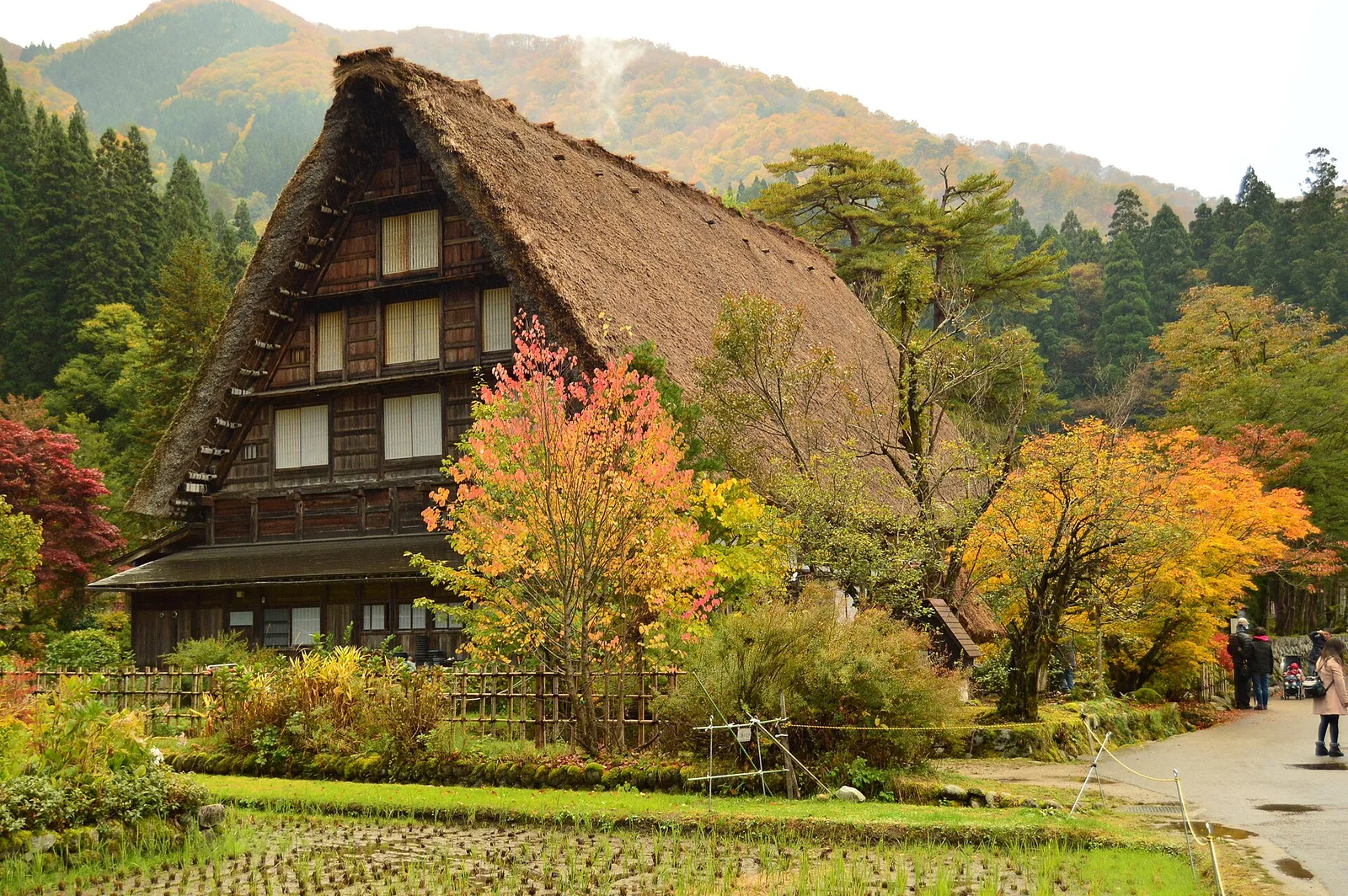
In Ogimachi, thatched roofs stand in steep rows, and neighbours re-thatch them together. On some autumn and spring mornings, white steam can rise from the thatch. In Takayama, cedar-leaf balls hang at brewery doors and a morning market lines a river.
The short answer
- By bus, a Shirakawa-go day trip costs 5,600 yen round trip from Takayama or Kanazawa (2,800 each way, as of September 20, 2026). Village entry is free.
- From Nagoya you're looking at 7,200 to 8,400 yen round trip, depending on your date: 3,600 yen each way on weekdays, 4,000 yen on weekends (2026 calendar, August to October).
- Village parking doubled to 2,000 yen per car on October 1, 2025. Some 2026 guides still quote the old 1,000 yen, so don't be caught out at the gate.
- Stopping in Shirakawa-go on the way between Kanazawa and Takayama costs 1,400 yen more than staying on the through bus.
- The 2027 light-up runs in January only, and every way in needs a reservation.
If the light-up is on your list, the lottery for a village stay opens October 1, 2026 and closes October 31, 2026 at 23:59 (details further down). Everyone else can jump straight to the calculator and price out their own day. Tours get their own checklist later on rather than a price tag here — and every figure above is for one adult.
What makes a Shirakawa-go and Takayama day worth it
The numbers come later. This section is about what the day holds, using facts from official pages checked on September 20, 2026. It does not copy their text.
A village that works together
Ogimachi was chosen as an Important Preservation District for Groups of Traditional Buildings in 1976. In 1995 it was listed as a World Heritage Site, together with Gokayama in Toyama. The Shirakawa-go Tourist Association says the listing is thought to have been won by more than the buildings: it also rewarded the way neighbours help each other, a habit called yui. One example is re-thatching a gassho roof, which the whole village does together. Ogimachi also set three rules for itself: do not sell the houses, do not rent them out, do not pull them down.
The roofs are built for the place. Nohi Bus's page says the thatch slopes at about 45 to 60 degrees to suit heavy, wet snow. All the houses face north and south, the same way, to cut wind resistance and to balance the sun on the roof, so that houses stay cool in summer and hold heat in winter. The name gassho means "palms together," from the roof's shape, although the association notes there are several theories.
Bus riders arrive at the Shirakawa-go Bus Terminal, about one minute on foot from Wada House. Drivers park at the village car park and cross the 107 m Deai Bridge, about five minutes to the hamlet. Next to that car park, the Deai-no-Yakata information centre (open 9:30 to 15:30) gives out a walking map. The village says about 500 people live in Ogimachi, so the houses come with rules: stay out of fields and private land, do not fly drones, and smoke only in the marked places.
Inside the houses
Some houses are open to visitors. Nohi Bus lists the walking time from the bus terminal for each, and the association describes them.
Wada House is one minute away. The association calls it one of the largest gassho houses in the World Heritage area and the only one designated an Important Cultural Property by the state. The family lives there, and you can visit the ground and second floors and look out from the second floor. In the Edo period the family served as village head and checkpoint officers. It grew prosperous by trading enshō (saltpetre, a raw material for gunpowder).
Kanda House, about five minutes on foot, has four storeys, and Nohi Bus says you can climb to the top floor and see tools once used for raising silkworms. A hearth burns on the ground floor, where, Nohi says, wild-herb tea is served to travellers. The association adds that you can see the place under the floor where enshō was made. Nagase House, about six minutes on foot, is a five-storey house built in 1890, and its ground floor shows a Buddhist altar said to be more than 500 years old.
The Gassho-zukuri Minka-en is about 15 minutes on foot. It is an open-air museum of houses moved from around the village: the association says it preserves 25 houses, including nine designated by the prefecture, and you can go up into the attic of the main houses. The Yamashita House there is one of the few 18th-century gassho houses left in the village, the association says. Some houses in the village serve lunch, from mountain vegetables to Hida beef, but Nohi says many take lunch customers only and keep short hours, so check ahead. The association's list of local foods and gifts includes hoba (magnolia-leaf) tea, "stone tofu," wood-ear mushrooms and doburoku-flavoured yōkan (sweet bean jelly). Closing days differ by house and by season, so check them for your date. Admission prices are in the cost section.
The viewpoint
Two viewing decks sit side by side above the hamlet: the municipal Ogimachi Castle Ruins Observation Deck and the privately run Tenshukaku Observation Deck. Private cars cannot go up. You can walk, about 15 minutes each way by the village guide's count (the association's light-up page says about 15 to 20 minutes by the trail behind Wada House), or ride the paid shuttle for 300 yen one way. The shuttle runs at 0, 20 and 40 minutes past the hour from 9:00 to 15:40, and comes back between 9:10 and 16:10.
Nohi Bus says the Tenshukaku deck, in the north-west of Ogimachi, looks over the whole hamlet with the Hakusan mountain range in front. The village's guide says the Ogimachi Castle Ruins deck is quiet in the morning. Only tour buses can book Tenshukaku in advance. A third view is the group of three gassho houses at the south end of Ogimachi, about 20 minutes on foot from the bus terminal. Nohi says photographers come for the houses reflected in flooded paddies or under white snow.
Four seasons
The village office's seasonal pages start with winter. Snow falls from late December to early March, and icicles hang from the houses. The association adds that in some years February brings 170 cm or more of snow. On January 1, a preservation troupe parades through the hamlet and performs the Harukoma dance and other pieces. The village suggests warm clothes and boots with deep tread, because paths can freeze.
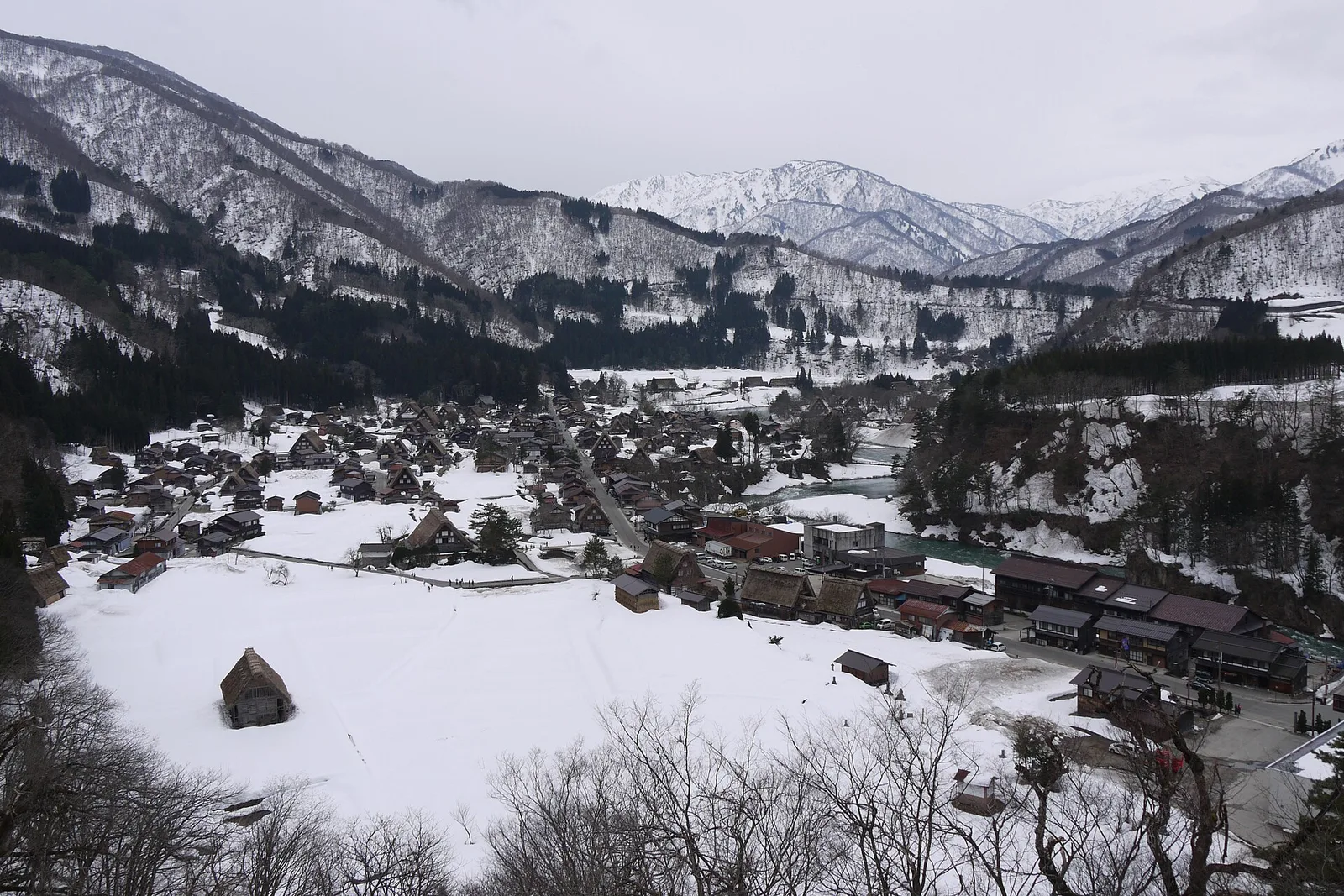
The village says spring arrives from March. Early March can still look frosted, and snow lingers in places until April. The association gives mid-April to early May for cherry blossoms. The village adds that in mid-May, before planting, the flooded paddies reflect the houses, and a rice-planting festival is held around the end of May. It says fireflies glow at night from early to mid July, a few days earlier or later by year.
The village says autumn starts with golden rice ears and pampas grass in September. It says leaves begin to turn in mid-October, and the association gives late October to mid-November for full colour. The two dates differ. Persimmons ripen on trees around the hamlet. In mid-October, the Doburoku Festival marks the harvest and prays for peace in the mountain village. The village says that on some early mornings in autumn and spring, something like white steam can be seen rising from the thatch.
Takayama: old town, morning market, jinya
Takayama's Sanmachi old town is a 12-minute walk from JR Takayama Station. The city describes rows of wooden latticework, clear water channels under the eaves, and sake breweries that mark their doors with balls of cedar leaves. Eateries serving local ingredients and souvenir shops fill the same streets.
The Miyagawa Morning Market runs along the river. It has about 60 stalls over about 350 m between Yayoi Bridge and Kaji Bridge. Vegetables, fruit and pickles are sold on the river side, sweets and crafts on the other. The Jinya-mae Market, in front of Takayama Jinya, is more than 300 years old, and only farmers may open stalls. The city says the sellers like to explain how to eat and keep their food, including unusual items such as potato stems, carrot leaves and wild vegetables. Both markets open at 7:00 from April to November and at 8:00 from December to March, and close around noon. Entry is free, and stalls can fall to about 10 when it rains or in winter. The first bus to Shirakawa-go leaves at 7:20, so a day with the markets means a later bus.
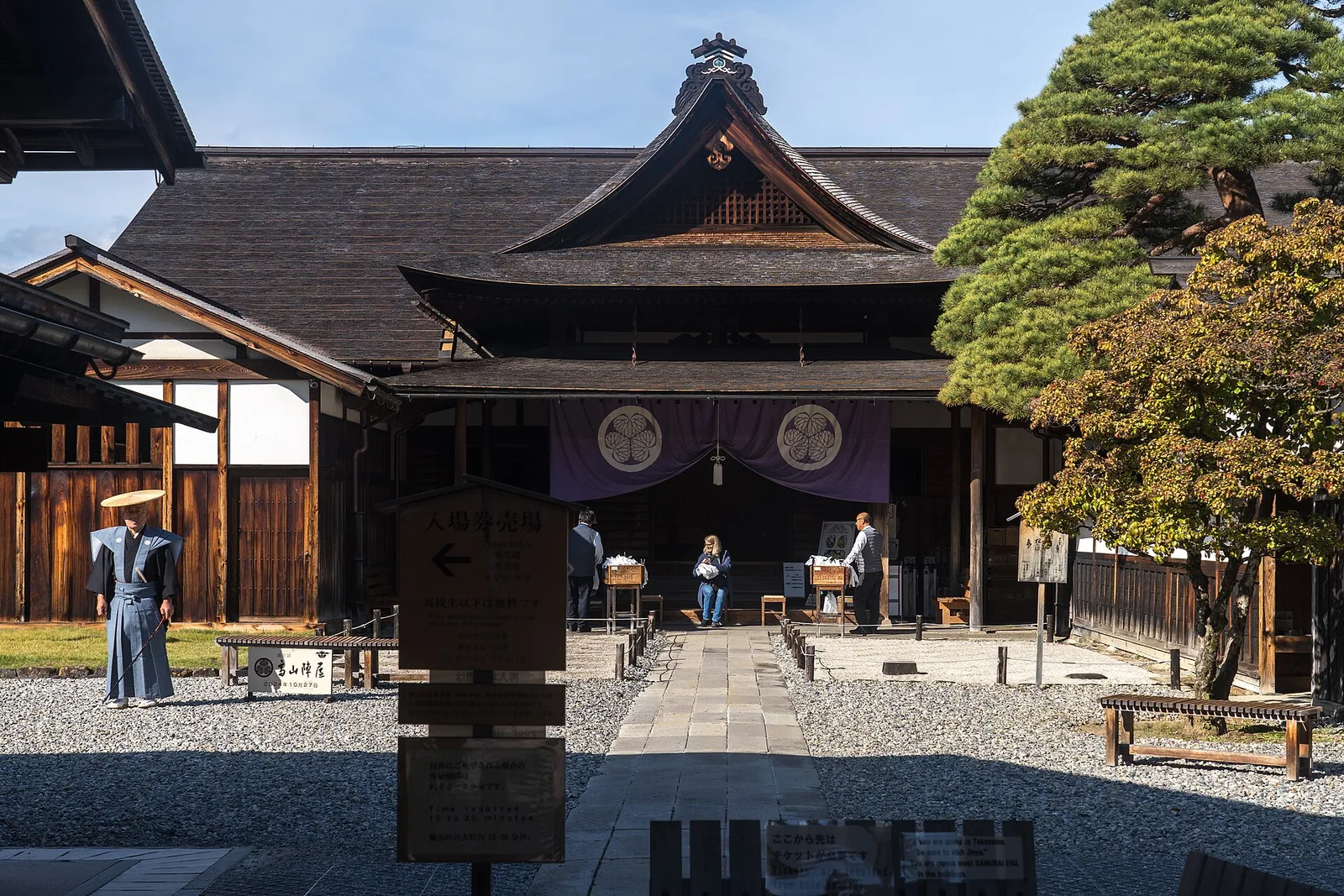
Takayama Jinya was the Edo-period government office of the Hida region. The city says more than 60 buildings like it once stood in Japan, and this is the only one left. It was in official use from 1692 to 1969.
Hida Folk Village (Hida-no-Sato), a 10-minute bus ride from the station, has more than 30 thatched-roof and other historic buildings on a site of about 99,000 square metres. It holds craft demonstrations of Hida lacquerwork, weaving and dyeing.
Takayama Festival
Takayama's festival is held twice a year. The spring festival (Sannō Matsuri, for Hie Shrine) is on April 14 and 15, and the autumn festival (Hachiman Matsuri, for Sakurayama Hachimangu) is on October 9 and 10, every year on the same dates. Twelve festival floats are paraded in spring and eleven in autumn, along with several hundred people in traditional costume, orchestra music, court music and lion dances. On the first evening of each festival, about 100 lanterns are lit on each float, and the floats parade after dark.
If you miss the dates, the Takayama Festival Floats Exhibition Hall shows four of the eleven autumn-festival floats at a time, rotated in March, July and November.
Staying the night
About 20 gassho guesthouses (minshuku) take guests in Ogimachi, according to the village guide. Nohi Bus adds that some stays are in houses more than 200 years old. The village does not admit visitors to the hamlet at night unless they are staying there. Its guide names a walk in the morning mist, before day visitors arrive, houses lit by moonlight and a starry sky as privileges of guests in the hamlet. It also says the view from the Ogimachi Castle Ruins deck is clear and quiet in the morning. Sources: Shirakawa-go Going, stay in the village (Japanese); Shirakawa-go Going, bus routes (Japanese).
A day visitor can warm up too. Shirakawa-go no Yu is a day-use hot spring about one minute on foot from the bus terminal, with an open-air bath overlooking the Shō River, according to the association. Hirase Onsen, about 20 minutes from the terminal by Nohi bus, is another hot spring area.
Services that help
The village's guide site is in English, French and Chinese as well as Japanese, and the association's site has English and Traditional Chinese. The village guide has live cameras of the hamlet, a crowd forecast calendar three months ahead, and weather. Nohi Bus takes online bookings from 5:00 to 2:00, and sells mobile tickets for non-reserved buses only. Its buses have trunks under the floor for larger bags (see the luggage note below).
Shirakawa-go bus fares from Takayama, Kanazawa and Nagoya
The numbers below are for one adult, as of September 20, 2026, and prices do move — treat them as a solid estimate, not a quote.
Fares and times by starting point
| Starting point | Bus, one way | Round trip | Ride time | First bus to Shirakawa-go |
|---|---|---|---|---|
| Takayama Nohi Bus Center | 2,800 (child 1,400) | 5,600 | about 50 minutes | 7:20, arrives 8:10 |
| Kanazawa Station West Exit | 2,800 | 5,600 | 1 h 15 min | 8:10, arrives 9:25 |
| Toyama Station | 2,400 | 4,800 | about 1 h 20 min | 9:00, arrives 10:20 |
| Takaoka | 2,200 | 4,400 | – | – |
| Nagoya (Meitetsu Bus Center) | 3,600 to 4,700 by date | 7,200 to 9,400 | about 2 h 42 min to 2 h 50 min | 7:50, arrives 10:32 |
The morning is what decides your day. Leave from Takayama and you get in earliest; from Nagoya, Kanazawa or Toyama you're looking at the 9 or 10 o'clock hour at best. Traffic builds toward 10:00 and peaks around noon, so an early bus buys you a quieter hamlet. Sources: Nohi Bus, Takayama to Shirakawa-go route (Japanese); Hokutetsu, Shirakawa-go and Takayama line (Japanese); Shirakawa-go Tourist Association, access (Japanese); Shirakawa-go Going, guide (Japanese).
For the ride home, the last buses leave Shirakawa-go at 17:30 for Takayama (in by about 18:35) and 17:30 for Kanazawa (18:45). Heading to Nagoya, the last bus leaves at 17:15 and lands at 20:00. Build in some slack: a queue of cars, snow or a closed road can delay these buses by two hours or more, and departures run late too.
Hokutetsu's Kanazawa line has assigned seats and a required booking, opening the same date one month ahead. If you're planning last-minute on a reservation-only bus, call ahead to check same-day availability. The operators' timetables are dated April 1, 2025 (Hokutetsu) and October 1, 2025 (Gifu Bus).
Nagoya: five fares depending on the departure date
Gifu Bus prices the Nagoya route by departure date, in five classes — so which day you travel changes what you pay. A fare revision took effect October 1, 2025. Here's how the August to October 2026 calendar breaks down:
| Class | One way | Round trip | Days on the August to October 2026 calendar |
|---|---|---|---|
| S | 4,700 | 9,400 | none |
| A | 4,200 | 8,400 | August 13 to 15, September 19 to 22, October 10 and 11 |
| B | 4,000 | 8,000 | All other Saturdays and Sundays; also August 10 to 12, September 23, October 12 |
| C | 3,800 | 7,600 | none |
| D | 3,600 | 7,200 | all other weekdays |
A weekday-to-holiday swing costs you up to 1,200 yen round trip. Traveling with a child? The fare calendar lists a child fare of 2,350 yen on every date, and its note says child fares do not change with the date (Gifu Bus's own page describes the child fare as half the adult fare). Sources: Gifu Bus, Nagoya to Shirakawa-go (Japanese); fare calendar (PDF, Japanese); timetable (PDF, Japanese).
Nagoya by train: the Hida limited express
That Gifu Bus route skips Takayama — it stops at Gujo Hachiman and Hirugano Kogen instead. If Takayama is part of your plan, take a different route in.
| Route, Nagoya to Takayama one way | Price | Details |
|---|---|---|
| Hida limited express, reserved seat, regular season | 6,140 | Ticket 3,410 plus limited express charge 2,730. About 2 h 20 min |
| Hida, 3-day early ticket | 5,810 | 3,410 plus 2,400. Sold on e5489 only, by three days before, seats limited. Not valid April 27 to May 6, August 10 to 19, December 28 to January 6 |
| Hida, 7-day early ticket | 5,210 | 3,410 plus 1,800. Only for EX Service members who are also WESTER members and who booked a Shinkansen to or from Nagoya on the EX Service |
| Highway bus, web discount | 3,300 | About 2 h 45 min. Pay by 24:00 on the third day counting the booking day, or the booking is cancelled |
| Highway bus, regular | 3,600 | Assigned seats |
The limited express charge moves with the season: 200 yen less when it's quiet, 200 more when it's busy, 400 more at peak. The 3,410 yen fare is for the route via Gifu; a local route via Tajimi comes to 3,080 yen, but the Hida doesn't run that way. Put the whole day together — Nagoya to Takayama to Shirakawa-go, one way — and you're looking at 6,100 yen by highway bus, 8,940 yen on the Hida at the regular price, or 8,610 yen with the 3-day early ticket.
These early tickets are domestic JR Central fares. Sources: JR Central, limited express ticketless (Japanese); 3-day early (Japanese); 7-day early (Japanese); Nohi Bus, Takayama to Nagoya (Japanese); JR West My Dia, searched for travel on September 25, 2026.
If you're stacking on more rail time, the Takayama-Hokuriku Area Tourist Pass runs 19,800 yen for adults (9,900 for children) over five days. It covers the Takayama line from Nagoya to Toyama, the Hokuriku Shinkansen from Toyama to Tsuruga in non-reserved seats, and Nohi, Hokutetsu, Meitetsu and Toyama Chitetsu buses, with some exceptions and required reservations. It comes with six free seat reservations, which matters because every seat on the Hida is reserved from September 18 to 23, 2026. Nagoya to Takayama (6,140 yen) plus Takayama to Shirakawa-go to Kanazawa (5,600 yen) comes to 11,740 yen on regular fares — 8,060 yen under the pass price. That's just this one leg, though — price the rest of your trip separately to judge whether the pass is worth it overall. Source: touristpass.jp.
Kanazawa to Takayama: stopping in Shirakawa-go costs 1,400 yen more
| How you ride | Fare | Note |
|---|---|---|
| Kanazawa to Takayama, through bus | 4,200 | 2 h 15 min. You stay on the bus through Shirakawa-go |
| Kanazawa to Shirakawa-go, then Shirakawa-go to Takayama | 2,800 plus 2,800 = 5,600 | 1,400 yen more than the through bus |
Once you step off in Shirakawa-go, your ticket is spent — get back on for the next leg and you pay that fare too. Your bags matter here: Nohi's buses take carry-on up to 10 kg and 1 m for free, and while there's no hard limit on trunk space, it does run out, so pack light if you can. The carrier takes no responsibility for damage, loss or theft. Coin lockers in Shirakawa-go aren't a given, so plan to carry your bags with you or check at the bus terminal before you count on storing them. Sources: Hokutetsu (Japanese); Nohi Bus, FAQ (Japanese).
The Minka-en set ticket saves 200 yen
If Minka-en is on your list, Nohi sells a set ticket at the Takayama Nohi Bus Center counter: 6,200 yen for adults, 3,100 yen for children, covering the round-trip bus plus Minka-en admission, valid for 10 days (refundable only before use). Buy the two separately and you'd pay 6,400 yen (5,600 for the bus, 800 for Minka-en), so the set saves you 200 yen — small, but it's there. Source: Nohi Bus, special tickets (Japanese).
Shirakawa-go parking, entry fees and other costs on the day
You won't pay to enter the village itself — part of what you hand over for parking goes toward keeping the hamlet in shape instead.
| Item | Price | Note |
|---|---|---|
| Village entry | 0 | No entry fee for the World Heritage area |
| Village car park, car | 2,000 | Raised on October 1, 2025 from 1,000. 8:00 to 17:00, last entry 16:30. No reservation except on light-up days |
| Village car park, motorbike / large vehicle or microbus | 500 / 10,000 | Were 200 / 3,000 before |
| Observation deck shuttle | 300 one way | Was 200 before the October 1, 2024 revision |
| Gassho-zukuri Minka-en / Wada House / Kanda House / Nagase House | 800 / 400 / 400 / 400 | As listed by Nohi Bus |
| Doburoku Festival Hall | 300 | Same |
| Takayama Jinya | 430 | Takayama City |
| Hida Folk Village (bus 210 one way) | 700 | Takayama City |
| Takayama Festival Floats Exhibition Hall | 900 | Takayama City |
| Morning markets in Takayama | 0 | 7:00 to noon from April to November, 8:00 to noon from December to March |
| Takayama lodging tax, per person per night | 100 / 200 / 300 | Room rate without meals and tax under 10,000 / 10,000 up to 30,000 / 30,000 or more. Children up to the first March 31 after their 12th birthday are exempt |
A peak-period surcharge is coming for stretches like Golden Week and Obon, though the village hadn't set the amount as of September 20, 2026 — so it's left out of the calculator below. Driving in? Winter tyres are expected from early December to late March, and the expressway requires tyres or chains. Sources: Shirakawa Village, parking fees (Japanese); shuttle fare (Japanese); Shirakawa-go Going, parking guide (Japanese); Takayama City, lodging tax; Takayama Jinya; Hida Folk Village; Floats Exhibition Hall; morning markets.
Calculator: what a Shirakawa-go day costs for your group
Pick where you're starting from and which admissions you want, and this does the adding for you. The first row is the direct bus plus those admissions; to check a tour against it, type in its price from the booking page and say whether admissions are included. Three things to know:
- For Nagoya, pick the fare class for your date from the calendar above.
- The reference row isn't always the same trip — from Nagoya it runs through Takayama, and from Kanazawa to Takayama it's the through bus, staying on board through Shirakawa-go.
- The parking row is just the parking fee, split across your group, not the full cost of a car.
What this doesn't cover:
- Lunch and drinks (tours may charge extra for these too)
- Kanda House and Nagase House (400 yen each) and the Doburoku Festival Hall (300 yen)
- Takayama's lodging tax and the room itself
- The peak-period parking surcharge, once the village sets an amount
- Rental car, fuel and winter tyres, and expressway tolls
- Coin lockers in Shirakawa-go
Scenarios: four Shirakawa-go day trips priced
One adult's share, without lunch, using official fares and fees as of September 20, 2026. Tour prices aren't listed here — the last column shows what a tour would have to charge to beat doing it yourself.
| Scenario | Direct bus and admissions | Tour price to beat (admissions included / extra) |
|---|---|---|
| 1. Takayama round trip, Minka-en and Wada House | 6,800 (5,600 + 800 + 400); 6,600 with the set ticket | 6,800 / 5,600 |
| 2. Nagoya round trip, weekday class D | 8,400 (7,200 + 1,200) | 8,400 / 7,200 |
| 2. Nagoya, weekend class B | 9,200 (8,000 + 1,200) | 9,200 / 8,000 |
| 2. Nagoya, holiday class A | 9,600 (8,400 + 1,200) | 9,600 / 8,400 |
| 3. Kanazawa to Shirakawa-go to Takayama, one way | 6,800 (5,600 + 1,200) | Not compared |
| 4. Nagoya, with Takayama on the way, round trip | 19,080 by Hida, 18,420 with the 3-day early ticket, 13,400 by highway bus (web), admissions included | Not compared |
Scenario 1 gets you moving early: the 7:20 bus reaches the hamlet at 8:10, ahead of the crowds. The set ticket only saves you 200 yen, and only if Minka-en is on your list.
Scenario 2 leaves you about 6 hours 40 minutes in the village — the first Nagoya bus lands at 10:32, the last one back leaves at 17:15. Weekday, weekend and holiday fares swing by up to 1,200 yen round trip, so match any tour you compare to the same date.
Scenario 3 is one way only. Stay on the through bus and you pay 4,200 yen; get off in Shirakawa-go instead and it's 5,600 yen in fares plus whatever you spend on admissions. Work out where your bags will sit before you decide — coin lockers in the village aren't a given.
Scenario 4 costs more because it's doing more: a full Nagoya-to-Takayama round trip stacked on top of Takayama to Shirakawa-go, with Takayama's own admissions left out. Treat it as its own plan rather than a rival to scenario 2. Just the Nagoya-to-Takayama leg runs 6,140 yen on the Hida, 5,810 yen with the early ticket, or 3,300 yen by highway bus (3,600 yen regular).
Planning a light-up evening? Nohi's buses from Takayama run 13,000 (A), 14,000 (C) and 16,000 yen (B, bundled with an observation deck ticket). A parking reservation for the second round costs 7,000 yen for one to five people or 10,000 yen for six to ten — 1,750 yen a head for a group of four. Keep in mind a parking reservation alone doesn't include the deck.
When to go: Shirakawa-go light-up 2027, autumn colours and crowds
Two dates anchor the calendar: January's light-up, which you book months out, and October's leaves and festival. Here's what's happening month by month, from official sources.
| Month | Shirakawa-go | Takayama | Crowds and booking |
|---|---|---|---|
| January | Light-up on January 11, 17, 24 and 31, 2027, 17:30 to 19:30. Harukoma on January 1 | Morning market from 8:00 | By reservation only. Gifu occupancy 50.5% |
| February | Snow can pass 170 cm | Morning market from 8:00 | Winter tyres needed. Occupancy 55.0% |
| March | Snow melts | Morning market from 8:00 | Occupancy 53.6% |
| April | Cherry blossom mid-April to early May | Spring festival, April 14 and 15 (Wednesday and Thursday in 2027) | Occupancy 59.5% |
| May | Rice-planting festival about the end of May. Golden Week traffic | The village warns of long queues | |
| June | Occupancy 49.5% | ||
| July | Fireflies at night, early to mid July | Occupancy 53.7% | |
| August | Obon holidays | Japanese guest peak. Occupancy 62.9% | |
| September | Rice ears, pampas grass | Occupancy 56.9% | |
| October | Leaves from mid-October. Doburoku Festival. Queues from late October to early November | Autumn festival, October 9 and 10 (Friday and Saturday in 2026, Saturday and Sunday in 2027) | Occupancy 63.6% |
| November | Leaves into mid-November | Occupancy 60.6% | |
| December | Winter tyres from early December. Tour-bus parking by reservation from December 1, 2026 | Occupancy 50.0% |
Sources: Shirakawa Village, seasons (Japanese); Takayama City, festival; Japan Tourism Agency, Overnight Travel Statistics Survey 2025 (Excel, Japanese). Weekdays are from the calendar. Occupancy is the room occupancy rate for Gifu Prefecture as a whole, not Takayama or Shirakawa-go alone (2025).
Japanese and foreign visitors peak at different times of year. In Gifu Prefecture, August draws the most Japanese guest nights (12.1% of the year's total), while foreign guest nights peak in April (10.9%), January (10.3%) and October (9.8%) — our own reading of the numbers, though the data doesn't say why. Source: Japan Tourism Agency, Overnight Travel Statistics Survey, 2025 annual figures (processed by Japan Trip Math).
Shirakawa-go light-up 2027: how to take part
The 41st light-up runs January 11 (a Monday holiday), 17, 24 and 31, 2027, from 17:30 to 19:30 — and there are no tickets at the door. Each way in has its own booking window:
| Way | Observation deck | When to book |
|---|---|---|
| Stay in the village (lottery) | Yes | Apply by October 31, 2026 at 23:59; applications open on October 1 at 13:00. Winners are notified on or after November 10, 2026 |
| Own car (parking reservation) | No | First round from September 10, 2026 sold out. Second round on or after December 1, 2026 at 13:00. Winter tyres required |
| Taxi | No | Book a parking space first |
| Operator bus tour (Nohi, Kaetsuno, Toyama Chitetsu, Hokutetsu, Iruka) | Depends on the tour | On or after October 13 (January 11), October 19 (January 17), October 26 (January 24), November 2 (January 31), 2026, each at 14:00 |
| Travel agency bus tour | No | List posted on or after December 2, 2026 at 13:00 |
Status as of November 6, 2026: the village-stay lottery and all four operator bus-tour sales dates have passed, and the first parking round sold out. Still ahead are the lottery results (on or after November 10), the second parking round (December 1) and the travel agency tour list (December 2), all dated in the table above.
Nohi's tours leave from Takayama, book up to six people at a time, and sell only on its website, paid by card when you book. Coming by regular daytime bus on one of these dates? Catch one that lands by 15:20 — the entrance gate opens at 15:30, and the last regular buses head out between about 16:00 and 17:00, before the event even starts, with nothing running back afterward. The walking path to the observation deck shuts at 16:10, and tripods and drones aren't allowed. Sources: Shirakawa-go Tourist Association, light-up overview; notice of the sold-out first round (Japanese); Nohi Bus, light-up bus.
A few pieces are still pending as of September 20, 2026: the lottery's list of inns and prices (due October 1, 2026), the travel agency tours (due December 2, 2026), the peak parking surcharge amount, and the 2027 Golden Week and Obon crowd calendar. We'll check back on or after October 13, November 10 and December 1, 2026.
How locals plan a Shirakawa-go day
These are the patterns that turn up on the village's and operators' own Japanese pages — the kind of thing a friend who's already done this would tell you:
- Get there before 10:00. The queue for parking builds from about then and peaks around noon, and it backs up buses too. The village's crowd calendar looks three months ahead — on September 20, 2026 it flagged September 20 to 23 (Silver Week) as very crowded.
- In winter, take the bus. Cars need winter tyres from early December to late March, and the expressway requires tyres or chains either way. The bus sidesteps both.
- Driving from Nagoya or Osaka? Get off the expressway one exit early, at Shokawa Interchange, and head north on Route 156 — you can then slip into the car park from the lane opposite the queue.
- Two small savings, if you're going that way anyway. The Hida 3-day early ticket knocks 330 yen off the limited express charge, and the Minka-en set ticket saves 200 yen. Beyond the 300 yen web discount on the Nagoya bus (3,300 versus 3,600 yen), we found no other early-booking discount advertised.
- Wondering if you can board a reserved bus same-day? Buses without the reservation mark need no booking; for reservation-only ones, call ahead to check same-day availability.
- Watch for outdated numbers. Some 2026 guides still list village parking at 1,000 yen and Takayama to Shirakawa-go at 2,600 yen. The current official prices are 2,000 and 2,800 yen.
Warning for light-up evenings: getting on or off a vehicle on the road, or stopping on the road, is a violation and can mean a permanent ban. Sources: Shirakawa-go Going, congestion guide (Japanese); Shirakawa-go Going (Japanese); Nohi Bus (Japanese).
Shirakawa-go tour or bus: what to check before you book
Day tours from Takayama, Kanazawa and Nagoya are all over the big booking sites, and we won't repeat their prices or descriptions here. What matters is comparing like with like, the same way we do in the Mt. Fuji tour versus DIY post. Before you book, check:
- Where and when it starts, and when you actually reach Shirakawa-go. The buses above land at 8:10 (Takayama), 9:25 (Kanazawa) and 10:32 (Nagoya) — see how a tour stacks up.
- How long you get in the village. The association recommends two to three hours there on light-up nights.
- What's included — transport, a guide and their language, admissions (Minka-en 800, Wada House 400, shuttle 300), lunch, and an observation deck ticket on a light-up night.
- What's not — often those same admissions, the shuttle, meals, drinks, lodging tax and insurance.
- Group size, and the per-person price if it's a private tour.
- What happens if plans change. Nohi's light-up buses can't be changed once paid for; ask any tour the same question about snow or traffic delays.
- Where you meet, and the last time you can head back.
- How the price compares to the bus, using the same date as the last column of the scenario table above.
One note if you run tours rather than book them: tour-bus parking needs a reservation from December 1, 2026 onward, and light-up travel-agency listings go up December 2, 2026 at 13:00. Everyone else, book bus tickets straight from the operators' own sites: Nohi Bus, Hokutetsu, Gifu Bus and, for the Hida early tickets, JR West's e5489. If you would rather not deal with bus schedules, (affiliate link) Browse tours run from Nagoya, Kanazawa and Takayama.
Whichever bus you catch, it ends the same way: you cross the Deai Bridge, and the roofs are waiting on the far side, steep and thatched, some of them a couple of hundred years old, kept up by neighbours who still climb up together to re-thatch them. That's worth the ride on its own.
Shirakawa-go from Takayama by Bus: common questions
Can I visit Shirakawa-go from Tokyo in one day?
It's tight, but doable with an early start. The bus from Toyama to Shirakawa-go is 2,400 yen and from Kanazawa 2,800 yen, and a 9:00 bus from Toyama arrives at 10:20, connecting with the first Hokuriku Shinkansen out of Tokyo. Price the Shinkansen fare and your return leg separately to get your full round-trip cost. The JR Tokyo Wide Pass area ends at Sakudaira, well short of Toyama, so it won't cover this trip.
Is the Hida limited express worth it from Nagoya to Takayama?
You'll pay 6,140 yen against 3,300 to 3,600 yen by highway bus, for a ride of about 2 h 20 min versus roughly 2 h 45 min — the early tickets (5,810 and 5,210 yen) narrow that gap a little. One thing worth checking first if you're riding on a JR Pass: its conditions say the pass covers JR limited express trains but not highway buses run by the JR Group, and the buses in this post (Nohi, Hokutetsu, Gifu Bus and Meitetsu) aren't JR Group companies. For the pass math, see Is the JR Pass Worth It?.
Is the Shirakawa-go light-up in 2027 open to day visitors?
Only with a reservation — there's no walking up on the night. You need a lodging lottery win, an operator bus tour, a parking reservation or a travel agency tour, and an observation deck ticket comes only with a stay or certain bus tours. Regular buses stop running before the event and don't come back after it, and the village doesn't let anyone into the hamlet after dark unless they're staying there.
For another day trip that works the same way, see Hiroshima Day Trip From Osaka. For how these numbers are made, see About.
Sources and data date
All fares, fees and dates were checked on official pages on September 20, 2026. Bus timetables are shown as of April 1, 2025 (Hokutetsu) and October 1, 2025 (Gifu Bus) on the operators' pages.
- Nohi Bus: Takayama to Shirakawa-go route (Japanese), English version, Takayama to Nagoya (Japanese), special tickets (Japanese), FAQ (Japanese), light-up bus
- Hokutetsu: Shirakawa-go and Takayama line (Japanese)
- Gifu Bus: Nagoya to Shirakawa-go (Japanese), fare calendar (PDF, Japanese), timetable (PDF, Japanese)
- JR Central: limited express ticketless (Japanese), 3-day early ticket (Japanese), 7-day early ticket (Japanese); touristpass.jp, Takayama-Hokuriku Area Tourist Pass
- JR West: My Dia
- JAPAN RAIL PASS: conditions for use
- Shirakawa-go Tourist Association: access (Japanese), highlights (Japanese), places to visit (Japanese), light-up 2027, notice on the parking reservation (Japanese)
- Shirakawa Village: parking fees (Japanese), shuttle fare (Japanese), seasons (autumn, spring, summer, winter, all Japanese); Shirakawa-go Going: guide (Japanese), parking (Japanese), stay in the village (Japanese), bus routes (Japanese), driving routes (Japanese)
- Takayama City: lodging tax, Sanmachi old town, morning markets, Takayama Jinya, Hida Folk Village, Floats Exhibition Hall, festival
- Japan Tourism Agency: Overnight Travel Statistics Survey, 2025 annual figures (Excel, Japanese). Processed by Japan Trip Math.