Day trips · Jigokudani Monkey Park
Snow Monkey Park From Tokyo Day Trip: What It Costs From Dec 2026
Prices checked October 30, 2026 against the official pages. Every figure links to its source.

Published: October 30, 2026
This page contains an affiliate link. If you book through it, we may earn a commission at no extra cost to you. It does not change our numbers. See our disclosure.
Fares and rules are from the official sources listed at the end, as of October 29, 2026. Tokyo – Nagano shinkansen fares are from April 10, 2026.
In the cold months, December to March, the wild macaques of Jigokudani use a hot spring pool. There are no fences, and you reach them by walking about 30 minutes along an unpaved path. This snow monkey park from Tokyo day trip guide prices the trip with fares and fees you can check, and shows where a tour starts to make sense.
The short answer
- Going on your own costs 21,020 to 23,900 yen per adult, round trip from Tokyo. The low end is a non-reserved shinkansen seat, the Nagano Dentetsu train and local bus, and a web ticket for the park. The high end is a reserved seat, the direct winter bus (Ex24) and the ticket window. Both ends use the entry fees from December 1, 2026.
- A tour is cheaper than going on your own only if its price per adult is below that number. For the train-and-local-bus route with a reserved seat and the ticket window, the number is 22,200 yen.
- The park's adult entry fee is 800 yen until November 30, 2026, and 1,000 yen on or after December 1, 2026. A web ticket is 880 yen on the new price list.
- The direct bus Ex24 from Nagano Station runs December 5, 2026 to April 5, 2027. It costs 3,000 yen each way, 1,700 yen more per adult for the round trip than the train-and-local-bus route. It has limited seats, and the bus company asks you to buy the bus-and-entry set ticket on the web first.
On or after December 1, 2026 the adult entry fee is 1,000 yen (800 before). The direct winter bus (Ex24) starts December 5, 2026 and runs to April 5, 2027.
Jump to booking a tour or going on your own →
What makes a snow monkey park day trip worth doing
The park's pages describe a walk, not a gate. You do not step off a bus at the pool. You walk in, and the monkeys are wild animals that come and go as they like.
The walk in the snow
From the parking lot or the bus stop, the official first-time visitor's guide says you must walk about 30 minutes along an unpaved path. The access page gives 35 minutes. In winter, the park recommends rubber boots or snow boots, and says to buy simple crampons (strap-on spikes) in advance. So the day starts with lacing up boots at a bus stop, then a slow walk through the cold toward the sound of the stream.
The path is unpaved and uneven, and it has steps. That is why the park says wheelchairs and carts cannot use either approach. It is also why you want boots with grip, not city shoes. In warmer months the park suggests sneakers or hiking shoes. In winter it asks for rubber or snow boots.

A park with no fence, on purpose
The park opened in 1964 in the Yokoyu River valley, inside Joshinetsukogen National Park. Its pages put it at 850 m above sea level, with snow for about a third of the year. Go! NAGANO, the official Nagano prefecture tourism site, says it was set up to protect the wild Japanese macaques nearby and to make them a place people could visit. It also says the park keeps the monkeys close to their natural life, with no fences or cages.
That is why the day feels different from a zoo. The troop lived here long before there were tickets, and the park is home to about 160 monkeys. In 1970 the American magazine LIFE printed a photo of a monkey in a hot spring. The Nagano Winter Olympics in 1998 then brought the place to the rest of the world. You are walking into their valley, and the path is the only thing built for you.
What the monkeys do through the year
The park says the monkeys use the hot spring in the cold months, December to March. They have babies in spring. In autumn there is plenty of food in the mountains, so they do not always come down. That is why the pool belongs to the cold months.
A monkey's day in the valley
Go! NAGANO describes the daily rhythm. The monkeys come down from the mountain in the morning, spend the day in the park, and go back up in the evening. They go into the hot spring mostly on cold days, snowy days and days of bad weather.
Outside the pool, the park lists things you can watch: a mother grooming her baby, siblings chasing each other, and young monkeys jumping into the water. There is an exhibit corner and a shop inside the park too.
The weekly forecast
The park's Japanese top page carries a weekly forecast of when the monkeys are expected to arrive, called the monkeys' "going to work" forecast. It gives an expected arrival window for each week, and it says when the monkeys are likely to stay away all day. The English top page says the monkeys may not visit on certain days, and it recommends checking the forecast and the live updates.
The park posts how the monkeys are doing every day on its Facebook and X accounts, and it runs a live camera (live camera, official). Open both on the morning you go, while you are still in Tokyo.
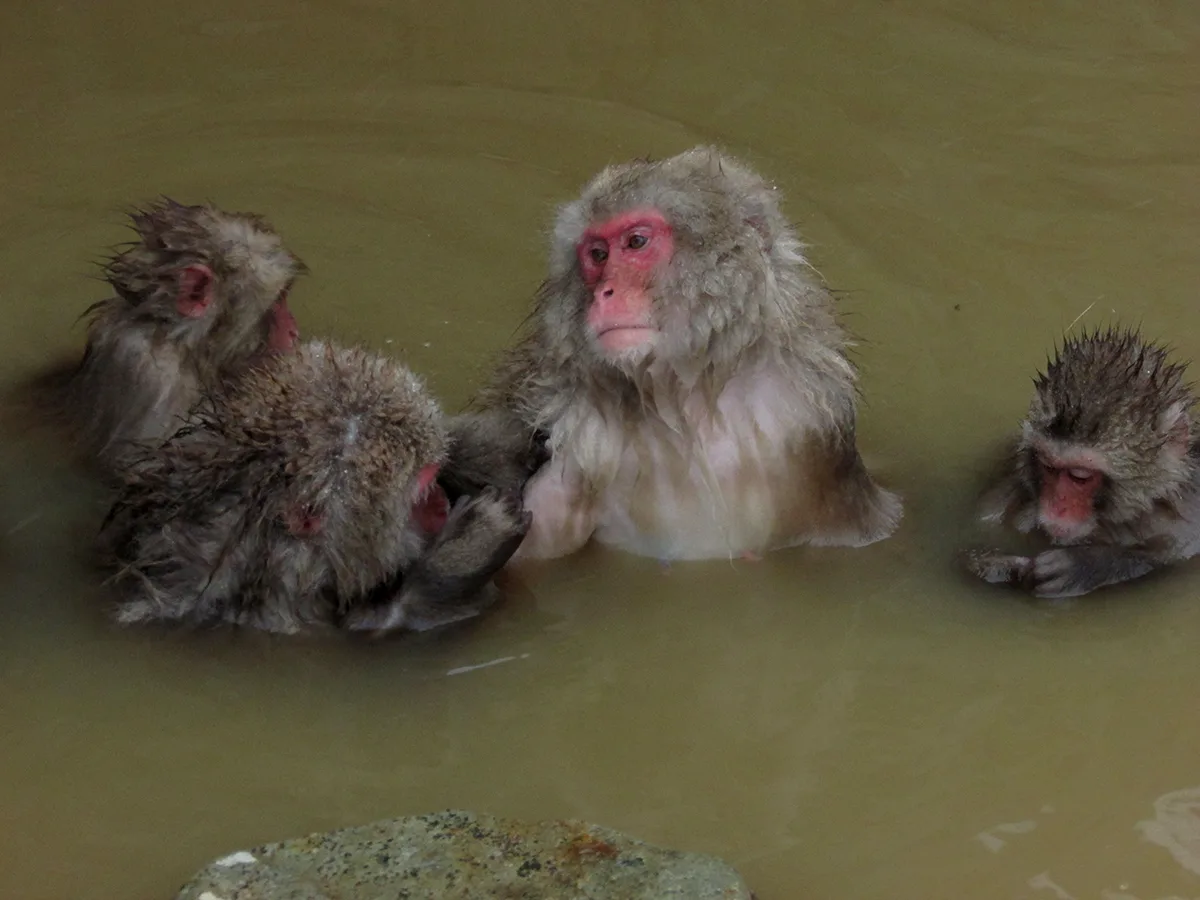
The photo at the top of this page shows what the walk leads to: monkeys sitting in warm water in a pool, close enough to see their faces.
Rules that change the visit
There are no fences, so the rules do the work of a fence. The park's rules say no feeding, no touching and no staring at the monkeys. In practice that means you keep your hands to yourself and do not offer food, even when a monkey walks close.
The park gives a reason for each rule on its caution page:
- No touching and no loud voices: a startled monkey may bite.
- No staring, and no showing your teeth: a long look in the eyes, or an open mouth, reads as hostility to a monkey.
- Babies: a young monkey that gets scared calls for an adult to help. If one comes close, do not touch it.
- No pets, including service dogs: dogs are natural enemies of the monkeys.
- No selfie sticks, drones or cameras in the bath: the flow page says selfie sticks and the like startle the monkeys.
Phones and cameras are fine, and photos, video and flash are allowed. Keep the camera from getting too close to a monkey. The park may ask a visitor who breaks the rules to leave. It also warns about venomous snakes, bees and thorny plants along the path.
Winter hours and the walk back
Open hours in winter (November to March) are 9:00 to 16:00. In summer (April to October) the park opens at 8:30 and closes at 17:00, so a winter day is one hour shorter at the end. The park asks you to arrive 30 minutes before closing. It is open every day of the year, but it can shorten its hours or close for weather or the monkeys' condition.
The walk works both ways. If you reach the pool at about 10:20, you have hours at the water. The last Ex24 bus leaves the park stop at 17:00, and the walk back to the stop is about 30 to 35 minutes. So you are on the path again by about 16:25 at the latest, with the park closing at 16:00 behind you.
Winter entry: who goes in first
From December to April, the park's Japanese site says visitors with a web ticket enter first. Web tickets are for a set date. The park's busy-day calendar for December 2026 to March 2027 is part of its notice, as an image.
Getting there is part of it
If you take the Nagano Dentetsu route, the line has a limited express called Yukemuri. Its reservation page lists private-compartment seats named Snow Monkey on that train (prices are on Nagano Dentetsu's seat reservation page, Japanese). The ride from Nagano to Yudanaka is 38 minutes on the park's official figure.
Nagano Dentetsu's seat reservation page says you can reserve a seat or a Snow Monkey private compartment on daytime limited express trains. The slow sightseeing train Yukemuri Nonbiri-go is not included. You reserve the seat only. The fare and the limited express ticket are bought at the ticket machine at the station where you board.
If you stay the night nearby
The official site of Shibu Onsen describes a stone-paved, retro hot spring town with nine public baths, called soto-yu, fed by natural spring water. It says guests staying in the town receive a key to the baths and can collect stamps on a prayer towel. That is an option for people who sleep in the area, not for a day trip from Tokyo.
The numbers: what a DIY day trip costs from Tokyo
These are adult prices. The first table lists each fare with its source. The second adds them up for a round trip for one adult.
Fares, one person
| Item | Price (yen) | Source and date |
|---|---|---|
| Shinkansen Tokyo to Nagano, reserved seat | 8,450 one way (4,180 fare + 4,270 limited express) | JR East fare search, April 10, 2026 |
| Shinkansen Tokyo to Nagano, non-reserved seat (limited express ticket included) | 7,920 one way | JR East fare search, April 10, 2026 |
| Nagano Dentetsu, Nagano to Yudanaka, limited express | 1,760 one way (1,660 fare + 100 limited express) | Nagano Dentetsu fare table, revised December 1, 2025 (Japanese) |
| Direct bus Ex24, Nagano Station East Exit to the park | 3,000 one way | Nagaden Bus fare table, effective December 5, 2026 (Japanese) |
| Local bus, Yudanaka Station to the park | 390 one way, summer timetable (April 7 to December 4, 2026) | Nagaden Bus timetable (Japanese) |
| Park entry, ticket window | 800 until November 30, 2026; 1,000 from December 1, 2026 | Park notice, September 20, 2026 |
| Park entry, web ticket | 880 on the price list from December 1, 2026 | Park notice, September 20, 2026 |
| Child entry (elementary to high school) | 400 until November 30; 500 from December 1; web ticket 440 | Park notice, September 20, 2026 |
The 390 yen local bus is the summer fare. The winter fare for this bus is yet to be published, so the calculator below lets you change it. Children under 6 enter free if they are with a guardian.
Travel time differs by source. The park's access page says the shinkansen is 79 minutes at its fastest. The Nagaden Bus timetable has an example train that leaves Tokyo at 7:20 and arrives in Nagano at 8:37, which is 77 minutes. JR East's fare search gives about 1 hour 24 minutes for the Kagayaki. The day plan below uses the bus company's own example.
The total, round trip, one adult
| Route | Reserved seat | Non-reserved seat |
|---|---|---|
| Shinkansen + Ex24, ticket window entry (1,000) | 23,900 | 22,840 |
| Shinkansen + Ex24, web ticket entry (880) | 23,780 | 22,720 |
| Shinkansen + Nagano Dentetsu limited express + local bus, ticket window | 22,200 | 21,140 |
| Shinkansen + Nagano Dentetsu limited express + local bus, web ticket | 22,080 | 21,020 |
All four rows use the entry prices that apply from December 1, 2026. The Ex24 rows add the 3,000 yen fare twice. They do not use the set ticket price (bus plus entry), which sits on the web ticket site. The local-bus rows use the 390 yen summer fare. Lunch and getting to Tokyo Station are not included.
The gap between the two routes is 1,700 yen per adult: 2 x 3,000 yen for Ex24 against 2 x (1,760 + 390) yen for the train and local bus, which is 4,300 yen. What you pay for is the direct ride. Nagano Station East Exit to the park is 50 minutes on the Ex24 timetable. The train route takes 38 minutes to Yudanaka plus 15 minutes by local bus.
Winter bus Ex24 and the December 1 fee change: the rules that decide your day
Three things change your day more than the price does.
Ex24, the direct winter bus
Nagaden Bus runs Ex24, the "Express Snow Monkey Park Line", from December 5, 2026 to April 5, 2027. On its announcement, the bus company says winter timetable buses go between Nagano Station East Exit and the park every 20 to 30 minutes.
- Out (Nagano Station East Exit): 15 buses a day, 8:00 to 13:30. Each takes 50 minutes. The 9:00 bus arrives at 9:50.
- Back (the park): 15 buses a day, 11:00 to 17:00. Each takes 55 minutes. The 17:00 bus arrives at Nagano at 17:55.
- How you board: the bus has limited seats, and you board in the order you queue at platform 24.
- How you buy: buy the "Nagaden express bus + entry ticket set" on the web in advance. Same-day tickets at the Nagano Station East Exit information desk may not be sold if the web sales have reached the limit. There is no payment on the bus and no convenience store sale. The set tickets went on sale on September 5, 2026.
- The other bus: the express to Shiga Kogen, Ex23, does not stop at the park.
- Going back: a ticket for the Nagano-bound bus is also sold at the vending machine in the waiting building at the park.
Entry from December to April
The Japanese official site says that in winter (December to April), visitors who bought a web ticket enter first. Web tickets are for a set date, and can be bought from three months before the day you want to enter. The official notice says that if you do not have one, you may have to wait to enter, and that entry may not be possible on busy days. The park's busy-day calendar for December 2026 to March 2027 is part of the notice, as an image.
Parking is also tight. The notice says the lots can fill in winter and asks visitors to use public transport. Some lots are closed over the New Year holiday, and on Saturdays, Sundays and national holidays from December to March.
The line that is out of date
The park's English guide page still says: "No advance ticket reservation service. Please purchase tickets at the park on the day." The same park site published a notice on August 6, 2026 that online ticketing had started. It sells date-specific tickets, and the Japanese site gives web ticket holders priority from December to April. The English guide page has not caught up. Many guides copy the "buy on the day at the gate" idea. If a guide says so, treat the park's own newer notice as the answer.
When to go: December to March, and what changes on the dates
| Date | What changes | Source |
|---|---|---|
| November to March | Open 9:00 to 16:00; monkeys use the hot spring from December to March | Park guide pages |
| Until November 30, 2026 | Adult entry 800 yen | Park notice |
| December 1, 2026 | Adult entry 1,000 yen; web ticket 880 yen | Park notice |
| December 4, 2026 | Last day of the summer bus timetable; no Ex24 until the next day | Nagaden Bus |
| December 5, 2026 to April 5, 2027 | Ex24 direct bus runs | Nagaden Bus |
| December to April | Web ticket holders enter first | Park website (Japanese) |
| New Year, and Saturdays, Sundays and holidays from December to March | Some parking lots closed | Park notice |
The date that moves your total is December 5. Before it, only the Nagano Dentetsu route exists, because Ex24 starts that day. From it, you choose between the two.
A day that works: the timetable from Tokyo
This plan uses the Nagaden Bus Ex24 timetable and its example shinkansen. The shinkansen leg is the example train in the bus company's timetable.
| Time | What happens |
|---|---|
| 7:20 | Shinkansen leaves Tokyo |
| 8:37 | Arrive Nagano. The 9:00 Ex24 leaves from platform 24 at the East Exit |
| 9:50 | The bus reaches the park's stop |
| About 10:20 | After the walk of about 30 minutes, you are at the park |
| Before 15:30 | The park asks you to arrive 30 minutes before the 16:00 closing |
| 17:00 | The last bus back leaves the park stop |
| 17:55 | That last bus arrives in Nagano |
The morning is tight and the afternoon is long. You have 23 minutes between the train arrival at 8:37 and the 9:00 bus, and the set ticket should already be in your phone. From about 10:20, there are roughly six hours before the last bus.
The edge is on the other side. The last bus leaves at 17:00, and the walk back to the stop is about 30 to 35 minutes, so you start walking by about 16:25 at the latest. The park closes at 16:00, so there are 25 minutes between closing time and that start. The 17:55 arrival in Nagano is when you start looking for your train to Tokyo.
Scenarios: who pays what
| Who | Ex24 route | Nagano Dentetsu route |
|---|---|---|
| 1 adult, reserved seat, ticket window | 23,900 | 22,200 |
| 2 adults, non-reserved, web ticket (total) | 45,440 (22,720 each) | 42,040 (21,020 each) |
| 4 adults, reserved seat, ticket window (total) | 95,600 | 88,800 |
Three things change which route fits, more than the group size does:
- The date. A trip on or before December 4 can only use the Nagano Dentetsu route. On or after December 5, you can choose.
- Where you buy the entry. A web ticket is 120 yen cheaper than the ticket window on the new price list, and in winter web ticket holders enter first.
- What you have to book. Ex24 buys you a direct ride, but the set ticket has to be bought on the web beforehand and the seats are limited. The train route has no set ticket to buy first.
The cost per adult stays the same as the group grows, because every fare is per person. The only thing that changes is what a tour has to beat: if you are four adults, a tour must come in under 22,200 yen per person to cost less than the train route, with a reserved seat and ticket-window entry. You can test your own number in the calculator.
How locals plan it in winter
These points come from the park's and the bus company's own Japanese pages, not from blogs.
- Winter parking is the first problem the notice names. The lots can fill, and the park asks visitors to use public transport. Some lots close at New Year and on winter weekends and holidays.
- The web ticket is the winter ticket. The Japanese top page says web ticket holders have priority from December to April.
- Older numbers are the ones to doubt. Guides that list 800 yen and a ticket you buy at the gate on the day were written before the web ticket and the new price list.
Calculator: DIY total for your group and a tour you enter
Enter the number of adults, the shinkansen seat, the entry fee and the date. Leave the tour price at 0 to see only the two ways of going on your own. Enter the price you see on a tour's booking page to add a third row. Change the local bus fare if you know the winter fare.
The calculator does not include lunch, getting to Tokyo Station, child fares, or any difference in the price of the Ex24 set ticket (bus plus entry). A tour may include some of these, so check before comparing.
Booking a tour or going on your own
To spend less, take the Nagano Dentetsu route: it costs 1,700 yen less per adult than Ex24. The 390 yen bus is the summer fare, and the winter fare is yet to be published.
For the easiest ride, take Ex24: no change at Yudanaka. In return you buy the set ticket on the web first, and the seats are limited.
On time, the two routes are close: 50 minutes on Ex24 against 38 minutes by train plus 15 minutes by local bus.
A tour fits when the things in this guide are the problem: a bus with limited seats, a snowy road, and a day that has to end by a fixed time. Group bus tours and private cars from Shinjuku are listed by KKday and GetYourGuide; each booking page shows its own itinerary, price, and inclusions.
Browse toursAffiliate link
Before you book any tour, read these on the booking page:
- What is included: transport, guide, lunch, the park entry fee
- What is not included, so you can add it to your cost
- The return time: when you are back in Tokyo or Shinjuku
- The group size: how many people the tour or private car takes
- The cancellation terms: how late you can cancel for free
- The meeting place: where and when the tour leaves
If you go on your own, the Web Tickets and the Ex24 set ticket come from the park's own site and the bus company. These are official sites, and we earn nothing from them. For the park, use the official web ticket page. For the bus, see Nagaden Bus (Japanese).
However you get there, it ends the same way: a 30-minute walk in the snow to a pool where monkeys sit in the hot water.
Snow monkey park from Tokyo day trip: common questions
How long does it take to get from Tokyo to the snow monkey park?
On the park's figures it adds up to 167 minutes: 79 minutes on the shinkansen, 38 minutes on the Nagano Dentetsu train, 15 minutes on the local bus and 35 minutes on foot. Waiting time between them is on top of that. The Ex24 shortens the bus part: 50 minutes from Nagano Station East Exit to the park, then the walk.
Will the monkeys be there on the day I go?
The park says that in autumn there is plenty of food in the mountains, so the monkeys do not always come down. They use the hot spring in the cold months, December to March. The park updates Facebook and X daily, and has a live camera, so look at those that morning.
Can I bring a stroller or wheelchair?
The park's access page says no wheelchairs and carts can use either approach. The roads are unpaved and uneven, and have steps.
Can I pay by QR code at the park?
Credit cards and electronic money work. QR and barcode payments do not, according to the park's guide.
Can I drive to the snow monkey park in winter?
The notice says the parking lots can fill in winter, and some are closed at New Year and on Saturdays, Sundays and holidays from December to March. It asks visitors to use public transport. If you arrive without a web ticket in winter, you may wait to enter.
Related guides
- Tour vs. DIY on a Mt. Fuji day trip, a same-style comparison for another popular day trip
- Nikko Day Trip From Tokyo: Is the Pass Worth It?
- Shirakawa-go From Takayama: What the Bus Schedule Decides, another day that depends on bus times
- Hokuriku Arch Pass: Is It Worth It?, the pass guide for the Hokuriku Shinkansen
- Is the JR Pass Worth It?, whether the nationwide pass pays back
Sources and data date
Park and bus information was checked on October 29, 2026. The Tokyo – Nagano shinkansen fares are from the JR East fare search of April 10, 2026.
- Jigokudani Yaen-koen (the park): admission fee revision notice, September 20, 2026, online ticketing notice, August 6, 2026 (Japanese version), guide, access, first-time visitor's guide, caution, web tickets, official top page (Japanese)
- Nagaden Bus: 2026-27 winter timetable notice (Japanese), Ex24 timetable (Japanese, PDF), fare table (Japanese, PDF), Yudanaka – park timetable (Japanese, PDF)
- Nagano Dentetsu: fare table, revised December 1, 2025 (Japanese, PDF), seat reservation (Japanese)
- JR East: fare search for Tokyo to Nagano, retrieved April 10, 2026
- Go! NAGANO (Nagano Prefecture tourism site, last updated November 8, 2023): Jigokudani Monkey Park
- Shibu Onsen: official site (Japanese)