Japan's Tax-Free Refund System From 1 November 2026
Fares checked September 21, 2026 against the official pages. Every figure links to its source.


Published: September 21, 2026
Figures checked on September 20, 2026.
Japan tax-free shopping changes on November 1, 2026. For purchases on or after that date, you pay the full 10% tax at the shop, then get it back after customs checks your goods when you leave. The tax you carry until then equals your refund. Japan had 64,499 tax-free shops on September 30, 2025, and 24,448 of them were outside the three big metropolitan areas (Japan Tourism Agency, Japanese). Three details decide whether the refund arrives: the 90 days start the day after you buy, each receipt is checked as a unit, and a shop that missed an October 31 filing stops being a tax-free shop.
Sources for the statistics: Japan Tourism Agency, Consumption Trend Survey for Foreigners Visiting Japan, 2025 (visitor spending, shopping places and items), and the Japan Tourism Agency count of tax-free shops by prefecture, as of September 30, 2025. Both are processed by Japan Trip Math. Public Data License 1.0.
The short answer
For purchases on or after November 1, 2026, tax-free shopping in Japan works as a refund system. You pay the price with tax at the shop. After customs confirms you took the goods out of Japan, the tax is returned to you (Japan Tourism Agency, Japanese).
- The 90 days start the day after you buy. Buy on November 1, 2026 and the last day for the customs check is January 30, 2027 (National Tax Agency, Japanese). It is not 90 days from the day you leave.
- One receipt is checked as one unit. If even one item on a receipt is missing or used up, none of the items on that receipt can be refunded.
- A tax-free shop in September 2026 may not be one in November. A shop that has not filed its electronic-records notice by October 31, 2026 loses its tax-free permit that day.
- The minimum is 5,000 yen before tax, per shop, per day.
The refund fee: no official source gave a rate or an amount (as of September 20, 2026). More on that below.
What changes on November 1, 2026
The method for purchases through October 31, 2026 sells goods without tax and seals some items. The new refund method sells goods with tax and returns the tax later. The date depends on the day of sale, not the day you leave. The National Tax Agency says there is no overlap period in which both methods work together.
| Purchases through October 31, 2026 | Purchases on or after November 1, 2026 | |
|---|---|---|
| At the shop | Tax removed from the price | You pay the price with 10% tax |
| Minimum | 5,000 yen before tax, per shop, per day | Same (no change) |
| Consumables (food, drink, medicine, cosmetics) | Separate category, 500,000 yen cap, special sealed packaging | Category, cap, special packaging and business-use check are removed |
| Customs | Documents handled at the shop | Show your passport at a terminal within 90 days; the refund follows |
| Goods excluded | ― | Gold and platinum bullion and goods that carry no consumption tax |
Sources: Japan Tourism Agency comparison table and traveler page; National Tax Agency Q&A (all Japanese). As of September 20, 2026.
Who can use the system (rules unchanged, according to the National Tax Agency Q&A, Japanese): non-residents in these groups. A foreign national qualifies with a status of residence such as "Temporary Visitor" (short stay), diplomatic or official, or with certain landing permissions such as a cruise-ship or transit landing permit. A Japanese national qualifies if they have had an address or residence outside Japan continuously for 2 years or more. The shop checks your passport and, for Japanese nationals, proof of the time abroad.
Key dates
| Date | What happens |
|---|---|
| March 31, 2025 | Sending tax-free goods home by post (betsuso) ended |
| July 8, 2026 | The National Tax Agency published its detailed Q&A |
| September 15, 2026 | A cabinet outline proposed a 1% tax rate on food and drink from April 2027. As of September 20, 2026, the bill had not passed |
| October 1, 2026 | Shops can start applying under the new system |
| October 31, 2026 | Last day of the existing method. Shops without the electronic-records notice lose their permit |
| November 1, 2026 | The refund system starts, by day of sale |
| January 30, 2027 | Customs-check deadline for goods bought on November 1, 2026 |
The tax agency's rule on midnight: the new system applies to sales from 0:00 on November 1. The Q&A (question 9) covers one case. A shop open until 1:00 a.m. that closes its daily sales at 1:00 a.m. may book sales made between 0:00 and 1:00 on November 1 as October 31 sales and handle them the old way. Most shops are not in that case. If you shop late that night, ask the shop which method it uses. Goods bought by October 31 and sent home later are taxed at customs on the spot. Goods bought on or after November 1 and sent home get no refund.
Packaging and carrying limits
For purchases through October 31, 2026, consumables go into special sealed packaging. From November 1, 2026 the special packaging, the category split and the 500,000 yen cap are removed (Japan Tourism Agency comparison table, Japanese). The trade is that a consumable you eat or use up before you leave cancels the refund. The amount you bring out is limited to what you can carry out yourself. For a single item of 1 million yen or more before tax, customs may ask for an appraisal or warranty paper, so keep the paper the shop gives you.
What visitors buy in Japan, and where they shop
A tax-free receipt is one part of a shopping day. The Japan Tourism Agency asks visitors where they shopped, what they bought and how they paid. The answers below are for all nationalities and all trip purposes in 2025, from the Consumption Trend Survey for Foreigners Visiting Japan (processed by Japan Trip Math). Use them as a picture of how visitors shop, not as a promise of what any one shop sells or refunds.
Tax-free shops are not only in big cities
Japan had 64,499 tax-free shops on September 30, 2025, up 1,221 in six months. The three big metropolitan areas held 40,051. The other 24,448 were elsewhere (Japan Tourism Agency, Japanese). A shopping trip in a regional city or a resort mall can include a tax-free receipt too.
Where visitors shop
Visitors could name every kind of place they had shopped in. Convenience stores came first, and the list runs on to drugstores, souvenir shops and outlets:
| Place | Share of visitors who shopped there |
|---|---|
| Convenience store | 85.3% |
| Department store | 59.4% |
| Drugstore | 59.2% |
| Duty-free shop at an airport | 55.3% |
| Supermarket | 50.4% |
| Souvenir shop at a sightseeing spot | 36.2% |
| Discount store | 27.0% |
| Fashion specialty shop | 26.7% |
| Complex in a city center | 20.8% |
| 100-yen shop | 16.3% |
| Electronics store | 15.1% |
| Outlet mall | 11.1% |
| Shop inside a railway station | 9.3% |
Source: Japan Tourism Agency, Consumption Trend Survey for Foreigners Visiting Japan, 2025 annual report, figure 3-3 (processed by Japan Trip Math). Multiple answers were allowed.
Convenience stores, department stores, drugstores and souvenir shops all appear in the survey. More than half of visitors also shopped at an airport duty-free shop. The survey does not say which of these places offered tax-free. Look for the mark on the door.
What visitors buy
Sweets were the most common purchase, followed by clothing. Buyers spent the most, per person, on jewelry and watches, which few visitors bought.
| Item type | Share of visitors who bought | Average spent by buyers |
|---|---|---|
| Sweets | 72.7% | 11,127 yen |
| Clothing | 47.9% | 27,160 yen |
| Other food, drinks and tobacco | 41.7% | 11,078 yen |
| Cosmetics and perfume | 34.6% | 21,128 yen |
| Medicine | 27.0% | 11,882 yen |
| Shoes, bags and leather goods | 24.5% | 38,311 yen |
| Sake and other alcohol | 22.0% | 11,462 yen |
| Crafts and traditional goods | 8.3% | 13,692 yen |
| Electrical goods | 5.3% | 36,234 yen |
| Watches and film cameras | 2.7% | 73,234 yen |
| Jewelry and precious metals | 2.0% | 87,765 yen |
Source: Japan Tourism Agency, Consumption Trend Survey for Foreigners Visiting Japan, 2025 annual report, figure 3-1 (processed by Japan Trip Math). In 2025 the average visitor spent 61,136 yen on shopping in Japan.
A reading of these numbers: buyers of sweets spent about 11,000 yen on them across a whole trip, so any single shop is less likely to reach 5,000 yen before tax on sweets alone. Clothes, cosmetics and bags reach it more easily. Your own receipts decide, and the calculator below tests them.
Crafts, sake and regional gifts
Crafts and traditional goods are a smaller category, bought by 8.3% of visitors. Those who bought spent 13,692 yen on average. The share depends on where visitors come from: 19.0% of visitors from the United States bought them (19,421 yen on average), against 3.9% of visitors from Korea (6,202 yen). Sake and other alcohol were bought by 22.0%, at 11,462 yen on average. Fresh farm produce reached 5.3%.
These numbers show a second kind of shopping trip. Alongside sweets and cosmetics, some visitors go home with a regional craft, a bottle of sake or a piece of local produce. Fresh produce is food, so it is a consumable if you plan to use it before you leave Japan. Whether a shop sells such goods tax-free is up to the shop. The survey does not say.
How many visitors use tax-free
In 2025, 57.5% of visitors did a tax-free procedure during their stay. The share was 75.3% for visitors from China, 72.5% for Taiwan, 63.8% for Hong Kong and 54.1% for Korea. It was 31.8% for the United States, 32.1% for France, 31.9% for Germany and 27.4% for the United Kingdom.
By item, clothing led the tax-free purchases: 28.1% of visitors bought clothing tax-free, followed by sweets (22.2%), cosmetics and perfume (21.0%), medicine (16.1%) and shoes, bags and leather goods (16.1%). Crafts came to 1.5%. The tax-free figure counts visitors out of all visitors, so it is always lower than the share who bought the item at all (source: figure 3-6, same report).
Paying at the shop
Cash was used by 92.3% of visitors, credit cards by 75.0%, transport IC cards such as Suica by 36.2% and mobile payments by 20.9% (figure 3-4, same report). Under the refund system you pay the price with tax at the register, so the payment method matters. A credit card leaves a record of the amount you carry until you leave. Which refund method the shop offers is a separate question (see the section on refund fees).
How to spot a tax-free shop and other ways to shop
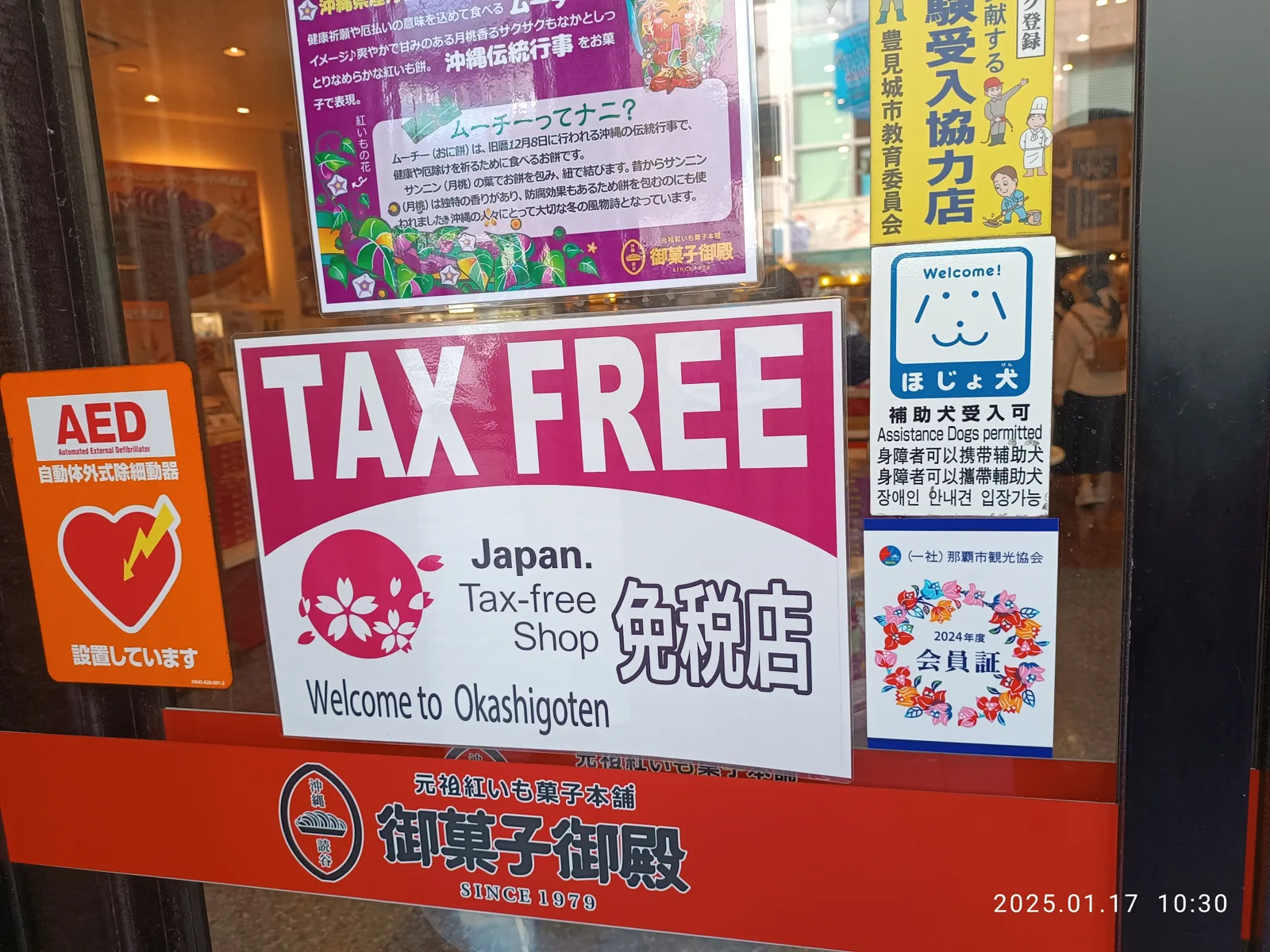
Look for the "Japan. Tax-free Shop" mark (Japan Tourism Agency, Japanese). The mark below is on the door of a food shop on Kokusai-dori, a shopping street in Naha, Okinawa. It shows the mark and the words 免税店 (tax-free shop), and it was photographed in January 2025.
For large purchases, some shops offer direct shipping: you sign a shipping contract in the shop and the shop hands the goods to the carrier. The price is set before tax, and no tax-free procedure is needed. That is only for shops that offer it (Japan Tourism Agency FAQ for shops, Japanese).
A separate option is the duty-free shop after immigration at an airport. KIX DUTY FREE, the operator at Kansai Airport, describes its prices as free of the 10% consumption tax. This is the operator's own description, and its legal basis was not checked. It is a different way to buy from the refund system above.
The 90-day count and the November 1 cutoff
Counting starts the day after you buy, not from the day you leave. The National Tax Agency counts "from the day after the purchase date to the 90th day."
| Purchase date | Day 1 | Last day for the customs check |
|---|---|---|
| November 1, 2026 | November 2, 2026 | January 30, 2027 (the agency's own example) |
| November 15, 2026 | November 16, 2026 | February 13, 2027 |
| December 20, 2026 | December 21, 2026 | March 20, 2027 |
The second and third rows are date arithmetic by Japan Trip Math, using the same rule (checked September 20, 2026). If you buy in several stages, the date that matters is the date on each receipt.
Calculator: minimum 5,000 yen, what you pay and what comes back
Enter each shop's purchases before tax. Purchases in the same shop on the same day go in the second box for that shop, because they are added together. Purchases in different shops are never added together. Choose "Yes" if you plan to eat, drink or use up any consumable from that shop before you leave. The results are arithmetic on the rules above (see About Japan Trip Math for how figures are handled).
What the calculator does not include:
- The refund fee (no rate or amount found in any official source).
- Special counters in some shopping complexes that add up purchases from several shops. Which complexes offer this was not checked.
- The 90-day deadline (see the table above).
- Food tax rates. Food and drink are taxed at 8% (as of September 20, 2026), and a 1% rate is only a proposal.
- Papers for items of 1 million yen or more before tax.
- Shipping-home services.
- What happens when one shop gives several receipts for consumables.
- Whether the shop is a tax-free shop after October 31 (ask before you buy).
Refund examples: how much you pay upfront
Each row uses 10% tax and amounts before tax for one shop in one day. The refund is before any fee. The amount you carry until you leave equals the refund.
| Before tax (one shop, one day) | You pay at the shop | Qualifies? | Refund after customs | Tax not returned |
|---|---|---|---|---|
| 3,000 | 3,300 | No | 0 | 300 |
| 4,999 | 5,499 | No | 0 | 500 |
| 5,000 | 5,500 | Yes | 500 | ― |
| 10,000 | 11,000 | Yes | 1,000 | ― |
| 30,000 | 33,000 | Yes | 3,000 | ― |
| 50,000 | 55,000 | Yes | 5,000 | ― |
| 100,000 | 110,000 | Yes | 10,000 | ― |
| 300,000 | 330,000 | Yes | 30,000 | ― |
The test uses the price before tax. A shopper who pays 5,499 yen has bought 4,999 yen of goods and does not qualify. Shopping days in Tokyo often mean many short rides, and the Tokyo subway ticket and Suica comparison shows how to price them.
One shop, one big purchase
A jacket for 30,000 yen before tax costs 33,000 yen at the register. It qualifies, so 3,000 yen comes back after customs confirms it left Japan. You pay 30,000 yen in the end, before any fee.
Two small purchases in different shops
Shop A sells you 3,000 yen of goods and Shop B another 3,000 yen. You pay 6,600 yen in total. Neither shop reaches 5,000 yen, and different shops are never added together, so the refund is 0.
Two small purchases in the same shop on the same day
Buy 3,000 yen of goods in the morning and 2,500 yen more in the afternoon in the same shop. The tax agency says purchases in the same shop on the same day, even at different times or in different departments, can be added together. The total is 5,500 yen before tax, so it qualifies: you pay 6,050 yen and 550 yen comes back. Some shopping complexes have a shared tax-free counter that adds up purchases across several shops. Which complexes offer this was not checked.
At the airport: what to do before you check your bags
The customs step is short, and it comes before the check-in desk. Officials give the processing time as a few seconds, from reading the passport to the result. If your bag needs inspection the wait is longer, and no official waiting time is published.
- Bring all tax-free goods with you. Do not put any in a checked bag.
- Go to the tax-free terminal (kiosk) in the international departure lobby, before you drop your bags. Airport-by-airport terminal locations were not found in official sources.
- Scan your passport. If the result is green, you are done. If it is red, go to the customs inspection place and show your goods.
- At seven airports (Narita, Haneda, Kansai, Chubu, Fukuoka, New Chitose and Naha), you can also do the procedure online through Visit Japan Web. Use the special wireless network in the international departure lobby, in the area before the security check.
- If you transfer from a domestic flight to an international one, do the procedure at the last airport you leave Japan from.
A bag you have checked in cannot be pulled back for the procedure. If you miss your flight because of the procedure, neither the airline nor customs pays compensation (Japan Tourism Agency, Japanese).
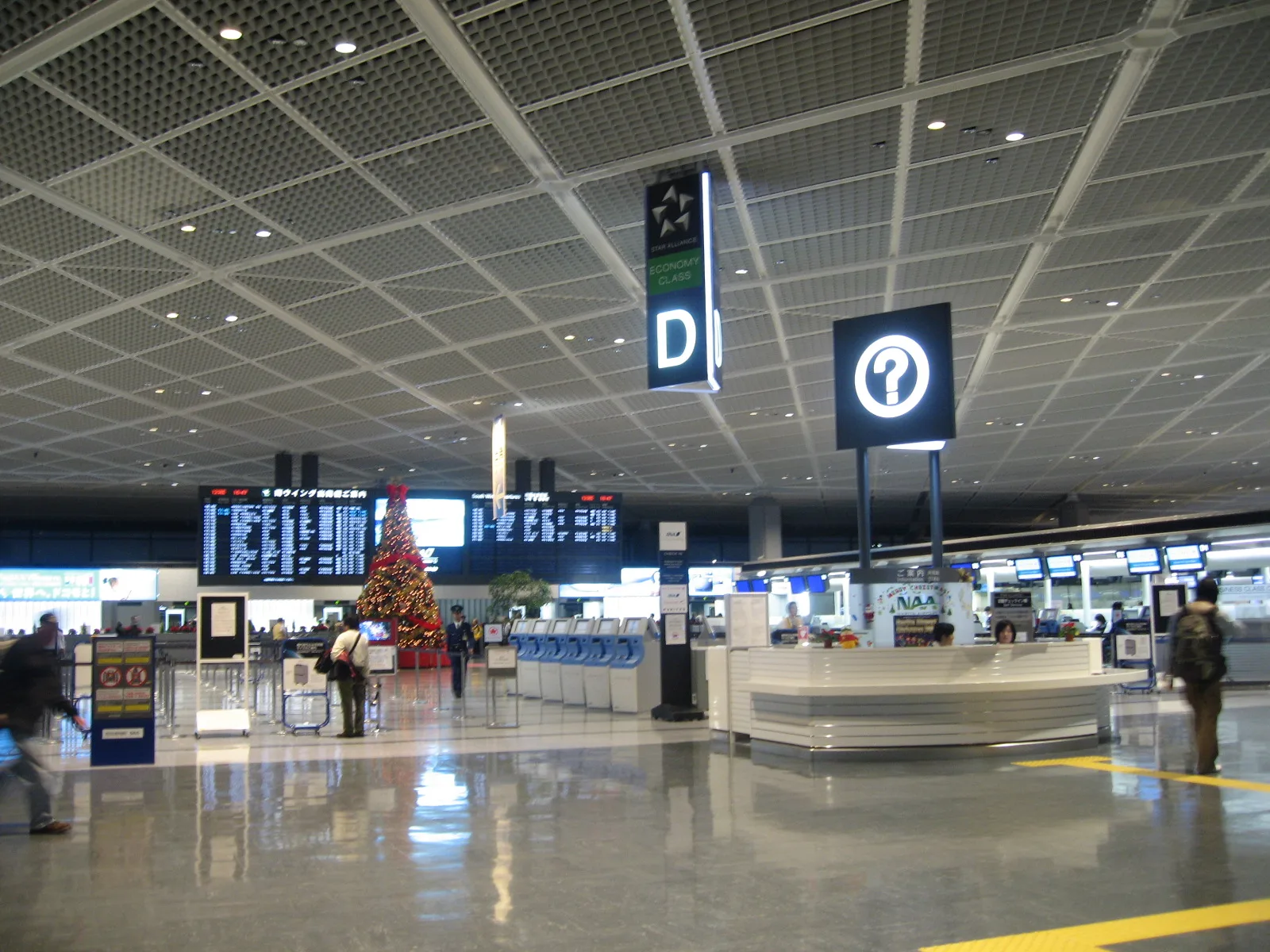
Arriving early helps because the step comes first. For the ride to the airport, see Narita Airport to Tokyo and Kansai Airport to Kyoto and Osaka.
When you lose the refund: receipts, checked bags and consumables
Four cases lose the refund:
- Under 5,000 yen before tax. 4,999 yen does not qualify.
- Purchases in different shops. They cannot be added together.
- Bags already checked in. The procedure needs all your tax-free goods in your hands.
- Consumables you used up. Food, drink, medicine and cosmetics count if eaten or used.
| Situation | Result |
|---|---|
| One item on a receipt is missing | The whole receipt is out. Customs checks one purchase receipt as one unit |
| You ate part of what you bought | Do not use the terminal. Tell the customs desk |
| You do not take the goods out of Japan | The exempted consumption tax is collected, and penalties can apply |
Source: Japan Tourism Agency traveler page (Japanese). A shopper who keeps a receipt for a bag of sweets and a jacket has one unit. If the sweets are eaten, the jacket on that receipt goes too.
What you can use before you leave Japan
Items that are not consumables can be used until you leave, as long as they leave Japan with you. The Japan Tourism Agency FAQ for shops says such goods can be confirmed even if used in Japan meanwhile. You must hold the goods in your hands at the terminal. The word that matters for consumables is "consume," not "unopened." Special sealed packaging has been removed. Food, drink, medicine, cosmetics and other consumables cannot be refunded if you used any or all of them in Japan.
So a sealed bag is not required, and an open box is not the test. What counts is whether you still hold the goods and whether you used them up. Do not put tax-free goods in a suitcase that you check in: the procedure needs them in your hands, before check-in. Sending them home separately does not work either, because sending goods by post ended on March 31, 2025 and goods sent separately after November 1, 2026 get no refund.
Refund fees and how you get paid
The fee is the most-asked question and the one official sources leave open. Japanese law sets no rule on refund fees. The government does not collect any. Whether the traveler or the shop pays a fee is up to the shop; the Japan Tourism Agency adds that in other countries the traveler paying is common. Any rate quoted elsewhere without a source was not repeated here. Ask the shop what fee applies and who pays it.
How the money reaches you is also up to the shop or its refund company. The National Tax Agency gives examples: bank transfer, credit card, app transfer, or cash inside the departure area after the customs check. A shop may return the money as a coupon or points, and may add a bonus. A refund method is normally registered at the time of purchase, and the shop tells you how. The deadline for applying is set between shop and traveler, so agree on it before you pay. How many days a refund takes to arrive is not published.
The National Tax Agency says a national association of tax-free shops lists refund companies that plan to handle refunds. The list was not checked, and the agency does not guarantee those companies.
Questions to ask the shop before you pay
Official guidance to Japanese shops shows what a shop must do, and so what you can ask. All three points come from the National Tax Agency and the Japan Tourism Agency pages for shops, in Japanese.
- Ask if the shop is registered. A shop that has not filed a "notice of how purchase-record information will be provided" by October 31, 2026 loses its tax-free permit that day. A shop that was tax-free in September may not be in November.
- Ask what the shop must tell you. Shops must explain that you need a customs check within 90 days of purchase, that you must show the goods on request, and that goods not exported are taxed. If the explanation is missing, ask for it.
- Ask how the refund is paid. Because the payment method is up to the shop, ask what it offers.
These pages are written for shop staff, not for travelers, and they are the reason the questions above are worth asking. Personal views from Japanese travelers on the change were not found, so none are reported here.
How to plan the airport day
Plan for the customs step to come first. The official page says to reach the airport early because an inspection can take time. If you carry shopping bags, a private or fixed-price ride to the airport is one option to compare.
For a wider view of what a trip costs, see Is the Japan Rail Pass worth it?.
A caution: same-day baggage delivery does not work for tax-free goods. Tax-free goods must be in your hands at the customs terminal, and goods sent separately get no refund. Delivery is for items that are not tax-free.
No official crowding data was found for late November, December or the New Year, so this article makes no forecast.
Common questions
When does the new Japan tax-free system start?
It starts with sales on or after November 1, 2026, judged by the sale date, not the day you leave. There is no overlap period. Purchases through October 31, 2026 follow the existing method (National Tax Agency).
Do I pay tax at the store from November 2026?
Yes. You pay the price with 10% tax. After the customs check when you leave, the tax is returned (Japan Tourism Agency).
What is the minimum purchase for tax-free in Japan?
5,000 yen before tax, in the same shop on the same day. 4,999 yen does not qualify. Different shops cannot be added together, but purchases in the same shop on the same day can.
How long do I have to leave Japan after buying?
Within 90 days, counted from the day after purchase. A purchase on November 1, 2026 has a deadline of January 30, 2027.
What is the tax-free refund fee in Japan?
Not found in any official source. The law sets no rule, the government collects none, and the shop decides whether the traveler pays. Ask the shop.
How do I get the refund?
By a method the shop offers, such as bank transfer, card, app or cash inside the departure area, and sometimes coupons or points. The shop tells you at purchase. It comes after customs confirms the goods left. How many days it takes is not published.
Do I do the tax-free procedure before or after checking my bags?
Before. Keep all tax-free goods with you. A checked bag cannot be pulled back.
Can I use or open tax-free items before I leave Japan?
Non-consumables can be used, if they leave Japan with you. Consumables (food, drink, medicine, cosmetics) cannot be used up. Sealed packaging is not required.
What happens if I eat a snack I bought tax-free?
Every item on that receipt is out. Tell the customs desk instead of using the terminal. If goods are not taken out of Japan, the exempted tax is collected and penalties can apply.
Is the tax-free refund available at every shop?
No. A shop without the October 31 electronic-records notice loses its permit that day. Ask before you buy.
Will the 1% tax on food change tax-free refunds?
Unknown. A cabinet outline on September 15, 2026 proposed a 1% rate on food and drink from April 1, 2027 to March 31, 2029 if a bill passes. As of September 20, 2026, the bill had not passed. No official guidance was found on how it would apply to tax-free purchases.
Can I ship tax-free purchases home?
Sending goods by post ended on March 31, 2025. Goods sent separately after November 1, 2026 get no refund. Direct shipping arranged in the shop, priced before tax, exists only at shops that offer it.
Sources and data date
All figures were checked on September 20, 2026. Rules and dates can change, and the Q&A may be revised; check the official page before you buy.
- National Tax Agency: Move to the refund method (Japanese); Q&A, overview (Japanese, PDF); Q&A, detailed edition (Japanese, PDF); leaflet for shops (Japanese, PDF); leaflet for travelers (English, PDF); reduced tax rate pamphlet (Japanese, PDF).
- Japan Tourism Agency: page for travelers (Japanese); FAQ for travelers (Japanese); FAQ for shops (Japanese); comparison table of changes (Japanese, PDF); tax-free shop numbers by prefecture (Japanese); tax-free shop mark and information (Japanese).
- Statistics: Japan Tourism Agency, Consumption Trend Survey for Foreigners Visiting Japan, 2025 calendar year: final report (Japanese, PDF) and annual report (Japanese, PDF). Public Data License 1.0 (processed by Japan Trip Math).
- KIX DUTY FREE (operator's own description, Kansai Airport only): tax refund information.
Tables and the calculator are arithmetic on the rules above, not a promise of savings. Next review: November 2, 2026.