Day Trip to Hiroshima From Osaka: What Skipping the Tour Costs
Prices checked September 25, 2026 against the official pages. Every figure links to its source.

Published: September 19, 2026
This page contains an affiliate link. If you book through it, we may earn a commission at no extra cost to you. It does not change our numbers. See our disclosure.
Fares checked on September 19, 2026.
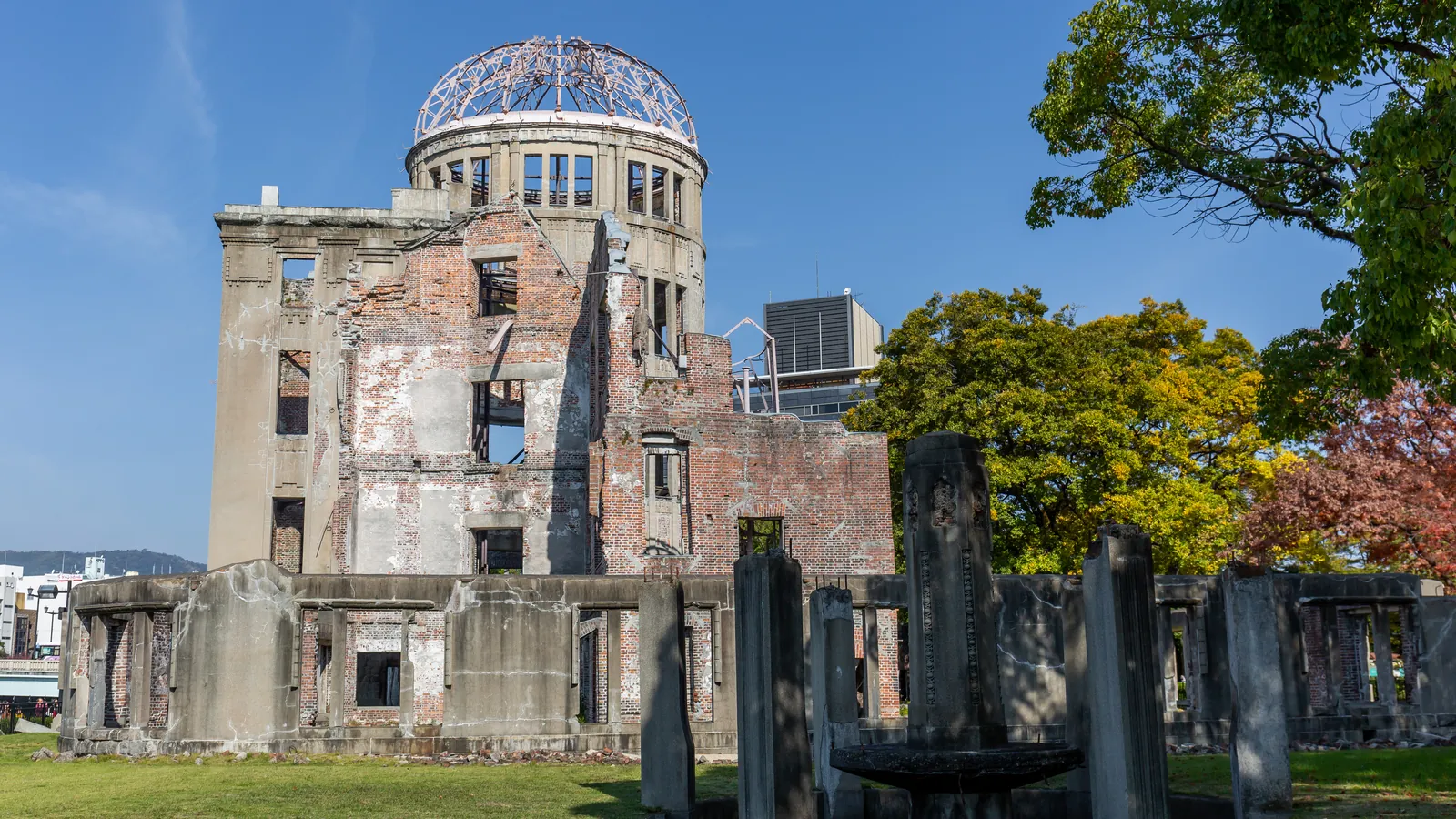
In Hiroshima, the Genbaku Dome (Atomic Bomb Dome) still stands where it survived the first atomic bomb on August 6, 1945 — UNESCO calls it "the only structure left standing in the area where the first atomic bomb exploded," preserved "in the same state as immediately after the bombing." A short trip away, on Miyajima island, Itsukushima Shrine rises "with the sea in the foreground and mountains in the background," founded in the 12th century by Taira no Kiyomori. Time your ferry right and you'll catch the "Great Torii ferry," which runs from Miyajimaguchi between 9:10 and 16:10 and passes closest to the big gate.
Both places carry World Heritage status, given in 1996, and both are drawing more visitors than ever — Miyajima logged a record year in 2025, its second in a row, beating 2024's 4.85 million (Hatsukaichi City, Japanese). You can see them both from Osaka in a single day.
Once the numbers are settled, we'll walk you through what to actually do there: the museum, the shrine's corridors, the tide, the ropeway up Mt. Misen.
But first, the part that decides everything else: how you pay for the ride. This post compares four ways — the regular fare, the discount one-way ticket, the Kansai-Hiroshima Area Pass and a guided tour (for tours, we give you a checklist rather than a price, since prices move by date). The calculator below is built for one adult.
The short answer
- Skip the regular fare if you can — it's the priciest of the three rail options in every case we ran. A reserved seat on Sakura/Hikari on an ordinary date is 20,840 yen round trip, 21,900 yen on the Nozomi. Go to Miyajima by JR and the JR ferry, and both the pass and the one-way tickets undercut that by 5,040 yen.
- Going to Miyajima by JR and the JR ferry? The pass and the one-way tickets land at the same price. The pass costs 1,200 yen more than two one-way tickets (17,000 versus 15,800 yen) — but that's exactly what the JR train and JR ferry to Miyajima cost round trip (840 plus 360 yen), and the pass throws both in for free.
- Skipping Miyajima, or taking the streetcar and Matsudai ferry instead? The two one-way tickets win by 1,200 yen. Stack on more JR West rides in the same five days, though, and the pass pulls ahead.
- One catch: the one-way ticket is sold overseas only. JR West says flatly that it "is not available for purchase within Japan." Sellers set their own price for it, so the calculator lets you type in your own price.
All figures above: adult, reserved seat, round trip Osaka to Hiroshima, one person, as of September 19, 2026.
The numbers
Fares and times in this section are as of September 19, 2026. All prices are in yen, for adults, and change over time.
Four ways to get there and back
| Way | Round trip | What it includes, and conditions |
|---|---|---|
| Regular fare, Sakura/Hikari reserved seat, ordinary date | 20,840 (10,420 x 2) | Shinkansen (bullet train) only. No round-trip discount on this route |
| Regular fare, Nozomi reserved seat, ordinary date | 21,900 (10,950 x 2) | Same |
| Discounted one-way ticket, Osaka City to Hiroshima City | 15,800 (7,900 x 2) | One ticket per direction. Reserved seat, Nozomi included, valid for one day. Sold overseas only, at each seller's own price |
| Kansai-Hiroshima Area Pass (5 days) | 17,000 (one pass) | Shinkansen, JR West trains and the JR West Miyajima Ferry for five days in a row. See the conditions below |
| Guided tour with Shinkansen | Not priced here | Prices change by date and option. See the checklist in the tour section |
Tour prices are not shown here. The tour section below lists what to compare.
Sources: JR West, Kansai-Hiroshima Area Pass; JR West, discounted one-way ticket; fares from JR West's My Dia search results.
Regular fare: it changes with the date
You're paying a ticket plus a reserved-seat surcharge, and the surcharge moves with the calendar. Starting from Osaka Station costs the same as starting from Shin-Osaka (both fall under the Osaka City fare), and the local train between the two takes just 4 minutes, so don't let that choice worry you.
| Train | Ticket | Surcharge | One-way total | Time |
|---|---|---|---|---|
| Sakura/Hikari, ordinary date | 5,720 | 4,700 | 10,420 | About 1 h 28 min to 1 h 33 min |
| Nozomi, ordinary date | 5,720 | 5,230 | 10,950 | About 1 h 25 min to 1 h 26 min |
| Non-reserved seat on Hikari/Kodama | 5,720 | 4,170 | 9,890 | – |
The surcharge changed with the date. We searched every day from September 19 to November 1, 2026. These are the values we saw:
| Train | Dates we searched | Surcharge | One-way total |
|---|---|---|---|
| Sakura/Hikari | September 19 to 23 | 5,100 | 10,820 |
| Sakura/Hikari | September 24 to October 1 | 4,500 | 10,220 |
| Sakura/Hikari | Ordinary dates | 4,700 | 10,420 |
| Nozomi | September 19 to 23 | 5,630 | 11,350 |
| Nozomi | September 24 to October 1 | 5,030 | 10,750 |
| Nozomi | Ordinary dates | 5,230 | 10,950 |
| Nozomi | October 9 to 12 (Friday to Monday); October 16 to 18, 23 to 25 and 30 to November 1 (Friday to Sunday) | 5,430 | 11,150 |
The same caution applies around October 1, 2026: JR Central is adding a new Supreme Class Cabin that day, which could shift the reserved-seat surcharge — check the fare directly if you're traveling then.
The discount one-way ticket is sold overseas only
Two things decide whether you can use it: a passport issued by a foreign government, and entry into Japan as a "Temporary Visitor." The same two conditions apply to the pass. JR West's English page is blunt about where to get it — "Available from select overseas travel agencies" — and just as blunt about where you can't: "The 'Discounted One-way Ticket' is not available for purchase within Japan."
| Kansai-Hiroshima Area Pass | Discounted one-way ticket | |
|---|---|---|
| Price, adult / child (6 to 11) | 17,000 / 8,500 | 7,900 / 3,950 (Osaka City to Hiroshima City) |
| Period | 5 days in a row (0:00 to 24:00). No changes | One day, one direction. Start date can be changed once |
| Shinkansen | Osaka to Hiroshima, Nozomi and Mizuho included, reserved and non-reserved seats. Not valid on S Work seats (per JR West's press release and JR-Odekake Net, both in Japanese) | One reserved seat, Nozomi included. No stopovers |
| JR West conventional lines | Limited express, rapid and local trains, including reserved seats (from your 7th reservation, book at the JR ticket office). JR West Bus route buses are included; expressway buses are not | None |
| Miyajima | JR Hiroshima to Miyajimaguchi and the JR West Miyajima Ferry (Miyajima visitor tax of 100 yen is extra) | Not included |
| Not valid for | Hiroshima to Hakata, Shin-Osaka to Tokyo, Kyushu Shinkansen | Not applicable |
| Where to buy | Overseas travel agencies, travel agencies in Japan, or JR-WEST ONLINE TRAIN RESERVATION (from 10:00 one month before use, by credit card) | Overseas travel agencies only |
| Refund | Fee of 10% (minimum 220 yen). None after the pass starts | 560 yen before or after the ticket is issued, up to two days before. From the day before, 30% of the regular express ticket plus 220 yen (minimum 560 yen) |
One detail JR West doesn't spell out: which stations actually count as "Osaka City" and "Hiroshima City" for this ticket. We treat Shin-Osaka and Osaka as inside Osaka City.
Packing a big suitcase? On the Sanyo Shinkansen, a bag with three sides adding up to more than 160 cm (and less than 250 cm) needs a seat with an oversize luggage area, per JR West's English page.
Sources: JR West, Kansai-Hiroshima Area Pass; JR West, discounted one-way ticket; JR-Odekake Net, pass (Japanese); JR-Odekake Net, one-way ticket (Japanese).
On the pass price: JR West's English page says its displayed information is as of August 1, 2024. JR West's January 28, 2026 press release (Japanese, PDF) still lists 17,000 yen for adults. The price was last revised on October 1, 2023.
Miyajima: the pass includes it, the one-way ticket does not
Here's why the pass and the one-way tickets end up tied on the most common plan: the pass covers the JR train from Hiroshima to Miyajimaguchi and the JR West ferry across to the island, and the one-way ticket covers neither.
Run the numbers and the tie isn't a coincidence, even if JR West never explains it. The pass costs 17,000 yen against 15,800 yen for two one-way tickets — a 1,200 yen gap that happens to match the JR train and ferry round trip to Miyajima exactly (840 yen plus 360 yen).
| Item | Adult | Included in the pass? |
|---|---|---|
| JR Hiroshima to Miyajimaguchi (about 27 minutes) | 420 (840 round trip) | Yes |
| JR West Miyajima Ferry | 180 (360 round trip) | Yes |
| Miyajima visitor tax | 100 | No. JR West's page states 100 yen as of October 2023 |
| Hiroden streetcar, one ride (city and Miyajima lines) | 240 | No |
| Hiroden 1-day streetcar and ferry ticket (all streetcar lines and the Matsudai ferry, not the JR ferry) | 1,000 (includes visitor tax) | No |
| Miyajima Ropeway, round trip | 2,000 (1,500 with the Hiroden 1-day ticket, per Hiroden's page (Japanese)) | No |
| Itsukushima Shrine (shrine only / with Treasure Hall) | 300 / 500 | No |
| Hiroshima Peace Memorial Museum | 200 | No |
One thing worth knowing if you're pricing the streetcar yourself: Hiroden's fare has been a flat 240 yen on all lines since February 1, 2025, per Hiroden's notice (Japanese) — its English fare page still shows some older fares, so we went with the Japanese notice instead. And the Hiroden 1-day ticket is explicit that it "is not valid for JR Miyajima Ferry," so don't mix the two up at the gate.
One more wrinkle: Hiroden's English page lists the 1-day streetcar and ferry ticket as valid on all streetcar lines and on the Miyajimaguchi-to-Miyajima ferry run by Miyajima Matsudai Kisen, while the Japanese fare notice above defines "all lines" as the city lines and the Miyajima line.
Sources: JR West Miyajima Ferry; Hiroden 1-day ticket; Miyajima Ropeway; Itsukushima Shrine; Peace Memorial Museum.
Calculator: which is cheaper for your day
Use it to try your own plan. Four notes:
- Pick the regular fare's train and date. Then type in the one-way ticket and pass prices from the seller's page. The default is JR West's list price.
- If you go to Miyajima, pick your route. The pass covers the JR train and JR ferry. It does not cover the streetcar and Matsudai ferry.
- Pick the places you will pay to enter. The same amount is added to all three columns, so the gaps stay the same. Use the total to compare with a tour price.
- If you will ride other JR West lines in the same five days, such as to Kyoto, type in what you would pay without the pass.
What the calculator leaves out:
- Tours. Prices are not shown here, and tours include different things.
- The Matsudai ferry fare on its own.
- Sellers' prices for the one-way ticket and the pass. You type them in.
- The full season table for the surcharge, and the effect of the October 1, 2026 JR Central revision.
- Children and infant fares. Age bands and prices differ by operator: for example, Hiroden's 1-day streetcar and ferry ticket is 550 yen for a child against 1,000 yen for an adult, which is not half, and the Miyajima Ropeway and the JR West Miyajima Ferry list children as ages 6 to 12 on their English pages. Admission fees have their own child prices.
- Non-reserved seats and Green Car.
- Lunch, souvenirs and lockers.
- The Have Fun in Hiroshima Pass and the Visit Hiroshima Tourist Pass.
- Hotels.
Scenarios: five ways the day can go
How to read the table below: it shows one adult in a reserved seat, as of September 19, 2026. The regular fare is Sakura/Hikari on an ordinary date (10,420 yen each way). The tickets and the pass use JR West's list price, not what individual sellers charge. For more about who writes these posts, see About.
| Scenario | Regular fare | Two one-way tickets | Pass | What stands out |
|---|---|---|---|---|
| S1: Hiroshima only, 2 streetcar rides | 21,320 | 16,280 | 17,480 | Tickets 1,200 cheaper. 5,040 and 3,840 below the regular fare |
| S2: Hiroshima and Miyajima, JR and JR ferry | 22,620 | 17,580 | 17,580 | Same price |
| S3: Hiroshima and Miyajima, Hiroden 1-day ticket (1,000) | 21,840 | 16,800 | 18,000 | Tickets 1,200 cheaper |
| S4: S2 plus a Kyoto round trip in the same five days (Nozomi) | 24,840 | 18,740 | 17,580 | Pass 1,160 cheaper |
| S5: Tour | Not priced here | Compare with the checklist below |
If your day looks like one of these, the numbers follow. Your own day will differ, so use the calculator.
City only: the Peace Memorial Park and museum
Skip Miyajima and stick to the city — two streetcar rides (240 yen each) and 200 yen into the museum — and the two one-way tickets pull ahead of the pass by 1,200 yen, simply because the pass has nothing left to cover once Miyajima is off the table. Against the regular fare, you're still saving either way: 3,840 yen with the pass, 5,040 yen with the tickets.
City and Miyajima by JR and the JR ferry
This is where the pass and the tickets land on exactly the same number. Buy the two tickets and you pay 15,800 yen, then add 1,300 yen more for the JR train (840), the JR ferry (360) and the visitor tax (100). Buy the pass instead and you pay 17,000 yen up front, then only the 100 yen tax. Add two streetcar rides to either route and both come to 17,580 yen. JR West never explains why the two paths meet at the same number, but they do — and if you catch the Great Torii ferry on this route (9:10 to 16:10 from Miyajimaguchi), the pass has already paid for your seat on it.
City and Miyajima by streetcar and Matsudai ferry
Swap the JR route for the Hiroden 1-day streetcar and ferry ticket (1,000 yen, visitor tax included) and the tickets pull back ahead by 1,200 yen, since the pass isn't covering any part of this route — it just adds 1,000 yen of cost you didn't need. Hiroden's English page says the ticket covers all streetcar lines and the Miyajimaguchi ferry, so we're assuming that covers your ride to the crossing; confirm the bundled fare on Hiroden's page before you commit to this route.
Adding Kyoto or Nara in the same five days
Tack on a Kyoto round trip by Special Rapid train (580 yen each way, about 29 minutes, Nozomi fare used throughout) and you start to see why the pass rewards a busier itinerary: every extra JR West ride it covers is money you'd otherwise be spending anyway.
Here's the rule of thumb worth remembering: without a JR trip to Miyajima, the pass overtakes the tickets once your other JR West rides pass 1,200 yen — a single Kyoto round trip (1,160 yen) gets you close but not quite there. Add Miyajima by JR and the JR ferry to the mix, though, and any extra ride at all tips the balance toward the pass.
Run your own numbers in the calculator below. The Haruka airport train is covered by the pass too — see Kansai Airport to Kyoto, Namba and Umeda for that comparison, and Kansai Area Pass vs Kansai Railway Pass vs ICOCA for the other Kansai passes and day trips beyond Hiroshima.
If you want the underlying rule rather than our worked examples: the pass wins once the gap between its price and two one-way tickets is smaller than what it saves you on the Miyajima crossing plus any other JR West rides. At list prices that gap is 1,200 yen (17,000 minus 15,800), which happens to be exactly what the JR train and ferry to Miyajima cost — hence the tie. Push a seller's one-way ticket above 7,900 yen and the pass wins the JR-and-ferry route outright; skip the JR Miyajima trip entirely, and the tickets stay ahead up to 8,500 yen each.
Guided tours: what to check, not what they cost
You won't find tour prices here — they shift by date and option, and copying a listing wouldn't give you an honest comparison anyway, since no two tours include quite the same things. What we can hand you is a checklist. Run through it on any product page before you book:
- Whether the Shinkansen tickets from Osaka are included, and where you meet the guide.
- Whether you ride the train with the guide or on your own.
- Whether the Itsukushima Shrine entry fee is included.
- Whether the Peace Memorial Museum entry fee is included.
- Whether lunch is included.
- Whether the ferry is included.
- The guide's languages.
- The group size, or whether the page shows none.
- Free cancellation: how many hours or days before the start.
- What time the tour ends compared with the last Shinkansen, 21:59 in our search (see the next section).
Comparing a tour price against doing it yourself takes three steps: put your admission fees into the calculator and note the total, see what the tour actually includes, then add those same items to your do-it-yourself side so you're comparing like with like. If a tour includes lunch, that's value the calculator won't show you, since lunch isn't part of its price. Tour operators may also use discounted Shinkansen tickets, which the calculator doesn't reflect.
If you'd rather hand the ferry timing and admission tickets to someone else, a tour may suit you better than planning it yourself. If setting your own pace matters more, the calculator above shows what the rail options alone will cost you.
What you will see: Hiroshima and Miyajima in one day
The numbers above decide how you pay. This section is about what the day holds. It uses facts from official pages, all checked on September 20, 2026, and it does not copy their text.
The museum: three official time guides
The Hiroshima Peace Memorial Museum gives you three time guides. Its front page has a guide to the Main Building that takes about 30 minutes. The audio guide takes about 70 minutes. The Hiroshima Tourism Federation's model course sets aside about 60 minutes for the museum. Choose the length that fits your day.
The permanent exhibition has six areas: an introduction, Hiroshima on August 6, the victims and survivors, a gallery on the building of the Peace Memorial Park, the danger of nuclear weapons, and the history of Hiroshima. The ground and basement floors of the East Building are free to enter. Tickets, audio guide rental and a rest lounge are there.
The audio guide costs 500 yen and comes in 15 languages, including English, Chinese and Korean. Its page mentioned a special price that ended on December 29, 2025, so the regular price is the one to expect.
A free English guide is also possible. The Hiroshima Peace Volunteers lead English-only walks, one to one and a half hours long. A group takes up to 10 people, you cannot reserve, and places go first come, first served. The page says there are no tours in July, August and September, and museum tours were paused when we looked. Whether a guide is available depends on your date.
The museum allows personal photos without flash. Tripods and selfie sticks are not allowed. Sources: Museum front page; audio guide; exhibition; Hiroshima Tourism Federation course.
The park and the streetcar
Outside the museum, the Peace Memorial Park has dozens of monuments. The Hiroshima Peace Culture Foundation's official map shows about 50 of them, including the Cenotaph for the A-bomb Victims, the Flame of Peace, the Children's Peace Monument, the Peace Bell and the Peace Pond. The Genbaku Dome was the Hiroshima Prefectural Industrial Promotion Hall, designed in 1915 by the Czech architect Jan Letzel. The model course above walks from the Dome (about 30 minutes) to the museum (about 60 minutes).
To move around the city, you may ride the Hiroden streetcar. You can board through any door. You pay when you get off, in cash into the fare box or by tapping an IC card. Nine kinds of IC cards work, including Suica, PASMO and ICOCA. If you have the 1-day ticket, you scratch off the date and show it as you get off. Get off through the door near the driver or conductor. Sources: Hiroshima Peace Culture Foundation, park map; Hiroden, how to ride.
Miyajima: tide, corridors and the torii
On Miyajima, the sea changes the view. At low tide you can walk to the foot of the Great Torii. At high tide the shrine buildings look as if they float. The Miyajima Tourist Association has a tide tool: type in your date and it shows the tide height and the time windows for each view.
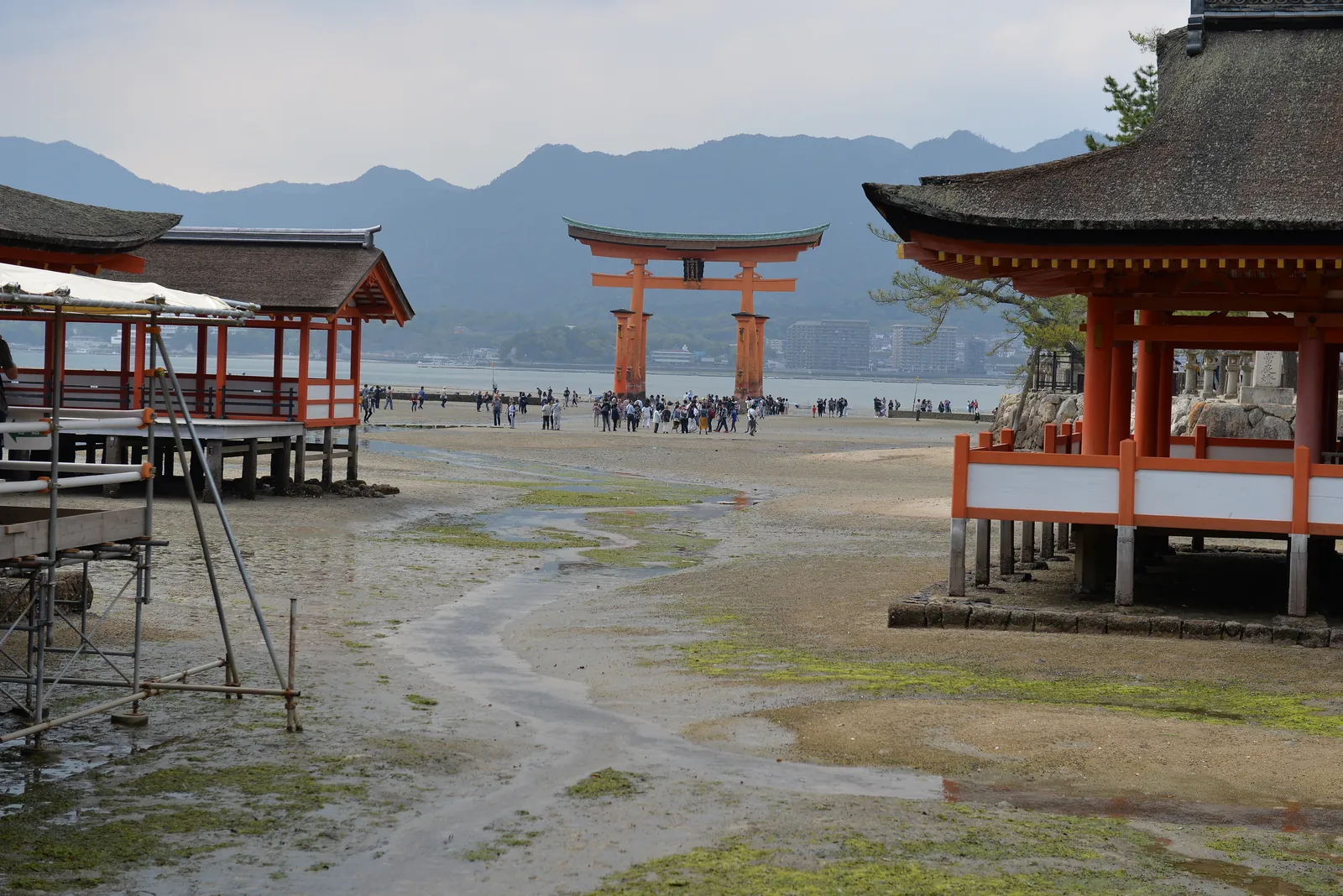
The gate is about 16.8 m high and stands in the sea. It is not buried in a foundation. The association says it is supported by its own weight. The present gate is the ninth, built in 1875.
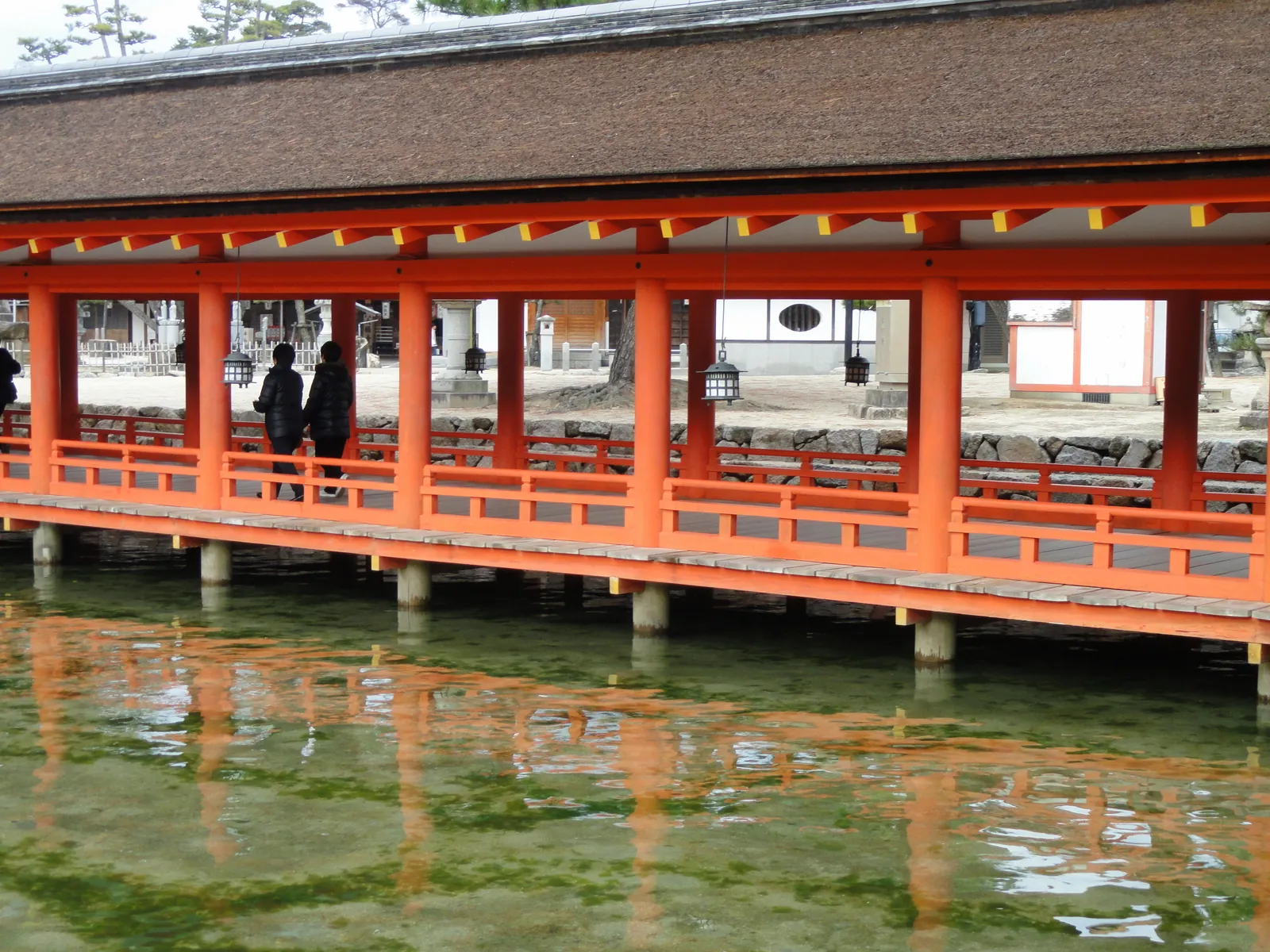
The shrine has a set route. It goes from the entrance through the East Corridor to the main shrine, then the West Corridor, the arched bridge and the Noh stage, and out toward the Great Torii. The official page says the floor boards have gaps between them, which ease the pressure of high tides. Wear shoes that are easy to walk in. The Hiroshima Tourism Federation's model course allows about 60 minutes at the shrine.
Sources: Miyajima Tourist Association, tide info; the Great Torii; Itsukushima Shrine.
Deer, the ropeway and the flame that links two cities
About 500 deer live on Miyajima. They spend the night in the forest, come out to feed at dawn and rest during the day, and return in the evening. The association says some also sleep in town.
Mt. Misen is reached by the Miyajima Ropeway, in two sections from Momijidani Station. The first takes about 10 minutes in an 8-person cabin. The second takes about 4 minutes in a 35-person cabin. Upbound cars run from 9:00 to 16:00. On certain days from September to November you need a reservation. The ropeway fare is in the table above.
On Mt. Misen stands the Reikado Hall. The association says its flame has burned for more than 1,200 years, and that the flame was used to light the Flame of Peace in Hiroshima Peace Memorial Park. So one flame links the two places you visit that day. Sources: Nature and animals; Miyajima Ropeway; Mt. Misen.
Evening on the island
The lights on Miyajima come on 30 minutes after sunset and stay on until 23:00. This is the usual schedule all year, but shrine events can pause it. They light the Great Torii, the main shrine, the five-story pagoda, the Tahoto pagoda and the stone lanterns on the Nishimatsubara approach. At high tide, boats can get close to the Great Torii, so you can see it from land or from a boat.
The shrine gate itself closes at 18:00 (17:30 from October 15 to November 30), as in the hours table below. The lights and the shrine visit are two different things. Source: Miyajima Tourist Association, lights.
Food and luggage
The Miyajima Tourist Association calls momiji manju (maple-leaf cakes) the most popular sweet on the island. At the Miyajima Traditional Crafts Center, you can try making them on the second floor, from 9:00 to 16:00. Oysters are a local food, and the Miyajima Oyster Festival is held on the second weekend of February. Anago-meshi (conger eel on rice) is another dish the association lists. Hiroshima-style okonomiyaki (savory pancake) is known for the noodles, soba or udon, layered inside.
For bags, Hiroshima Station has a luggage service (Kurosuta Hiroshima) with a standard size at 800 yen per bag. Delivery to a hotel is 1,500 yen. Tours Hiroshima, a four-minute walk from the station, charges 500 yen to store a bag and 1,000 yen to deliver it, mostly within Hiroshima city. The museum's lockers are 100 yen (see the hours section). Prices are as of September 20, 2026 and set by each operator. Sources: Miyajima Tourist Association, souvenirs; events; okonomiyaki; Hiroshima Tourism Federation, luggage.
How many hours do you get in Hiroshima?
For departures on September 25 to 27, 2026 (the days we searched), the first Hikari 681 leaves Shin-Osaka at 06:06 and arrives in Hiroshima at 07:54. The last Hikari 682 leaves Hiroshima at 21:59 and reaches Shin-Osaka at 23:32. That is 14 hours and 5 minutes in Hiroshima (07:54 to 21:59).
Picture the morning. You arrive at 07:54, and the Peace Memorial Museum is open from 7:30 in September to November. The first Great Torii ferry leaves Miyajimaguchi at 9:10. The JR train from Hiroshima to Miyajimaguchi takes about 27 minutes and the ferry about 10 minutes. Look up the connecting train times for your specific morning before you plan the connection tightly.
Evening depends on the season. The shrine gate closes at 18:00 until October 14, and the museum stays open to 19:00 in autumn (last entry 30 minutes before).
People online argue over whether Hiroshima is a day trip. These numbers do not decide that. They show the time you would have.
Opening hours change by season
| Place | Dates | Hours |
|---|---|---|
| Itsukushima Shrine gate | January 1 | 0:00 to 18:30 |
| Itsukushima Shrine gate | January 2 to 3 | 6:30 to 18:30 |
| Itsukushima Shrine gate | January 4 to end of February | 6:30 to 17:30 |
| Itsukushima Shrine gate | March 1 to October 14 | 6:30 to 18:00 |
| Itsukushima Shrine gate | October 15 to November 30 | 6:30 to 17:30 |
| Itsukushima Shrine gate | December | 6:30 to 17:00 |
| Itsukushima Shrine Treasure Hall | Year round (as we recorded it) | 8:00 to 17:00 |
| Hiroshima Peace Memorial Museum | September to November | 7:30 to 19:00 (last entry 30 minutes before closing) |
| Hiroshima Peace Memorial Museum | December to February | 7:30 to 18:00 |
| Hiroshima Peace Memorial Museum | March to July | 7:30 to 19:00 |
| Hiroshima Peace Memorial Museum | August | 7:30 to 20:00 (to 21:00 on August 5 and 6) |
| Former Hiroshima Communications Hospital annex (opened May 2026) | Year round | 9:00 to 17:00, free |
Some pages give one time for the shrine all year. The official page lists the seasons above. The museum's page also lists extra evening time slots that need an online reservation; the times above are the regular hours, not those reservation-only slots.
The museum is closed on December 30 and 31, and the museum announced a closure for exhibit changes on February 15 to 20, 2027. Its front page recommends buying a web ticket in advance, and says entry may be limited at busy times. Large bags are not allowed inside; the lockers on the ground floor of the East Building cost 100 yen. Sources: Itsukushima Shrine; Peace Memorial Museum.
One day or one night?
Most foreign visitors treat Hiroshima as a stop, not a base: the Japan Tourism Agency counted 1.687 million of them in 2025, spending about 49,000 yen per person and staying 2.5 nights on average — well short of Osaka Prefecture's 3.5 nights and 16.996 million visitors spending 98,000 yen each. (These prefecture-level figures don't capture travel between prefectures, so they're a rough read on the habit, not a precise split of day-trippers versus overnighters.)
Hiroshima City's own count, covering all visitors rather than only foreign ones, adds a local data point: 14.76 million visitors in 2025, with 48.2% staying overnight and spending 28,540 yen per person on average (Hiroshima City, Japanese).
A night's stay is not in the calculator — if you're weighing a stay against a day trip, that's the number you'll need to add in yourself.
Source: Japan Tourism Agency, Consumption Trend Survey for Foreigners Visiting Japan, 2025 (final), processed by Japan Trip Math.
How to buy
The discount one-way ticket
Since you can't buy this one in Japan, line up an overseas travel agency before you fly — JR West's English page has the rules, and online travel sites carry the ticket itself. Prices vary by seller, so plug the price you find into the calculator above.
The Kansai-Hiroshima Area Pass
JR West sells this one directly: go to JR-WEST ONLINE TRAIN RESERVATION, where sales open at 10:00 one month before your first day, paid by credit card. Travel sites carry it too — check their price against JR West's list price of 17,000 yen, since JR West itself says "Product sales prices are set according to the date of purchase."
Plan your five days carefully before you buy: they run in a row with no changes allowed, the refund fee is 10% of the price (minimum 220 yen), and nothing comes back once the pass starts. Need a pass that covers the whole country instead? See Is the JR Pass Worth It?
Tours
Tour prices and details are on the seller's page. Use the checklist above to compare them.
Browse toursAffiliate link
Hiroshima Day Trip from Osaka: common questions
Is a Hiroshima day trip from Osaka worth it?
That's your call to make, not ours — but here's what you're working with: 14 hours in Hiroshima between the first and last Shinkansen we searched, plus about 27 minutes by JR and 10 minutes by ferry each way to reach Miyajima. Weigh that against your own priorities.
How much is the Shinkansen from Osaka to Hiroshima?
Budget 10,420 yen one way for a reserved seat on Sakura/Hikari on an ordinary date, or 10,950 yen on the Nozomi. On the actual dates we searched, it ranged from 10,220 to 11,350 yen — some pages only show you one price, so double-check against your travel date.
Is the Kansai-Hiroshima Area Pass worth it for a day trip?
Depends on your route. Go to Miyajima by JR and the JR ferry, and the pass costs exactly the same as two discounted one-way tickets, and about 5,040 yen less than the regular fare (Sakura/Hikari, ordinary date). Plan more JR West rides into your five days and the pass pulls further ahead — run your own trip through the calculator above.
Can I buy the discount one-way ticket in Japan?
No — line up an overseas travel agency before you fly. You'll need a foreign passport and Temporary Visitor status. The ticket covers one day, one direction, no stopovers, though you can change the start date once.
Does the pass include the Nozomi?
Yes, along with the Mizuho, per JR West's press release and JR-Odekake Net (both Japanese, PDF). The one-way ticket covers the Nozomi too. The one seat type left out either way: S Work seats (JR-Odekake Net, Japanese).
Does the pass include Miyajima?
The JR train to Miyajimaguchi and the JR West ferry crossing, yes — just budget the 100 yen visitor tax on top, since that's not covered. The streetcar and the Matsudai ferry sit outside the pass entirely.
What are the opening hours of Itsukushima Shrine?
As a quick anchor: the gate runs 6:30 to 18:00 from March 1 to October 14, and 6:30 to 17:30 from January 4 through the end of February.
Do I need to book the Peace Memorial Museum?
The museum's own front page pushes a web ticket booked in advance and warns entry can be limited when it's busy. Entry itself is 200 yen.
What is the Great Torii ferry?
The JR West Miyajima Ferry sailing that runs closest to the big torii gate, from Miyajimaguchi between 9:10 and 16:10. The pass has you covered on it.
What time is the last Shinkansen back to Osaka?
On the dates we searched (September 25 to 27, 2026), Hikari 682 left Hiroshima at 21:59 and reached Shin-Osaka at 23:32 — but times shift by day, so check My Dia before you count on that departure.
Can I use the pass on the expressway bus?
No. JR West Bus route buses are fine, but expressway buses aren't included, and neither is travel from Hiroshima to Hakata, Shin-Osaka to Tokyo, or the Kyushu Shinkansen.
Do I need a seat reservation with the pass?
Reserved seats are yours to use, and for passes offering unlimited reservations, JR West asks you to book in person at the ticket office from your 7th reservation onward. Traveling with a large bag? It needs its own seat with an oversize luggage area (see above).
Is a guided tour better than going on my own?
That's genuinely up to what you value — run the tour checklist above alongside the calculator, and let the included items and cancellation terms make the call for you.
Can I get a refund?
For the pass: a 10% fee (minimum 220 yen), and nothing back once it starts. For the one-way ticket: 560 yen or more, see the table above. For a tour, the cancellation terms live on the product page.
Whichever way you choose to get there, the payoff is the same either way — a torii gate rising out of the sea, and a city that turned its hardest day into a promise worth walking through in person.
Sources and data date
All fares were checked on September 19, 2026.
- JR West: Kansai-Hiroshima Area Pass, discounted one-way ticket, news release of January 28, 2026 (Japanese, PDF), JR-WEST ONLINE TRAIN RESERVATION
- JR-Odekake Net: pass (Japanese), one-way ticket (Japanese)
- JR West My Dia: https://mydia.jr-odekake.net/. We used search results for September 25, 2026 and other dates.
- JR West Miyajima Ferry: fares, home page
- Hiroshima Electric Railway (Hiroden): fare notice (Japanese), 1-day ticket, Visit Hiroshima Tourist Pass
- Miyajima Ropeway: fares
- Itsukushima Shrine: admission and hours
- Hiroshima Peace Memorial Museum: admission and hours, Former Hiroshima Communications Hospital annex
- UNESCO World Heritage Centre: Hiroshima Peace Memorial (Genbaku Dome), Itsukushima Shinto Shrine
- Japan Tourism Agency: Consumption Trend Survey for Foreigners Visiting Japan, 2025 (final), PDF. Processed by Japan Trip Math.
- Hiroshima City: 2025 visitor numbers (Japanese)
- Hatsukaichi City: Miyajima visitors in 2025 (Japanese)