When to go · Tokyo · Osaka
When to Visit Japan by Month: Crowds and Hotel Occupancy
Prices checked September 22, 2026 against the official pages. Every figure links to its source.
.jpg)
Published: September 22, 2026
Data checked on September 22, 2026.
In Kyoto, the Gion Matsuri runs for the whole of July, and on July 17 crews pull tall, decorated yamaboko floats through the streets near Yasaka Shrine. About seven months later in Sapporo, crews carve city blocks of packed snow into castles and characters for the Sapporo Snow Festival. On a July evening in Tokyo, fireworks fill the sky over the Sumida River. These events do not happen at the same time, and neither does Japan's travel crowding. Official data from the Japan Tourism Agency shows Tokyo, Osaka and Kyoto filling up around April and October, Okinawa filling up in summer, and Hokkaido pulled in two different directions: full of foreign visitors in the depth of winter, and fullest by overall hotel occupancy in mid-summer.
The short answer
- Crowds and hotel occupancy in Japan are not the same nationwide. Tokyo's, Osaka's and Kyoto's occupancy is highest around April and October, and Okinawa's is highest in October, with August and July close behind. Hokkaido is a special case: its overall hotel occupancy is actually highest in July and August, while its foreign-visitor traffic specifically peaks in the opposite season, January and December.
- Osaka Prefecture has the highest annual-average hotel room occupancy of any prefecture (78.6% in 2025), including in the business-hotel and budget-lodging categories. It is not on top every month, though: in November and December, Tokyo's occupancy is higher.
- There is no single "best month to visit Japan." The quietest month depends on which prefecture you mean. Use the calculator below to check your own month and prefecture.
Jump to what to book for each season →
All figures in this section: 2025 calendar year (final), Japan Tourism Agency, checked September 22, 2026.
The numbers: hotel occupancy by prefecture and month
The Japan Tourism Agency runs a monthly sample survey of lodging facilities, the Overnight Travel Statistics Survey. It reports a room occupancy rate (the share of available rooms that were filled) for each prefecture, by month. The table below uses the 2025 calendar-year figures, which are final (not a preliminary estimate).
| Prefecture | Jan | Feb | Mar | Apr | May | Jun | Jul | Aug | Sep | Oct | Nov | Dec | Annual |
|---|---|---|---|---|---|---|---|---|---|---|---|---|---|
| Hokkaido | 62.1 | 68.0 | 55.2 | 46.3 | 55.1 | 64.7 | 69.8 | 69.5 | 67.4 | 63.2 | 54.2 | 59.5 | 61.2 |
| Tokyo | 71.1 | 75.4 | 76.3 | 79.4 | 77.5 | 73.2 | 73.5 | 74.5 | 76.5 | 80.6 | 79.8 | 78.2 | 76.3 |
| Kyoto | 52.8 | 56.1 | 66.7 | 73.9 | 71.3 | 66.1 | 61.9 | 63.9 | 70.1 | 76.8 | 74.3 | 67.0 | 66.8 |
| Osaka | 71.6 | 76.2 | 76.8 | 81.0 | 82.0 | 79.4 | 74.9 | 80.7 | 83.4 | 84.9 | 79.0 | 72.9 | 78.6 |
| Fukuoka | 67.8 | 74.9 | 72.4 | 73.8 | 72.9 | 68.5 | 68.8 | 71.2 | 69.9 | 76.3 | 77.8 | 71.1 | 72.1 |
| Okinawa | 52.5 | 62.1 | 59.6 | 60.5 | 56.2 | 58.8 | 64.4 | 66.4 | 62.6 | 66.6 | 61.3 | 51.9 | 60.3 |
| National (annual only) | — | — | — | — | — | — | — | — | — | — | — | — | 61.6 |
Source: Japan Tourism Agency (MLIT), Overnight Travel Statistics Survey, Table 8 (occupancy rate by prefecture and month), 2025 calendar year (final), checked September 22, 2026. Processed by Japan Trip Math. A monthly figure for the whole country was not part of this extract, so the "Annual" row is the only national number here.
The bold cells mark something worth noticing on their own: Tokyo's occupancy in October, November and December is higher than in most other months of the year, and by November and December it overtakes Osaka.
Which prefecture has Japan's highest occupancy?
Osaka Prefecture had the highest annual room occupancy of any prefecture in Japan in 2025, at 78.6%, according to the Japan Tourism Agency's year-end release. Osaka also led by facility type, including business hotels and simple lodgings (budget guesthouses and hostels). We compare Osaka against Kyoto in more depth, including lodging tax, in Stay in Kyoto or Osaka?, which uses the same 2025 statistics.
Osaka's lead is not constant through the year, though. Looking at the table above month by month, Tokyo's occupancy is higher than Osaka's in November (79.8% vs 79.0%) and December (78.2% vs 72.9%). For the rest of the year, Osaka is on top.
A related, separate statistic shows where foreign visitors actually go. In 2025, Tokyo Prefecture drew the largest share of foreign visitors to Japan, followed by Osaka, Kyoto, Fukuoka, Hokkaido and Okinawa:
| Prefecture | Share of foreign visitors | Visitors |
|---|---|---|
| Tokyo | 50.8% | 20.892 million |
| Osaka | 41.3% | 16.996 million |
| Kyoto | 29.7% | 12.228 million |
| Fukuoka | 11.0% | 4.513 million |
| Hokkaido | 7.3% | 3.009 million |
| Okinawa | 5.6% | 2.303 million |
Source: Japan Tourism Agency, Consumption Trend Survey for Foreign Visitors to Japan, 2025 (final), checked September 22, 2026. Processed by Japan Trip Math. Visitors can appear in more than one prefecture's count, since many trips cover several places.
Why Hokkaido's busiest months are opposite Tokyo, Osaka and Kyoto's
Occupancy counts every guest, domestic and foreign, in every room. A second Japan Tourism Agency survey counts only foreign-visitor overnight stays, and it shows just how differently the months line up by prefecture.
| Prefecture | Highest month (foreign-visitor nights, 2025) | Lowest month |
|---|---|---|
| Hokkaido | January (1,984,710) | April (647,740) |
| Tokyo | April (5,608,530) | February (4,257,990) |
| Kyoto | April (2,077,260) | February (1,020,520) |
| Osaka | April (2,502,230) | September (1,500,790) |
| Fukuoka | May (817,660) | July (587,890) |
| Okinawa | August (1,017,330) | December (519,750) |
Source: Japan Tourism Agency, Overnight Travel Statistics Survey, Table 2 (foreign-visitor nights by prefecture and month), 2025 calendar year (final), checked September 22, 2026. Processed by Japan Trip Math.
Hokkaido stands apart. Foreign-visitor nights there were highest in January (nearly 2 million) and December (1.79 million), and lowest in April, when they fell to about a third of the January figure. That pattern is in line with the ski season, and it runs opposite to the other five prefectures in this table.
Tokyo, Kyoto and Osaka share a broadly similar shape: foreign-visitor nights peak in April (cherry-blossom season) and stay high into October, then dip through the winter months. Room occupancy (the first table above) tells a related but slightly different story for these three: it peaks in October rather than April, because occupancy also reflects domestic travel and room supply, not foreign visitors alone. Either way, both spring and autumn stand out as the busiest stretches in these three prefectures.
Okinawa's own peak, August, lines up with Japan's summer school holidays. Foreign-visitor nights there were highest in August (a little over 1 million) but made up only about 27% of Okinawa's total overnight stays that month; the rest were Japanese travelers. We note this as a pattern in the data rather than a confirmed cause.
The takeaway: there is no month when "Japan" as a whole is quiet or busy. A quiet month for Hokkaido (April) is one of the busiest for Tokyo, Kyoto and Osaka.
Calculator: check crowds and occupancy for your month and prefecture
Pick a month, and the tool shows the 2025 room occupancy rate for each of the six prefectures above, sorted from most to least full, against the national annual average as a reference line. The highlighted row is the prefecture with the highest occupancy for that month, which is not always Osaka.
What the calculator does not show:
- Monthly national average. The reference line is the annual average (61.6%) because a monthly national figure was not part of this data extract.
- Facility type. Occupancy differs by ryokan, business hotel, city hotel and simple lodging; this tool uses the overall rate only.
- 2026 or later months. From January 2026 the survey's methodology changed (see the update section below), so 2026 figures are kept separate rather than mixed into this tool.
- Domestic vs. foreign guests. Occupancy is a single combined rate. For the foreign-visitor breakdown, see the table in the section above.
- Actual hotel prices. Occupancy measures how full hotels are, not what a room costs. The two are related, but this article does not use price data.
When to go: Japan's 2026 holiday and festival calendar
Fares, holiday dates and event dates below are as of September 22, 2026, and some can still change. "Nozomi fully reserved" refers to periods when JR Central sells no non-reserved seats on the Tokaido/Sanyo Shinkansen's Nozomi and Hikari services, which is JR Central's own definition of its busiest travel windows.
| Month | What the occupancy data shows | Peak travel dates (JR Central, Cabinet Office) | Notable event |
|---|---|---|---|
| January | Hokkaido's foreign-visitor nights at their yearly high, even though its overall occupancy (62.1%) is only mid-range for Hokkaido itself; Kyoto at its yearly low (52.8%), Okinawa near its yearly low (52.5%) | New Year holidays: Nozomi fully reserved Dec 25, 2026 – Jan 5, 2027. Coming of Age Day: Nozomi fully reserved Jan 9–11, 2027 | Niseko is in its deep-winter Regular season |
| February | Hokkaido's occupancy near its own yearly high (68.0%, behind only July and August); Kyoto near its yearly low (56.1%) | — | Sapporo Snow Festival: Feb 4–11, 2027 (Odori Park, Tsudome, Susukino) |
| March | Kyoto and Okinawa begin rising from their winter lows | — | Niseko's Spring season begins March 23, 2026 |
| April | Tokyo, Kyoto and Osaka all at or near their yearly highs (also their foreign-visitor-night peak); Hokkaido at its yearly low (46.3%) | Golden Week: Nozomi fully reserved Apr 24 – May 6, 2026. Public holidays Apr 29, May 3–5, with May 6 a substitute holiday | Cherry blossom season (a dedicated guide is planned separately) |
| May | Osaka among its highest months (82.0%), though its single highest is October; Fukuoka's foreign-visitor nights at their yearly high | Golden Week continues into early May | — |
| June | Tokyo and Fukuoka both near their yearly lows | — | Rainy season (tsuyu) in most of Japan |
| July | Hokkaido at its yearly high (69.8%); Okinawa rising toward its own peak | — | Gion Matsuri, Kyoto, July 1–31. Sumida River Fireworks Festival, Tokyo, held in 2026 on July 25 |
| August | Hokkaido near its yearly high (69.5%); Okinawa near its yearly high (66.4%, just behind October's 66.6%) and at its foreign-visitor-night peak | Obon: Nozomi fully reserved Aug 7–16, 2026 (Obon itself has no official date; we use JR Central's period as a marker) | — |
| September | Osaka among its highest months (83.4%), just behind October | Silver Week: Nozomi fully reserved Sep 18–23, 2026. Respect for the Aged Day Sep 21, Autumnal Equinox Sep 23 | — |
| October | Osaka, Tokyo, Kyoto and Okinawa all at their yearly highs (84.9%, 80.6%, 76.8% and 66.6%); Fukuoka near its yearly high (76.3%) | Sports Day: Nozomi fully reserved Oct 10–12, 2026 | — |
| November | Tokyo overtakes Osaka (79.8% vs 79.0%); Fukuoka at its yearly high (77.8%) | Labor Thanksgiving Day: Nozomi fully reserved Nov 21–23, 2026 | Autumn leaves (a dedicated guide is planned separately) |
| December | Tokyo stays high (78.2%); Okinawa at its yearly low (51.9%); Hokkaido recovering from its autumn low, though still well below its summer peak | New Year holidays begin: Nozomi fully reserved from Dec 25, 2026 | — |
Sources: Japan Tourism Agency (as in the tables above); JR Central, Nozomi fully-reserved-seat periods; Cabinet Office, national holidays; Yasaka Shrine (Japanese), Gion Matsuri dates; snowfes.com, Sapporo Snow Festival dates; sumidagawa-hanabi.com, Sumida River Fireworks Festival; niseko.ne.jp, lift-ticket season dates. All checked September 22, 2026.
A few things are left out of the table above: whether the Sapporo Snow Festival's Odori Park site charges an entrance fee, the full 2027 Golden Week and Obon Nozomi fully-reserved periods (not yet announced as of September 22, 2026), and the 2027 date of the Sumida River Fireworks Festival (also not yet announced).
What makes each season worth visiting
The numbers above say how full hotels get. They do not say what fills them. Here is what is happening in each part of that yearly rhythm, from official sources, region by region.
Gion Matsuri: a month-long festival in Kyoto
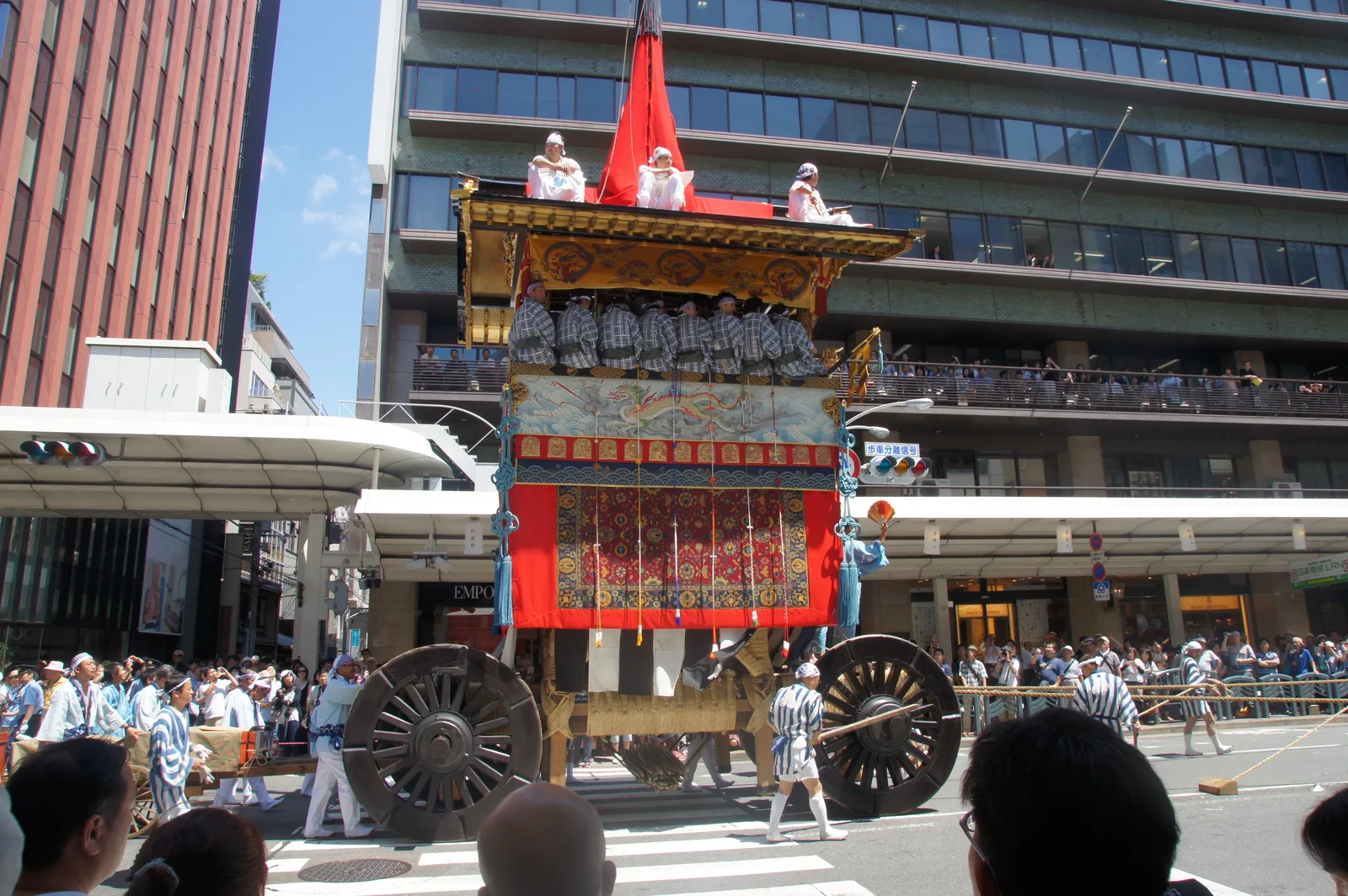
Yasaka Shrine's Gion Matsuri runs for the whole of July, and the shrine describes it as having continued for more than 1,000 years. It is built around two processions of yamaboko: tall, elaborately decorated floats, some of them two stories high and pulled by hand through central Kyoto. The first procession (saki matsuri) takes place on July 17. The second procession (ato matsuri), which had been folded into the first for decades, was revived as a separate event in 2014 and runs on July 24.
In the photo below, taken during a procession, musicians sit in a row partway up the float, playing as it moves, while attendants in white stand on the small platform at the very top. Teams in matching happi coats guide the float's heavy wooden wheels at street level, and office workers watch from the balconies of the buildings lining the route, a reminder that the parade passes straight through Kyoto's modern business district, not a separate festival ground.
In the evenings before each procession, the yoiyama period lets visitors walk among the floats up close while they are lit with lanterns: July 14–16 for the first group of floats, and July 21–23 for the second. This is a working part of the city for the whole month, not a single day, so a July trip to Kyoto can land on a lantern evening, a procession day, or simply a city that has decorated floats standing in its streets for weeks.
Sapporo Snow Festival: a city built out of snow
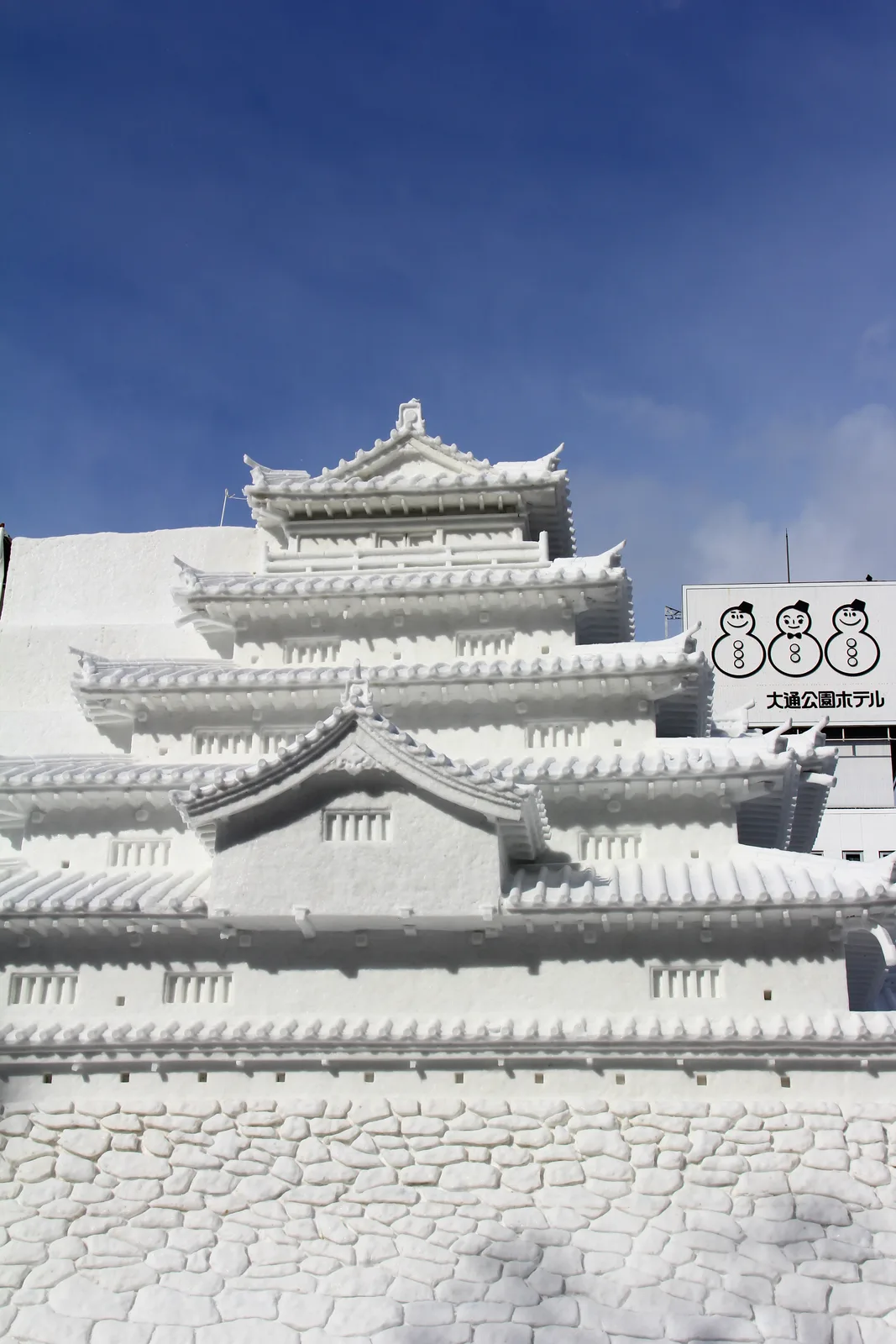
For a little over a week each February, Sapporo's Odori Park fills with snow and ice sculptures, some of them the size of buildings. The 2027 festival runs February 4–11, across three sites: Odori Park in the city center, the Tsudome dome-shaped venue, and the Susukino entertainment district, which has its own ice-sculpture displays.
The photo below, taken at a past festival, shows one of the large snow sculptures at the Odori Park site: a multi-tiered structure carved to resemble a Japanese castle, with tiled eaves and stonework worked entirely out of packed snow, standing against a clear winter sky beside a hotel sign for scale. Sculptures like this are built new each year and cleared away once the festival ends, so no two years look the same even at the same site.
Niseko's late-winter powder, at a lower price
Hokkaido's foreign-visitor traffic is at its yearly high in the depths of winter, but the resort area of Niseko runs its own lift-ticket pricing by season, and the pattern is not simply "cheaper when quieter." A one-day lift ticket in Niseko's Regular season (March 1–22) is priced at 12,600 yen; from March 23 to April 4, in the Spring season, the same one-day ticket drops to 8,800 yen, a difference of 3,800 yen a day, even though the Regular season is itself defined as Niseko's deep-snow period.
That three-week window sits right at the edge of two very different pictures in this article's data: Hokkaido's occupancy is still moderate in March (55.2%), well above its April low (46.3%), while the resort's own pricing has already moved to its cheaper tier by late March. In other words, the lift-ticket calendar and the hotel-occupancy calendar do not switch over on the same day, so a late-March trip can land in the gap between them. Travelers weighing a Hokkaido ski trip against the numbers in this article can find a fuller cost breakdown in a dedicated pass guide (in progress).
Sumida River Fireworks Festival: a summer night over the river
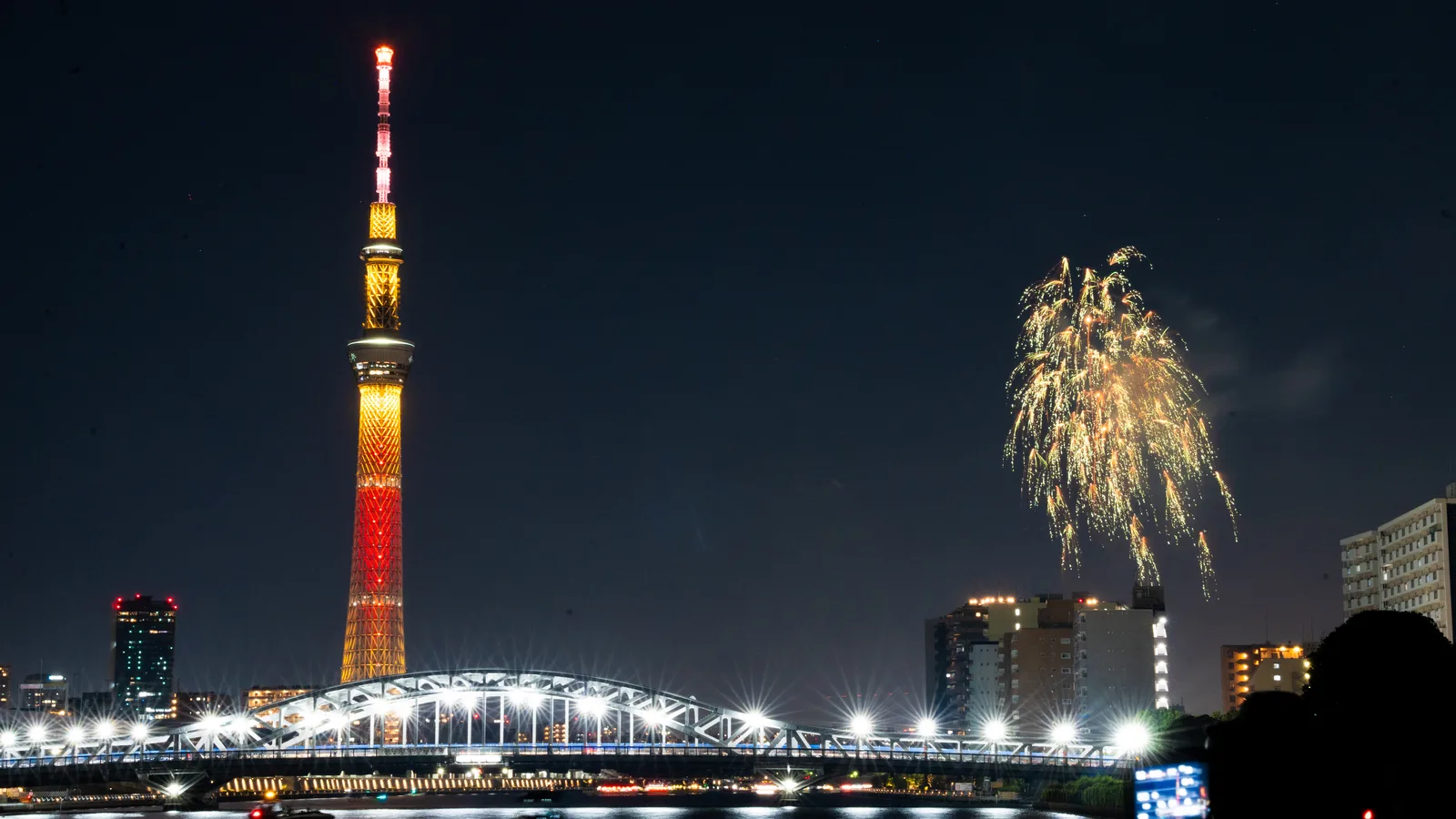
Tokyo's Sumida River Fireworks Festival is held annually in July; in 2026 it took place on July 25, as the 49th running of the event. Tokyo Skytree is visible from much of the riverbank near Asakusa, lit up for the evening and standing behind the bursts, as in the photo at the top of this article. Viewing along the riverbanks is mostly standing room, open to anyone who arrives early enough to find a spot. The festival also sells a limited number of paid, reserved viewing areas (called resident-support seats) directly through its own website in advance of the event.
A season for each region, all in the same country
Put the two tables above side by side and a pattern appears. Okinawa's season is summer into autumn, when its room occupancy is at its highest in October, closely followed by August. Tokyo, Kyoto and Osaka share a spring-and-autumn season built around cherry blossoms, comfortable travel weather and, in Osaka's case, an October occupancy rate of 84.9%, the highest single month recorded anywhere in this article.
Hokkaido tells two different stories depending on which number you read. Its foreign-visitor nights, the count of overnight stays by travelers from abroad, are nearly three times higher in January than in April, in line with the ski season. But its overall room occupancy, which counts every guest, domestic and foreign, is actually at its highest in mid-summer, in July and August, and at its lowest in April. Hokkaido's summer appeal to domestic travelers, likely tied to its cooler climate, is large enough to outweigh its own winter ski season in the occupancy figures.
That mismatch is not a small effect. A trip timed for cherry blossoms in Kyoto, Osaka or Tokyo lands in the exact month Hokkaido's occupancy is at its lowest. A trip aimed at Hokkaido's ski season will find plenty of foreign visitors already there, even in a month when the prefecture's hotels overall are not as full as they will be that same summer. Neither timing is wrong; they are simply aimed at different seasons for different reasons, and the calculator above is built to let you check which one applies to the prefecture you actually plan to visit.
Golden Week, Obon and New Year: also Japan's own travel season
The periods when JR Central makes every Nozomi and Hikari seat reserved, Golden Week, Obon, Silver Week and New Year, are not only busy for visitors from abroad. They are the weeks when Japanese travelers themselves are moving in large numbers, heading home for family visits or taking their own vacations, which is part of why JR Central sells out every reserved seat on its busiest Tokaido and Sanyo Shinkansen services during exactly these windows. A trip planned around one of these weeks is, in that sense, traveling alongside Japan's own domestic travel season rather than only a season set by foreign-visitor demand. The next section looks at how Japanese travel companies frame these same weeks, and where that framing does and does not match the official occupancy numbers.
How Japanese travelers plan around the crowds
Two of Japan's major domestic travel agencies, JR Central Tours (a JR Central group company) and View Travel (JR East's in-house travel arm), publish their own columns on when to travel more cheaply within Japan. These are the agencies' own pages, not independent research, but they reflect how sellers of Japanese domestic travel talk to Japanese travelers.
A few periods come up repeatedly across these columns as relatively inexpensive times to travel within Japan:
- Mid-January to February, once the New Year rush has passed
- Mid-April to just before Golden Week, after the spring-break travel period ends
- Late May to just before the summer holidays (including the rainy season in June)
- Late November to mid-December
Checked against the 2025 occupancy figures in this article, one of these holds up clearly: Kyoto's occupancy is at its lowest in January (52.8%) and February (56.1%), matching the "cheap season" idea.
Tokyo does not match as well. Its lowest month is January (71.1%), not February, and by February occupancy has already climbed to 75.4%, closer to the middle of Tokyo's own range for the year than to a seasonal low, and far above Kyoto's February figure. Why Tokyo's quiet season is shallower and shorter than Kyoto's is unclear: it could reflect a higher share of foreign visitors in Tokyo, a Lunar New Year travel bump, or something else. We report the gap between the general "February is cheap" idea and Tokyo's actual occupancy, without claiming to know the cause.
The broader point connects back to the numbers throughout this article: even a widely repeated "cheap season" is a national rule of thumb, and Japan's own occupancy data shows that whether it holds up depends on which prefecture you are looking at.
2026 update: what changed in the survey, and the latest months
From January 2026, the Japan Tourism Agency changed how it groups lodging facilities in this survey, from a classification based on number of employees to one based on number of rooms. The agency notes this change in its 2026 press releases. Because of it, comparing a 2026 month against the same month in 2025 or earlier may partly reflect the change in survey method, not only a change in travel demand.
The most recent figures available, both preliminary, show a year-on-year drop in foreign-visitor nights:
| Month | Foreign-visitor nights | Year-on-year change | National room occupancy |
|---|---|---|---|
| May 2026 (2nd preliminary) | 14,510,000 | −9.0% | 61.0% |
| June 2026 (1st preliminary) | 12,510,000 | −11.9% | 56.2% |
Source: Japan Tourism Agency, monthly press release for May–June 2026 figures, published July 31, 2026, checked September 22, 2026.
For comparison, foreign-visitor nights for the full 2025 calendar year were up 9.4% on 2024. We do not know how much of the May–June 2026 drop comes from the survey's methodology change and how much reflects an actual change in visitor numbers, so we do not describe this as a decline in demand. We will revisit this table as later 2026 months are published.
Scenarios: four months, four different crowds
These four months show how differently the same official data reads depending on the prefecture. Figures are 2025 calendar-year occupancy rates, checked September 22, 2026.
| Scenario | Month | Highest occupancy | Lowest occupancy | What stands out |
|---|---|---|---|---|
| 1. Hokkaido's foreign-visitor peak | January | Osaka 71.6%, Tokyo 71.1% | Okinawa 52.5%, Kyoto 52.8% | Hokkaido, at 62.1%, sits well above Kyoto and Okinawa, even though January is not Hokkaido's own highest month for occupancy |
| 2. Checking the "cheap month" idea | February | Osaka 76.2% | Kyoto 56.1% (matches the "cheap" idea) | Tokyo is at 75.4%, closer to the middle of its own yearly range than to a seasonal low (does not match the "cheap" idea) |
| 3. Cherry blossoms and Hokkaido's low point | April | Osaka 81.0% | Hokkaido 46.3% (its yearly low) | Tokyo, Kyoto and Osaka are all at or near their yearly highs while Hokkaido sits at its yearly low |
| 4. Autumn's peak, then a late-year swap | October / Nov–Dec | Osaka 84.9% in October (its yearly high) | Hokkaido 63.2% in October | Tokyo, Kyoto and Okinawa also hit their yearly highs in October; by November and December, Tokyo overtakes Osaka |
If you are comparing these prefectures for one of these months, this is what the numbers say. They are not a ranking of "good" or "bad" months to travel overall.
Hokkaido in January: quiet for itself, busy next to its neighbors
January is not Hokkaido's own busiest month for occupancy (that is July), but next to Kyoto and Okinawa it looks different: at 62.1%, Hokkaido sits close to 10 points above both of them in the same month. It is also the single month when Hokkaido's foreign-visitor nights are at their highest of the year, in line with the ski season covered above, even while its overall hotel occupancy is still climbing toward its summer peak.
Where the "cheap month" idea holds, and where it does not
February is one of the months Japanese travel-agency columns describe as relatively inexpensive to travel within Japan. Kyoto backs that up, with its second-lowest occupancy of the year (56.1%, just behind January). Tokyo does not: its lowest month is January (71.1%), and by February it has already climbed to 75.4%, closer to the middle of Tokyo's own yearly range than to a seasonal low. The same month reads two different ways depending on the prefecture.
Cherry blossoms in the south, a quiet month up north
April is one of the busiest months for Tokyo (79.4%), Osaka (81.0%) and Kyoto (73.9%). It is also Hokkaido's quietest month of the year, at 46.3%, roughly 35 points below Osaka in the same month. A trip built around cherry blossoms in central and western Japan and a trip built around Hokkaido are, by this data, pulling toward opposite ends of the spring calendar.
October's peak, and a late-year change of leader
October is Osaka's single highest month of the year (84.9%), and Tokyo (80.6%), Kyoto (76.8%) and Okinawa (66.6%) all hit their own yearly highs at the same time, with Fukuoka close behind. By November and December, the lineup changes: Tokyo's occupancy (79.8% and 78.2%) moves above Osaka's (79.0% and 72.9%). Try setting the calculator above to November or December to see this swap for yourself.
What to book for each season
The numbers above point to a few practical next steps, depending on when and where you are headed.
- Traveling to Tokyo, Osaka or Kyoto in October, or to any of these three in April: rooms are near their highest occupancy of the year, so book lodging and any timed tickets early. If you are also riding the Shinkansen through Golden Week, Obon or Silver Week, a dedicated fare and luggage guide is in progress.
- Heading to Hokkaido for the ski season: foreign-visitor traffic there is at its yearly high in January, even though the prefecture's overall hotel occupancy actually peaks later, in mid-summer. A dedicated rail-pass guide for Hokkaido, and a lift-ticket break-even guide covering Niseko, are both in progress.
- Planning a Kansai side trip in the October–November peak: Nara and Kobe both make sense as day trips from Kyoto or Osaka during the same high-occupancy stretch; dedicated day-trip guides for both are in progress.
- Visiting Tokyo in November for the autumn leaves, when Tokyo's occupancy overtakes Osaka's: a dedicated Nikko day-trip guide is in progress.
- Traveling to Fukuoka around the September Silver Week or October peak: dedicated guides to getting around Fukuoka and comparing Kyushu's rail and bus passes are in progress.
- Booking lodging directly: we do not have a lodging affiliate program in place yet, so this article does not link to hotel booking sites.
- Event tickets: some operators sell tickets or reserved viewing for events like the Gion Matsuri, the Sumida River Fireworks Festival and the Sapporo Snow Festival through third-party marketplaces. This article does not name or link to individual products.
If you are deciding between a Kyoto or Osaka base for any of these trips, Stay in Kyoto or Osaka? compares lodging tax and train fares using the same 2025 statistics as this article. If your trip includes a nationwide rail pass, see Is the JR Pass Worth It?. For the Hakone loop, see Is the Hakone Free Pass Worth It?, and for getting around the Kansai region, see Kansai Area Pass vs Kansai Railway Pass vs ICOCA.
None of this adds up to one right month. It adds up to one right month for the trip you're actually planning — pick your prefecture in the calculator above and let the data tell you whether to book early or take your time.
Common questions
What is the best time to visit Japan to avoid crowds?
There is no single answer. The busiest month is different for each prefecture: Okinawa is busiest around October, Tokyo, Osaka and Kyoto around April and October, and Hokkaido depends on what you count — its foreign-visitor traffic is busiest in winter, but its overall hotel occupancy is busiest in mid-summer. Pick your destination in the calculator above and check its month-by-month occupancy.
Is Japan crowded in October?
In Tokyo, Kyoto, Osaka and Fukuoka, yes — October has some of the highest room occupancy of the year. Osaka's October occupancy (84.9%) is its highest of any month in 2025.
Is Japan crowded during Golden Week?
Golden Week (April 29 – May 6, 2026) falls inside JR Central's Nozomi fully-reserved period (April 24 – May 6, 2026). You'll find April's occupancy among the highest of the year in Tokyo, Osaka, Kyoto and Fukuoka — though it's Hokkaido's lowest month of the year.
How bad are hotel prices during Obon?
This article tracks occupancy, not price. Obon, marked here by JR Central's Nozomi fully-reserved period (August 7–16, 2026), overlaps with one of Okinawa's highest-occupancy months of the year, August (66.4%, just behind October's 66.6%).
What is the cheapest month to visit Japan?
There's no single answer for the whole country. Japanese travel agencies commonly describe mid-January to February and late November to mid-December as relatively inexpensive times to travel within Japan. That holds up for Kyoto, whose two lowest months are January and February. It holds up less clearly for Tokyo: its lowest month is January, but by February it's already climbed back to 75.4%, well above Kyoto's February figure.
Is Hokkaido crowded in winter?
Depends which number you're asking about. Hokkaido's overall hotel occupancy isn't at its highest in winter — that's mid-summer (69.8% in July, 69.5% in August). But foreign-visitor nights there hit their yearly high in January, in line with the ski season, and Hokkaido's occupancy in January (62.1%) and February (68.0%) is still well above Kyoto's and Okinawa's in the same months.
When is Okinawa least crowded?
By room occupancy, December (51.9%) was Okinawa's quietest month in 2025. Its busiest was October (66.6%), with August close behind at 66.4%.
Sources and data date
All figures were checked on September 22, 2026. Survey methods and dates can change; check the source pages before relying on them for your own trip.
- Japan Tourism Agency (MLIT), Overnight Travel Statistics Survey (Japanese); 2025 annual figures (final): press release (Japanese), report PDF (Japanese), data tables (Japanese), published July 6, 2026; May–June 2026 figures (preliminary): press release (Japanese), published July 31, 2026
- Japan Tourism Agency, Consumption Trend Survey for Foreign Visitors to Japan, prefecture reference tables, 2025 (final) (Japanese)
- Japan Tourism Agency, site policy (Japanese; data used here under Japan's Public Data License 1.0, processed by Japan Trip Math)
- JR Central, Nozomi fully-reserved-seat periods: railway.jr-central.co.jp/nozomi/ (Japanese), global.jr-central.co.jp/en/nozomi/
- Cabinet Office, National holidays (Japanese)
- Yasaka Shrine, Gion Matsuri schedule (Japanese)
- Sapporo Snow Festival, official site: snowfes.com
- Sumida River Fireworks Festival, official site: sumidagawa-hanabi.com
- Niseko United, lift-ticket season dates and prices: niseko.ne.jp (Japanese)
- JR Central Tours (Japanese) and View Travel/JR East (Japanese), travel-season columns, referenced in "How Japanese travelers plan around the crowds"