Passes & tickets · Fukuoka · Kumamoto
SUNQ Pass vs JR Kyushu Rail Pass: Which One Wins
Prices checked September 22, 2026 against the official pages. Every figure links to its source.

Published: September 22, 2026
This page contains an affiliate link. If you book through it, we may earn a commission at no extra cost to you. It does not change our numbers. See our disclosure.
Fares checked on September 22, 2026.
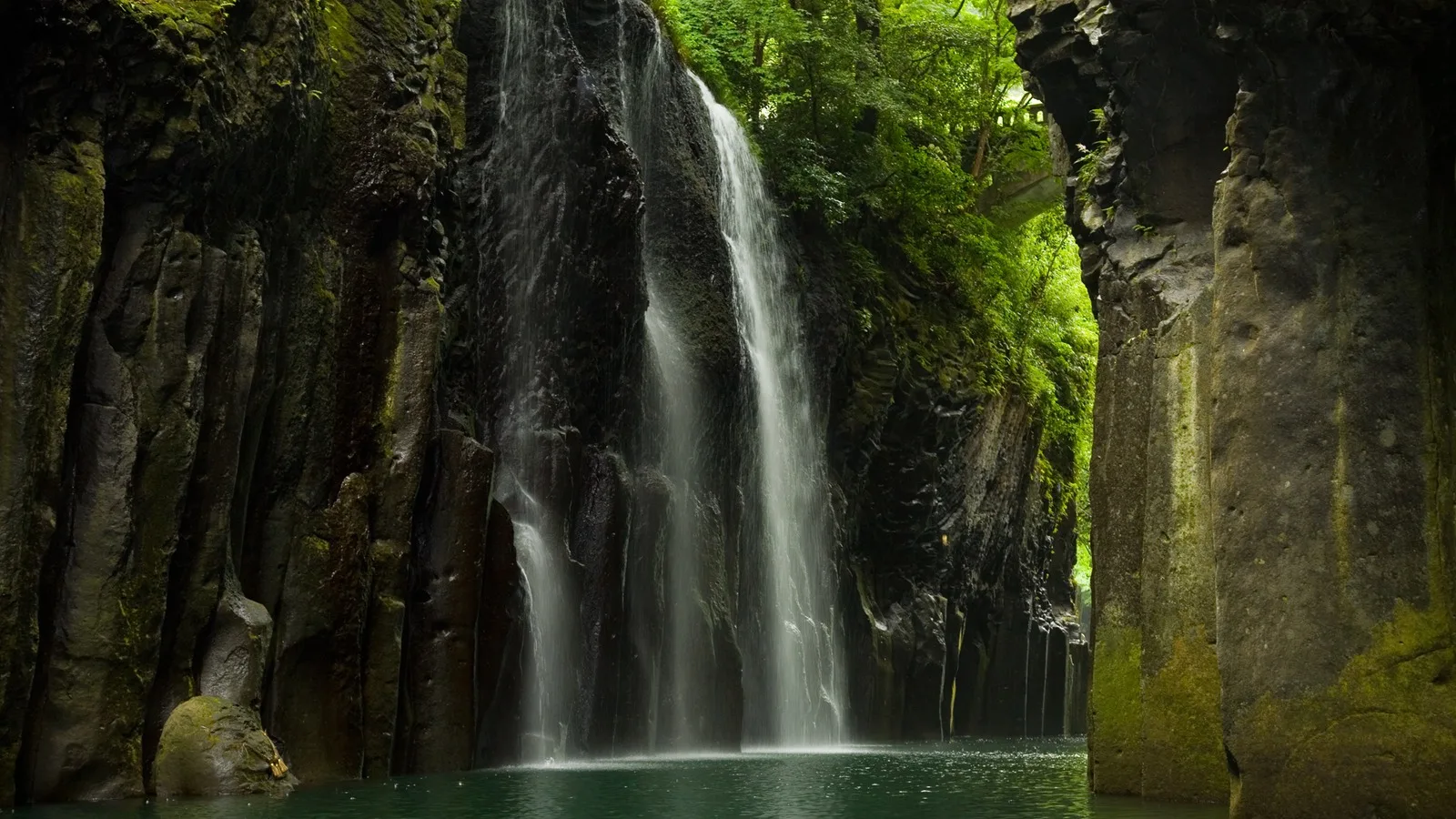
At Takachiho Gorge, you can row a small boat out across still, deep-green water toward Manai Falls, close enough to feel the spray, with walls of columnar basalt rising on both sides. In the evening, Takachiho Shrine stages a kagura dance performance every night at 8 p.m., one hour long, on a covered stage. Further south in Kurokawa Onsen, a single wooden tag bought once lets you soak in three open-air baths of your choice among twenty-five member ryokan.
Getting between places like these is the real question this post answers: is it cheaper to buy a bus pass (SUNQ PASS), a rail pass (JR KYUSHU RAIL PASS), or neither? The short version is that it depends on your route. Bus-only places such as Kurokawa Onsen and the road through Aso favor the SUNQ PASS. Shinkansen-heavy routes such as Hakata to Kagoshima-chuo favor the JR KYUSHU RAIL PASS. A short trip with only one or two rides can cost less with no pass at all.
The short answer
- The SUNQ PASS's own price chart marks every digital ticket as roughly 12% to 15% cheaper than the matching paper ticket, for the four ticket types where a digital price is shown. The fifth type, the Northern Kyushu + Shimonoseki 2-day ticket, has no digital price on the operator's chart; only the 6,000 yen paper price is confirmed.
- The JR KYUSHU RAIL PASS costs about 1,000 yen less per adult (500 yen less per child) when bought through JR KYUSHU RAIL PASS Online Booking than at a station counter or an overseas travel agency. This has applied to tickets sold since April 1, 2025, and as of September 22, 2026 we found no later revision notice on the operator's page.
- Which pass pays off depends on your route. Routes built around buses with no train option, such as Kumamoto to Kurokawa Onsen or Aso, tend to favor the SUNQ PASS. Routes built around the Shinkansen or limited express trains, such as Hakata to Kagoshima-chuo or Nagasaki, tend to favor the JR KYUSHU RAIL PASS. A short trip with only one or two rides can cost less with no pass at all.
All figures: adult, one-way fares, one person, as of September 22, 2026.
Three things to check before you compare
- The SUNQ PASS's official price chart is published as an image, not as text. We read the figures from that image and note the date we checked it; a search engine cannot read prices directly off that page.
- The JR KYUSHU RAIL PASS has two different prices for the same ticket, depending on whether you book online or buy at a station counter or overseas travel agency.
- Both passes are sold in three area versions (roughly northern, southern and all of Kyushu), and the trains or bus routes each version covers are not identical, even at the same number of days. Check the coverage before you buy.
Jump to what to buy and how to buy →
The numbers: digital vs paper, online vs counter prices
Fares and prices in this section are as of September 22, 2026. All prices are in yen, for adults, and can change.
SUNQ Pass: digital tickets vs paper tickets
| Ticket | Validity | Digital ticket | Paper ticket |
|---|---|---|---|
| Northern Kyushu + Shimonoseki, 2-day | 2 consecutive days | Not shown on the operator's price chart (see note below) | 6,000 |
| Northern Kyushu + Shimonoseki, 3-day | Any 3 of 5 days from your first day of use (paper ticket: 3 consecutive days) | 10,000 | 12,000 |
| Southern Kyushu, 3-day | Same as above | 8,500 | 10,000 |
| All Kyushu + Shimonoseki, 3-day | Same as above | 12,000 | 14,000 |
| All Kyushu + Shimonoseki, 4-day | Any 4 of 7 days from your first day of use (paper ticket: 4 consecutive days) | 15,000 | 17,000 |
The SUNQ PASS Steering Committee publishes these prices as a set of price-tile images on its Japanese-language page, not as page text. We downloaded each image and read the figures by eye on September 22, 2026. The operator's chart doesn't list a digital-ticket price for the Northern Kyushu + Shimonoseki 2-day ticket; treat 6,000 yen as the paper-ticket price only. One SUNQ PASS day runs from 3:00 a.m. to 2:59 a.m. the next day.
Source: SUNQ PASS official, About (Japanese, price images); SUNQ PASS official, About (English).
JR Kyushu Rail Pass: online booking vs station counter
| Pass | Days | Online booking (adult / child) | Station counter or overseas agent (adult / child) |
|---|---|---|---|
| Northern Kyushu | 3 | 14,000 / 7,000 | 15,000 / 7,500 |
| Northern Kyushu | 5 | 16,000 / 8,000 | 17,000 / 8,500 |
| Southern Kyushu | 3 | 11,000 / 5,500 | 12,000 / 6,000 |
| All Kyushu | 3 | 21,000 / 10,500 | 22,000 / 11,000 |
| All Kyushu | 5 | 23,000 / 11,500 | 24,000 / 12,000 |
| All Kyushu | 7 | 25,000 / 12,500 | 26,000 / 13,000 |
The gap between the two channels is a flat 1,000 yen for an adult and 500 yen for a child, on every ticket type. JR Kyushu's notice about the online-booking price says the change is "effective: 1st of April, 2025," and as of September 22, 2026 the operator's pass page still shows this as the current notice, with no later revision we could find.
Source: JR KYUSHU RAIL PASS official page; Notice about product revision, Online Booking (PDF, February 3, 2025).
What each pass covers, and what it doesn't
| Item | SUNQ PASS | JR KYUSHU RAIL PASS |
|---|---|---|
| Area versions | Northern Kyushu + Shimonoseki / Southern Kyushu / All Kyushu + Shimonoseki | Northern Kyushu / Southern Kyushu / All Kyushu |
| Shinkansen (bullet train) | Not covered (buses and some ferries only) | All Kyushu covers the Kyushu Shinkansen between Hakata and Kagoshima-chuo, plus the Nishi Kyushu Shinkansen between Takeo-Onsen and Nagasaki. Northern Kyushu covers the Kyushu Shinkansen only as far as Hakata to Kumamoto (plus the Nishi Kyushu Shinkansen), not on to Kagoshima-chuo. Southern Kyushu covers only the Kyushu Shinkansen between Kumamoto and Kagoshima-chuo, with no Nishi Kyushu Shinkansen |
| Hakata to Kokura Shinkansen | Not applicable (buses only) | Not covered on any version. The operator's page says this segment "is a part of the Sanyo Shinkansen operated by JR-WEST" |
| Kurokawa Onsen and Aso (Kyushu Odan Bus route) | Covered on Northern Kyushu + Shimonoseki and All Kyushu + Shimonoseki. Not covered on the Southern Kyushu pass, even though the route runs through Kumamoto Prefecture | No route serves Kurokawa Onsen or Aso by train; the pass only covers trains |
| Free seat reservations | Not applicable | Unlimited on All Kyushu. Up to 6 free reservations each on Northern Kyushu and Southern Kyushu |
| Fukuoka to Nagato/Hagi, Fukuoka to Kagoshima overnight bus | Not covered on any version | Not applicable |
| Who can buy it | Not stated on the pages we checked | Only non-Japanese citizens with a temporary visitor visa. Japanese nationals, including permanent residents, cannot buy it |
Source: SUNQ PASS official, About (English); JR KYUSHU RAIL PASS official page.
Regular fares for the routes in this calculator
| Route | Mode | Fare (one way, adult) |
|---|---|---|
| Hakata to Kumamoto | Kyushu Shinkansen, reserved seat | 5,840 |
| Hakata to Kagoshima-chuo | Kyushu Shinkansen, reserved seat | 11,950 |
| Kumamoto to Kagoshima-chuo | Kyushu Shinkansen, reserved seat | 7,970 |
| Hakata to Nagasaki | Relay Kamome + Nishi Kyushu Shinkansen Kamome, reserved seat | 6,490 |
| Hakata to Beppu/Oita | Sonic limited express, reserved seat | 6,910 |
| Hakata to Yufuin | Yufuin no Mori / Yufu limited express, reserved seat | 5,630 |
| Fukuoka (Hakata/Tenjin) to Kumamoto | Hinokuni-go highway bus | 2,500 |
| Fukuoka (Tenjin) to Beppu | Toyonokuni-go highway bus | 3,250 |
| Kumamoto Station to Beppu Station | Kyushu Odan Bus, via Aso and Kurokawa Onsen | 6,000 |
| Kumamoto Station to Kurokawa Onsen | Kyushu Odan Bus | 4,000 |
These are the fares after JR Kyushu's April 1, 2025 revision and the Kyushu Odan Bus's October 1, 2025 revision. As of September 22, 2026, we found no later fare-revision announcement for either. Hakata to Shin-Tosu (1,530 yen by Shinkansen) is a much shorter hop, so we left it out of the calculator.
Source: JR Kyushu fare revision approval (PDF, November 29, 2024); Nishitetsu, Hinokuni-go; Nishitetsu, Toyonokuni-go; Kyusanko Bus, Kyushu Odan Bus fares (PDF, October 1, 2025 revision).
What makes Kyushu worth the trip
Takachiho Gorge and its kagura dances
Takachiho Gorge, in Miyazaki Prefecture, is a narrow river canyon cut into columnar basalt: hexagonal rock columns that formed as ancient lava cooled slowly and cracked into regular shapes, then were carved out by the river over a very long time. The walls rise on both sides of the water, dark and ridged, with greenery hanging over the top. You can rent a small rowboat at the base of the gorge and paddle out across the calm, deep-green water, straight toward Manai Falls, where a thin curtain of water drops between the columns, close enough that you can feel the spray on your face. The sound changes as you get closer: the flat quiet of the pool gives way to the falls' steady rush, echoing off the rock on both sides. The Takachiho Town Tourism Association's own pages describe the boats and the falls but don't list a rental price or opening hours, so check the operator's page before you plan your visit around them.
In the evening, Takachiho Shrine holds a nightly kagura performance year-round, starting at 8 p.m. and running about an hour, on a covered stage next to the shrine. It shows four of the thirty-three sacred dances that make up the full cycle, a manageable sample if you are only passing through for one night. From mid-November to early February, the full thirty-three-dance cycle is performed overnight in roughly twenty hamlets around the town, as a harvest offering known as yokagura, with each hamlet holding its own night on its own date. That means the town effectively hosts kagura somewhere almost every night across the whole winter season, not just on a single fixed evening, though which hamlet is dancing on which night changes from year to year. As of September 22, 2026, the Takachiho Town Tourism Association's schedule page had not yet published the detailed dates for the 2027 season; check the operator's page closer to your trip.
Kurokawa Onsen's bathing pass, and Beppu's hells
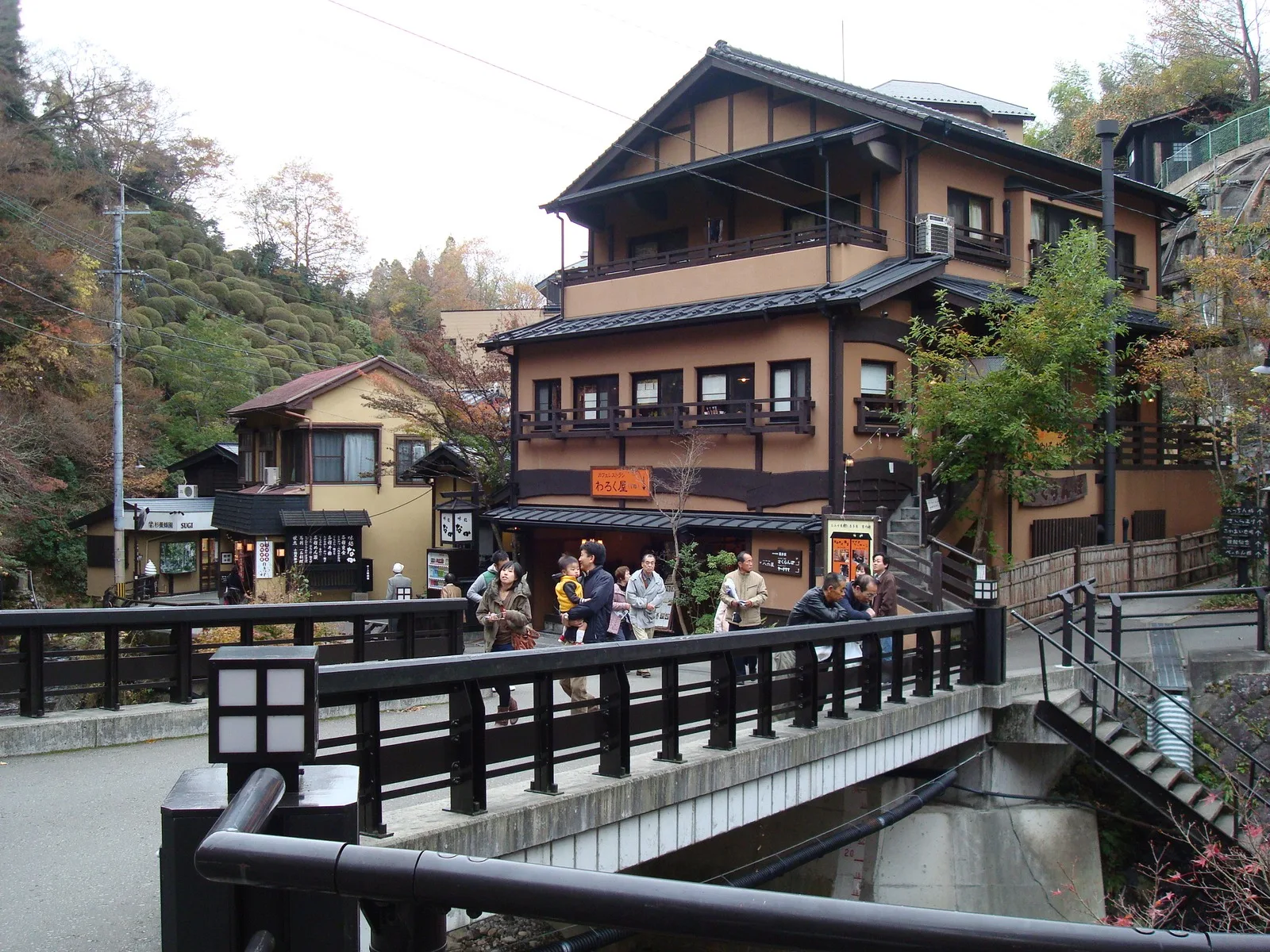
Kurokawa Onsen, a hot spring town tucked into a river valley in Kumamoto Prefecture, sells a wooden tag called a nyuto tegata (bathing pass) for 1,500 yen. It is carved from local Oguni cedar and cypress thinnings, small enough to carry in a pocket or wear on a cord around your neck, and it lets you choose and soak in three open-air baths among the twenty-five member ryokan, at your own pace, rather than being tied to whichever inn you happen to be staying at. One of the three stamps can be swapped for food or a souvenir instead of a bath, if you would rather do that. The tag is valid for six months from the day you buy it, so an unused stamp is not wasted if you run out of time on your first visit. Most visitors walk the town's narrow lanes and footbridges between baths, changing into a yukata between soaks, and keep the tag afterward as a wooden souvenir of the trip. The town itself is bus-only: no train line reaches it, which is one reason the Kyushu Odan Bus, and which version of each pass covers it, matters so much for this itinerary.
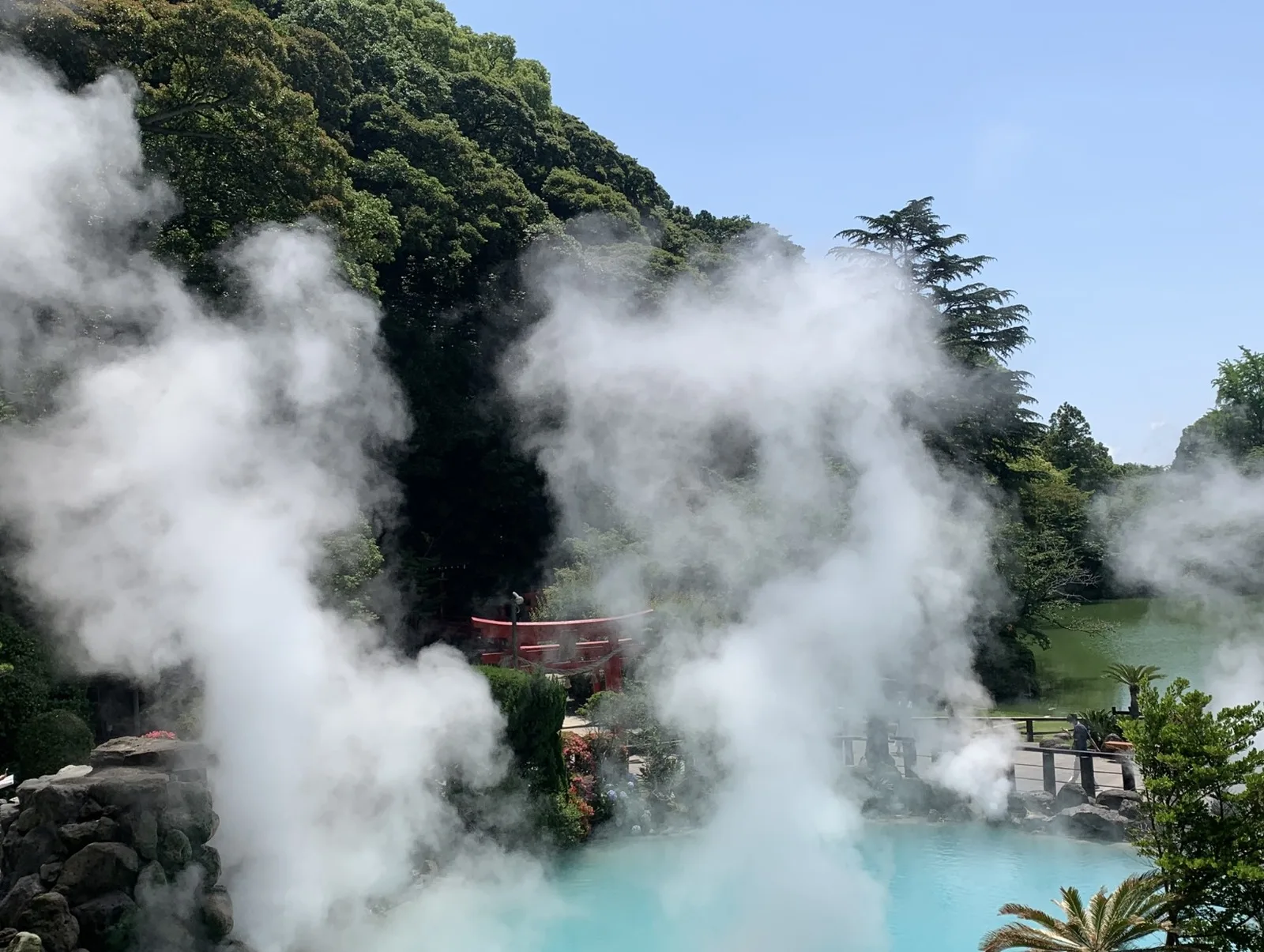
In Beppu, the "hells" (jigoku) are hot spring pools too hot to bathe in, each colored differently by the minerals dissolved in its water; Umi Jigoku's pool, in the photo above, is a striking turquoise blue, with clouds of steam drifting off the surface even on a clear day. The Beppu Jigoku Association sells a common ticket, bought at any of the seven hells, that covers admission to all seven for 2,400 yen, valid for the day of purchase and the following day. A single-site admission price isn't listed on the association's own pages, so ask at the ticket window if you only want to see one or two. Beppu's Kannawa hot spring district also has a facility called Jigoku-mushi Kobo Kannawa, where visitors buy fresh ingredients and steam-cook them themselves over a geothermal vent, a local specialty known as jigoku-mushi, or "hell-steaming."
What the passes add, and what locals rate highly
Beyond the fare itself, the JR KYUSHU RAIL PASS includes free seat reservations on the trains it covers: unlimited on the All Kyushu version, and up to six each on the Northern Kyushu and Southern Kyushu versions. That means you can walk up to a ticket machine or the reservation counter and lock in a reserved seat on a busy Shinkansen run without paying anything extra, as long as you stay under the limit, rather than standing in the aisle or gambling on an unreserved car during a peak travel weekend. The SUNQ PASS, on the other hand, is the only one of the two passes that reaches Kurokawa Onsen and Takachiho at all, since neither place has a train station; if those two places are on your list, the bus pass is doing something the rail pass structurally cannot.
Japanese-language review sites, which general English-language travel guides do not draw on, give a sense of how these particular places rank with domestic visitors who actually use these sites to plan their own trips. As of September 22, 2026: Takachiho Gorge carries a 4.4 rating from 1,646 reviews on Jalan, a major Japanese travel booking and review site; the steam-cooking facility Jigoku-mushi Kobo Kannawa, mentioned above, carries a 3.49 rating from 608 reviews on Tabelog, Japan's dominant restaurant review site; and Shiratamakko, a sweets shop in Kurokawa Onsen, carries a 3.24 rating from 69 reviews on Tabelog, ranking first among the cafes and coffee shops listed for the Kurokawa Onsen area on that site. None of these figures are English-language crowd ratings; they reflect how Japanese users of these specific platforms have rated the places, as of the date we checked.
Calculator: SUNQ Pass vs JR Kyushu Rail Pass for your route
Enter your own route below. Three notes before you use it:
- Count one-way legs for each route (enter 2 for a round trip). Train legs and bus legs are counted separately.
- Bus legs are covered by the SUNQ PASS and not by the JR KYUSHU RAIL PASS; train legs are covered by the JR KYUSHU RAIL PASS and not by the SUNQ PASS. The calculator adds the regular fare only on the side that does not cover that leg, so both pass columns are compared on the same set of trips.
- This calculator only adds up fares and pass prices. It does not check whether the specific pass area you pick (Northern, Southern or All Kyushu) actually covers every leg you entered; use the coverage table above for that. It also does not know your travel dates, so if your trip extends beyond Kyushu, see Is the Japan Rail Pass Worth It? for the nationwide pass.
What the calculator leaves out:
- The short Hakata to Shin-Tosu leg (1,530 yen).
- Child fares. Both passes have child prices; this calculator is adult only.
- The seat-reservation limit on the Northern and Southern Kyushu JR KYUSHU RAIL PASS (6 free reservations each; extra reservations cost a separate limited-express ticket).
- Sellers' prices. All figures are the operators' own list prices.
- Refund fees, and the JR KYUSHU RAIL PASS Option Ticket for reserving seats on sightseeing trains.
- Whether your chosen pass area actually covers every leg you entered. Check the coverage table above.
Scenarios: four ways to use a Kyushu pass
Each scenario below is an example we chose, not a recommendation. The method is explained on how the numbers are worked out. Adult, one-way legs as entered, totals for one person, as of September 22, 2026. Fares are the operators' list prices.
| Scenario | Pay each fare, no pass | SUNQ PASS | JR KYUSHU RAIL PASS |
|---|---|---|---|
| S1: Hakata to Kumamoto (train), Kumamoto to Beppu (Kyushu Odan Bus), Beppu to Hakata (train) | 18,750 | 24,750 | 27,000 |
| S2: Fukuoka to Kumamoto (bus), Kumamoto to Beppu (Kyushu Odan Bus), Kumamoto to Kurokawa Onsen (Kyushu Odan Bus) | 12,500 | 10,000 | 26,500 |
| S3: Hakata to Kagoshima-chuo, Kumamoto to Kagoshima-chuo, Hakata to Nagasaki (all by train) | 26,410 | 38,410 | 23,000 |
| S4: Fukuoka to Kumamoto by bus, one way only | 2,500 | 6,000 | 16,500 |
A short Fukuoka–Kumamoto–Beppu loop
If your route looks like S1, one train leg, one bus leg and another train leg, paying each fare comes to 18,750 yen. Both passes cost more: the SUNQ PASS's 12,000 yen All Kyushu + Shimonoseki 3-day ticket plus the two train fares reaches 24,750 yen, and the JR KYUSHU RAIL PASS's 21,000 yen All Kyushu 3-day online price plus the one bus fare reaches 27,000 yen. A loop this short and this mixed does not earn back either pass price.
A bus-heavy route through Aso and Kurokawa Onsen
S2 drops the train legs entirely: Fukuoka to Kumamoto, then Kumamoto to Beppu and Kumamoto to Kurokawa Onsen, both on the Kyushu Odan Bus. Paying each fare comes to 12,500 yen, against 10,000 yen for the Northern Kyushu + Shimonoseki 3-day digital SUNQ PASS: a saving of 2,500 yen. This route runs through Aso and Kurokawa Onsen, so it needs the Northern Kyushu + Shimonoseki or All Kyushu + Shimonoseki version of the SUNQ PASS; the Southern Kyushu version does not cover the Kyushu Odan Bus at all, even though Kumamoto itself is within its area.
A train-heavy route to Kagoshima and Nagasaki
S3 uses three Shinkansen and limited-express legs and no bus at all: Hakata to Kagoshima-chuo, Kumamoto to Kagoshima-chuo, and Hakata to Nagasaki, totaling 26,410 yen at regular fares. The All Kyushu 5-day online JR KYUSHU RAIL PASS, at 23,000 yen, comes in 3,410 yen cheaper. Note that Hakata to Nagasaki uses the Nishi Kyushu Shinkansen at the Nagasaki end, which is covered on the All Kyushu and Northern Kyushu versions, not on Southern Kyushu.
One bus ride only: when neither pass pays off
S4 is a single one-way bus ride, Fukuoka to Kumamoto, for 2,500 yen. The cheapest SUNQ PASS (the Northern Kyushu + Shimonoseki 2-day paper ticket, 6,000 yen) and the cheapest JR KYUSHU RAIL PASS (the Southern Kyushu 3-day online ticket, 11,000 yen, which does not even cover this bus) both cost far more. If your Kyushu trip really is one bus ride, buy the ticket and skip the pass.
If your itinerary continues north from Kyushu on the Sanyo Shinkansen, see Hiroshima day trip from Osaka for how that stretch of the line is priced.
How locals plan a Kyushu trip
Two habits show up directly in how the two operators built their own passes, so we can point to them without guessing at anyone's private preferences.
Both operators split their passes into a northern area, a southern area and an all-Kyushu version. JR Kyushu's own pass page defines Northern Kyushu as covering "Fukuoka, Oita, Kumamoto, Nagasaki, Saga" and Southern Kyushu as covering "Oita, Kumamoto, Miyazaki, Kagoshima." The SUNQ PASS mirrors this with its own three versions, Northern Kyushu + Shimonoseki, Southern Kyushu and All Kyushu + Shimonoseki. Picking the version that matches your itinerary, rather than defaulting to the all-Kyushu version, is a choice built into both operators' own naming, not a trick.
Where the train network has a gap, the bus fills it, and the coverage tables show exactly where that gap is. The Kyushu Odan Bus route through Aso and Kurokawa Onsen is on the SUNQ PASS's Northern Kyushu + Shimonoseki and All Kyushu + Shimonoseki route lists. The JR KYUSHU RAIL PASS's own list of applicable trains never includes a bus at all, and no train line reaches Kurokawa Onsen. Comparing the two operators' own coverage lists side by side, rather than assuming one pass "does everything," is what settles the Kurokawa Onsen and Aso question.
When to go: Kyushu's festivals and seasonal highlights
| When | Event | Notes | Source | Checked |
|---|---|---|---|---|
| Late February to March | Controlled burning (noyaki) of the grasslands at Aso's Kusasenri, timing depends on weather | No special fee. Date can be postponed | Aso City official notice | Sep 22, 2026 |
| Early April | Beppu Hatto Onsen Matsuri, centered on April 1 ("hot spring thanks day") and the first weekend of April | No special fee. 2026 was the 112th edition | Oita Prefecture official tourism site; 112th festival official site | Sep 22, 2026 |
| Every night, 8:00 p.m. | Takachiho Shrine's kagura dance performance, four of the thirty-three sacred dances, in the shrine's kagura hall | Year-round | Takachiho Town Tourism Association | Sep 22, 2026 |
| Mid-November to early February | Yokagura, the full night-long kagura cycle, in about 20 hamlets around Takachiho | Dates vary by hamlet. The 2027 schedule was not yet published as of the date checked | Takachiho Town Tourism Association, yokagura schedule | Sep 22, 2026 |
What to buy instead, and how to buy
Whether either pass is worth buying depends on the route, as the scenarios above show. Here is where each one is actually sold.
Buying the SUNQ Pass
Digital tickets are bought and activated on a smartphone, through the LINKTIVITY platform that the operator uses. Paper tickets are sold at designated travel agencies and at bus operator offices across Kyushu's seven prefectures and Shimonoseki. The pass is also listed on travel platforms such as KKday and Klook.
Book hereAffiliate link
Buying the JR Kyushu Rail Pass
You can buy it at a JR Kyushu station counter, through an overseas travel agency, or online through JR KYUSHU RAIL PASS Online Booking, which the operator's own notice prices about 1,000 yen lower per adult ticket than the counter price, effective for tickets sold from April 1, 2025. It is also listed on travel platforms such as KKday and Klook.
Kurokawa Onsen, Takachiho and Beppu tickets and tours
KKday and Klook both list day tours and admission tickets covering Kurokawa Onsen, Takachiho and Beppu's hells.
Buy the pass your route actually earns back, and let the rest of the budget go toward the boat ride at Manai Falls or a second soak in Kurokawa Onsen — that's where the trip actually happens.
Common questions
SUNQ Pass or JR Kyushu Rail Pass: which is cheaper?
It depends on your route, not on the pass itself. A route built around Shinkansen and limited express trains tends to favor the JR KYUSHU RAIL PASS (S3 above). A route built around buses into places with no train, such as Kurokawa Onsen or Aso, tends to favor the SUNQ PASS (S2). Use the calculator with your own legs.
Is the SUNQ Pass worth it?
It depends on how bus-heavy your route is. In our Aso and Kurokawa Onsen example (S2), it saves 2,500 yen over paying each fare. In a short mixed route (S1) or a single bus ride (S4), paying each fare costs less.
Is the JR Kyushu Rail Pass worth it?
It depends on how much Shinkansen and limited express riding you do. In our Kagoshima and Nagasaki example (S3), it saves 3,410 yen over paying each fare. It can only be bought by non-Japanese citizens with a temporary visitor visa; Japanese nationals, including permanent residents, cannot buy it.
What is the SUNQ Pass digital ticket price?
10,000 yen for the Northern Kyushu + Shimonoseki 3-day ticket, 8,500 yen for the Southern Kyushu 3-day ticket, 12,000 yen for the All Kyushu + Shimonoseki 3-day ticket, and 15,000 yen for the All Kyushu + Shimonoseki 4-day ticket. The operator's chart doesn't list a digital price for the Northern Kyushu + Shimonoseki 2-day ticket.
What is the JR Kyushu Rail Pass online booking price?
Online booking runs 11,000 to 25,000 yen for an adult, depending on area and days, and is about 1,000 yen cheaper than the station-counter or overseas-agent price on every ticket type (500 yen cheaper for a child). See the table above for every combination.
How do I get to Kurokawa Onsen without a car?
The Kyushu Odan Bus runs from Kumamoto Station to Kurokawa Onsen for 4,000 yen one way. It is covered by the Northern Kyushu + Shimonoseki and All Kyushu + Shimonoseki SUNQ PASS, but not by the Southern Kyushu SUNQ PASS, and no JR KYUSHU RAIL PASS covers it, because it is a bus route.
Can I use these passes on the Shinkansen between Hakata and Kokura?
No, on either pass. The JR KYUSHU RAIL PASS's own page says: "JR Kyushu Rail Passes do not apply to Shinkansen (bullet train) rides between Hakata and Kokura since this portion is a part of the Sanyo Shinkansen operated by JR-WEST." The SUNQ PASS does not cover any Shinkansen at all; it is a bus-and-ferry pass.
What's included in the JR Kyushu Rail Pass?
Local trains, limited express trains, and the Shinkansen routes within your chosen area, plus free seat reservations: unlimited on All Kyushu, up to 6 each on Northern Kyushu and Southern Kyushu. It does not cover JR Kyushu Bus, B&S Miyazaki Bus, or the sightseeing trains "Seven Stars in Kyushu," "Aru Ressha" or "Kawasemi Yamasemi."
Which pass should I get for Fukuoka, Kumamoto and Beppu?
There is no single answer; it depends on how you connect those three places. Our short loop example (S1) shows that neither pass beats paying each fare on that particular route. Enter your own legs into the calculator above. If your trip also reaches the Kansai region, see Kansai Area Pass vs Kansai Railway Pass vs ICOCA for a similar area-pass comparison there.
Can I buy the SUNQ Pass or JR Kyushu Rail Pass in Japan?
Yes. SUNQ PASS paper tickets are sold at designated travel agencies and bus operator offices inside Japan; digital tickets are bought on a smartphone from anywhere. The JR KYUSHU RAIL PASS is sold at JR Kyushu station counters inside Japan, through overseas travel agencies, or online through JR KYUSHU RAIL PASS Online Booking.
Can I get a refund?
For a SUNQ PASS digital ticket, you can cancel for a 110 yen fee per ticket if it is completely unused and within three months of purchase. For the JR KYUSHU RAIL PASS, a refund is possible before your validity period starts (a 10% fee applies), but not once your pass's start date has begun, for any reason.
Sources and data date
All fares were checked on September 22, 2026. SUNQ PASS prices were read from an image on the operator's page. Prices and coverage can change; check the operator's page before you travel.
- SUNQ PASS Steering Committee: About (English), About (Japanese, price images), Available Areas
- JR Kyushu Railway Company: JR KYUSHU RAIL PASS, Notice about product revision, Online Booking (PDF, February 3, 2025), Notice about product revision (PDF, February 3, 2025), Fare revision approval notice (PDF, November 29, 2024)
- Nishitetsu: Hinokuni-go, Toyonokuni-go
- Kyusanko Bus: Kyushu Odan Bus fares (PDF, October 1, 2025 revision)
- Beppu Jigoku Association: common ticket and prices
- Kurokawa Onsen Ryokan Cooperative: nyuto tegata (bathing pass)
- Takachiho Town Tourism Association: kagura, yokagura schedule
- Aso City: noyaki controlled-burn notice
- Oita Prefecture official tourism site / 112th Beppu Hatto Onsen Matsuri committee: visit-oita.jp, beppu-event.jp
- Japanese-language review sites (evaluation scores and review counts only, checked September 22, 2026): Jalan, Takachiho Gorge, Tabelog, Jigoku-mushi Kobo Kannawa, Tabelog, Kurokawa Onsen cafe ranking
Last checked: September 22, 2026.