Day Trip to Nara From Kyoto or Osaka: JR vs Kintetsu
Prices checked September 22, 2026 against the official pages. Every figure links to its source.

Published: September 22, 2026
This page contains an affiliate link. If you book through it, we may earn a commission at no extra cost to you. It does not change our numbers. See our disclosure.
Fares checked on September 22, 2026.
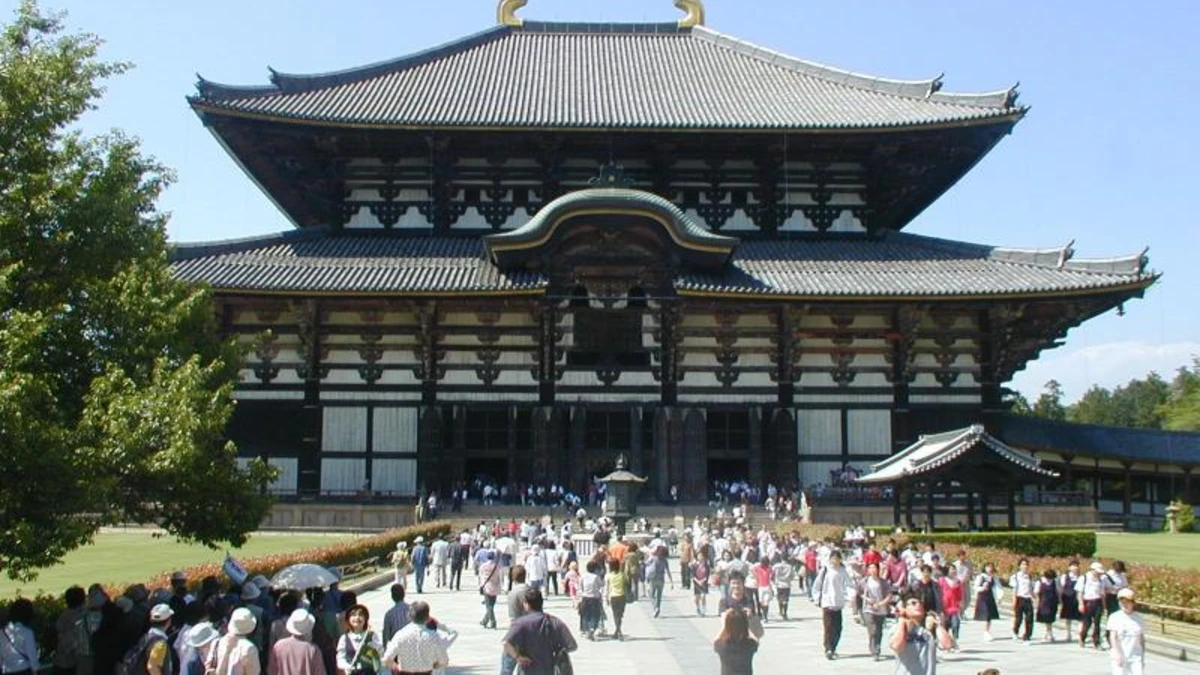
At Todaiji, one of the world's largest wooden buildings holds a bronze Buddha, and 1,687 deer roam freely through the park outside, per a July 2026 count by Nara Deer Preservation Foundation. A short walk away, Kasuga Taisha's covered walkways carry rows of stone lanterns, and for 700 yen you can pass through the inner gate on a special visit. This is a day-trip city: the Japan Tourism Agency records an average of just 0.4 overnight stays per foreign visitor to Nara Prefecture, against 3.5 in Osaka and 2.3 in Kyoto.
Here's how to get there for less, and what's waiting once you do.
The short answer
- From Osaka, Kintetsu (680 yen) is cheaper than JR (840 yen), and Kintetsu Nara Station is about a 20-minute walk from Todaiji (official). Kofukuji sits right by the station's east exit. JR Nara Station has no official walking time to Todaiji; unofficial Japanese sources put it at about 30 minutes.
- From Kyoto, JR's direct rapid service (720 yen) and Kintetsu (760 yen) are close in price, so station distance and whether you pay for the Kintetsu Limited Express (plus 520 yen) decide it.
- If you visit several temples and use the city loop bus (250 yen per ride, raised from 220 yen on February 1, 2024), the Nara World Heritage Pass (1,800 yen from Osaka or Kyoto) can cost less than paying for each leg separately. Check your own plan with the calculator below.
Jump to how to buy tickets, passes and tours →
All fares: adult, one person, one way unless noted, as of September 22, 2026.
The numbers: JR and Kintetsu fares from Kyoto and Osaka to Nara
Fares and times in this section are as of September 22, 2026 and can change. JR West and Kintetsu are the two railways that reach Nara from Kyoto and Osaka, and this section compares them stop by stop, from the ticket gate to the temple gate. If you're arriving straight from the airport rather than from central Kyoto or Osaka, see Kansai Airport to Kyoto, Namba and Umeda first.
Fares and travel time by route
| From | Way | Fare | Limited Express charge | Total | Time |
|---|---|---|---|---|---|
| Osaka Station | JR Yamatoji Rapid | 840 | — | 840 | About 50 minutes |
| Kyoto Station | JR Miyakoji Rapid | 720 | — | 720 | About 45 to 47 minutes |
| Osaka Namba | Kintetsu, regular fare | 680 | — | 680 | About 35 to 40 minutes |
| Osaka Namba | Kintetsu, Limited Express | 680 | 520 | 1,200 | About 30 minutes |
| Kyoto Station | Kintetsu, regular fare | 760 | — | 760 | — |
| Kyoto Station | Kintetsu, Limited Express | 760 | 520 | 1,280 | — |
Sources: JR West's My Dia fare search and JR-Odekake Net's timetable; Kintetsu's official fare tables for Osaka Namba to Nara and Kyoto to Nara.
The Yamatoji Rapid and Miyakoji Rapid both run through, with no change of train, for most of the day. That direct service is one advantage JR shares on both the Osaka and Kyoto routes.
Kintetsu also runs the sightseeing limited express Aoniyoshi (Osaka Namba, Kyoto and Kintetsu Nara). It charges the regular fare plus a Limited Express charge plus a set special-car fare, and the current total isn't one we could pin down, so it's left out of this table and the calculator below. Check Kintetsu's official Aoniyoshi page before you travel.
Walking time from the station changes the total
The fare is only half the trip. What matters next is how far the station leaves you from Todaiji, Kofukuji and Kasuga Taisha, and here the two railways are not equal.
Todaiji's official access page gives the walk from Kintetsu Nara Station as "walk east on Noborioji-cho for about 20 minutes." Kofukuji sits right by the station's east exit, an easy walk of only a few minutes, though no official page puts a number of minutes on it.
JR Nara Station is a different story. Todaiji's official access page does not give a walking time from JR Nara Station at all. Instead, it tells JR travelers to take the city loop bus to the "Todaiji Daibutsuden / Kasuga Taisha-mae" stop and walk 5 minutes from there. Unofficial Japanese travel sites put a direct walk from JR Nara Station at around 30 minutes, but Todaiji itself does not publish that figure.
| From | To | Walking time | Source |
|---|---|---|---|
| Kintetsu Nara Station | Todaiji (Daibutsuden) | About 20 minutes, official | Todaiji official access page |
| Kintetsu Nara Station | Kofukuji | A few minutes, right by the station | Not officially timed |
| JR Nara Station | Todaiji | Not stated officially; about 30 minutes per unofficial Japanese sites | Todaiji's own guidance is to ride the city loop bus |
Add the walk to the fare and the gap widens: from Osaka, Kintetsu is cheaper and lands you closer to the temples.
The city loop bus fare was raised to ¥250
If you start from JR Nara Station, or simply want to save your legs between temples, Nara Kotsu's city loop bus is the usual choice. From February 1, 2024, the flat fare in the central loop (around JR Nara, Kintetsu Nara and Takanohara stations) is 250 yen, up from 220 yen, following a fare-cap change authorized by the Kinki District Transport Bureau. Some older travel write-ups still show the previous 220 yen fare, so double-check any bus price you read before your trip. Source: Nara Kotsu (Kintetsu Group Holdings), fare revision notice (2023-12-19, Japanese, PDF).
A day pass is also available: the Nara Park & Nishinokyo World Heritage 1-Day Pass costs 600 yen for an adult (300 yen for a child) and covers unlimited rides on the loop buses around Nara Park, Todaiji, Kasuga Taisha, Kofukuji, the Heijo Palace Site, Toshodaiji and Yakushiji. Source: Nara Kotsu, 1-Day Pass.
Temple and shrine admission, itemized
Each temple and shrine in Nara Park sells its own tickets, and the totals add up faster than a single "Todaiji entry fee" suggests. Here is every item we could confirm directly from the operators' own pages.
| Place | What you're paying for | Fee (adult) |
|---|---|---|
| Todaiji | Daibutsuden, or Hokke-do, or Kaidan-do, or the museum (each, individually) | 800 |
| Todaiji | Daibutsuden + Museum, combined ticket | 1,200 |
| Kasuga Taisha | Main Sanctuary special sanctuary visit | 700 |
| Kasuga Taisha | National Treasure Hall (Kokuhokan) | 700 |
| Kofukuji | National Treasure Museum (Kokuhokan) | 900 |
| Kofukuji | Chukondo (Central Golden Hall) | 500 |
| Kofukuji | Tokondo (Eastern Golden Hall) | 500 |
| Kofukuji | 3-building combined ticket (museum + both halls) | 1,600 |
Two of these prices changed recently. Kasuga Taisha raised its special sanctuary fee from 500 yen to 700 yen on October 1, 2024, so any older post that quotes 500 yen is out of date. Source: Kasuga Taisha, official notice (Japanese). Kofukuji's four fees above are confirmed directly from its own admission page, checked on September 22, 2026; all four halls are open 9:00 to 17:00 (last admission 16:45), year-round, cash only. Source: Kofukuji, official admission page (Japanese).
The Nara World Heritage Pass: a Japan-only day-trip ticket
Kintetsu sells a ticket most visitors from abroad never see, because it barely surfaces in English-language search results: the Nara World Heritage Pass. The Nara-Ikaruga course, valid for one day, costs 1,800 yen for an adult (900 yen for a child) from Osaka or Kyoto. It bundles a round-trip Kintetsu ticket to the Nara-Ikaruga free-travel zone with unlimited rides on Kintetsu trains and Nara Kotsu buses inside that zone.
| Course | Price (adult / child) | What it covers |
|---|---|---|
| Nara-Ikaruga (1 day, from Osaka or Kyoto) | 1,800 / 900 | Round-trip Kintetsu ticket to the free zone, plus unlimited Kintetsu trains and Nara Kotsu buses in the Nara-Ikaruga area |
| Nara-Ikaruga-Yoshino (3 days, from Osaka or Kyoto) | 3,530 / 1,770 | Same, extended to Yoshino, valid 3 days |
Source: Kintetsu, Nara World Heritage Pass, Nara-Ikaruga course and Nara-Ikaruga-Yoshino course.
It's worth knowing this ticket exists precisely because so few people find it: across four separate English-language searches on JR-versus-Kintetsu and Nara pass topics, it never once turned up. Kintetsu's pages for it are Japanese only, with no sign of an English version or sales channel, so treat it as a ticket you buy on the Japanese page or at a Kintetsu station counter. The 3-day Yoshino course is worth knowing about if you plan to add Yoshino, but it isn't built into the calculator below.
Calculator: what a Nara day trip actually costs
Pick your starting city, your train options, how you'll use the bus, and which temples you'll enter. The calculator adds the same admission fees to all three columns, so it shows how the travel choices alone shift your total.
- Choose your starting point, Osaka or Kyoto.
- Decide whether to pay for the Kintetsu Limited Express (JR's rapid trains have no such option here).
- Choose how you'll use the city loop bus: walking only, paying per ride, or the 1-Day Pass.
- Pick the temples and shrine visit you'll pay for, and how many packs of deer crackers you expect to buy.
What the calculator leaves out: the sightseeing limited express Aoniyoshi (check Kintetsu's official page for its current fare); child fares; discounts for Kofukuji and Kasuga Taisha; the JR fare from Tennoji (510 yen, not offered as a start point); and the Nara Park & Nishinokyo 1-Day Pass Wide version, whose price isn't listed directly on Nara Kotsu's own page.
What makes Nara Park worth the day trip
The numbers above decide how you get there and what you pay at the gate. This section is about what waits on the other side: a park open around the clock where deer roam freely, a hall built to hold one of the largest bronze Buddha statues in the country, and a shrine walkway lined with stone lanterns.
Open 24 hours, with deer that roam freely
Nara Park opened on February 14, 1880. Nara Prefecture, which manages the park, says it is open 24 hours a day, 365 days a year, with no admission fee. The area most people think of as Nara Park spans about 660 hectares, taking in Todaiji, Kofukuji, Kasuga Taisha and the Nara National Museum alongside its lawns and woodland. Source: Nara Prefecture, official page on Nara Park (Japanese).
Nara City Tourism Association describes the park's greenery as including pine trees more than 1,000 years old, and its deer as wild animals that "roam freely within the park." Source: Nara City Tourism Association, Nara Park and deer feature page. One part of the park is not open-access for deer: Rokuen, a facility run by Nara Deer Preservation Foundation, protects about 300 sick, injured or pregnant deer, and keeps mother deer and fawns there until around mid-July each year.
That free-roaming habit is what makes the deer easy to meet. Nara Deer Preservation Foundation's July 2026 survey, checked September 22, 2026, counted 1,687 deer living in the park: 411 males, 990 females and 286 fawns. The foundation calls the deer messengers of the god enshrined at Kasuga Taisha, protected here for more than 1,300 years, and Nara's deer are recognized as a National Natural Monument for their distinct genetic line. Source: Nara Deer Preservation Foundation, 2026 survey (Japanese).
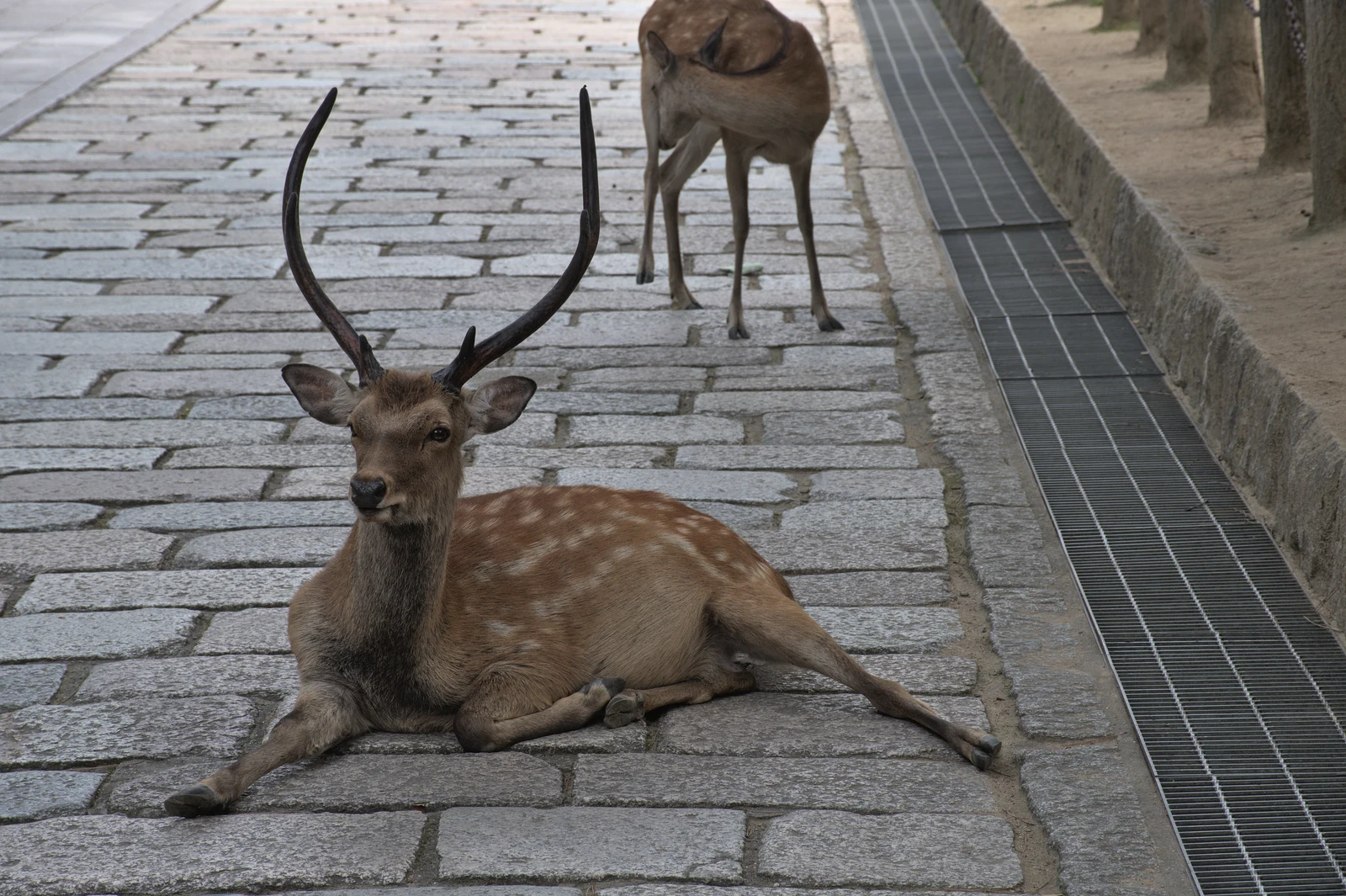
You can feed them. Nara City Tourism Association sells shika senbei (deer crackers, made from wheat flour and rice bran) in packs of 10 for 200 yen at staffed stalls around the park, and the association publishes official feeding manners: offer one cracker at a time, hold both hands open and empty once you're out to show the deer there is no more, and watch small children closely. Do not feed snacks, bread, vegetables or leftovers; they are bad for the deer's health. The association also gives a clear safety warning: the deer are wild animals, and especially in autumn, males can become aggressive, and bites do happen. Deer will also try to eat plastic bags, maps and pamphlets, so keep paper items out of reach. Source: Nara City Tourism Association, deer feature page.
There is a price gap worth knowing before you buy. The 200-yen staffed-stall price is the association's own figure. Separately, unstaffed vending machines near the deer enclosure and outside Kasuga Taisha's National Treasure Hall, installed on October 26, 2022, sell the same 10-cracker pack for 500 yen, according to a 2022 report by Nara Shimbun, a regional newspaper. Treat the vending-machine price as reported by Nara Shimbun, not an official Nara Deer Preservation Foundation figure. The gap is not necessarily a rip-off: the vending machines work outside stall hours, and the newspaper reports that part of the proceeds from both sales channels supports deer conservation work.
Because the deer roam freely across the park rather than staying at one site, you are likely to meet them on the paths around Todaiji, on the approach to Kasuga Taisha and around Kofukuji's pagoda, not just in one part of the park.
One of the world's largest wooden buildings, and the Buddha inside it
Todaiji's Daibutsuden (Great Buddha Hall) is described by UNESCO as one of the component sites of the World Heritage listing "Historic Monuments of Ancient Nara," registered in 1998 under criteria (ii), (iii), (iv) and (vi). UNESCO's summary says the monuments "provide a vivid and comprehensive picture of religion and life in the Japanese capital in the 8th century." From April to October the hall opens at 7:30, and from November to March it opens at 8:00, both closing at 17:30 and 17:00 respectively; the attached museum keeps slightly different hours (see the table in the "When to go" section below). Source: UNESCO World Heritage Centre, Historic Monuments of Ancient Nara; Todaiji, official admission page.
Two practical notes from Todaiji's own page: an audio guide can be rented for 500 yen per person, and photography by drone is not allowed anywhere on the grounds. Smoking is also prohibited within the precinct.
The "eight UNESCO World Heritage Sites" phrase you'll see in some travel write-ups is a slight overstatement. UNESCO's record is a single 1998 listing, "Historic Monuments of Ancient Nara," made up of eight component assets: the Heijo Palace Site, Todaiji, Kofukuji, Yakushiji, Gangoji, Toshodaiji, Kasuga Taisha and the Kasugayama Primeval Forest. It is one registration, not eight separate ones.
A walkway of stone lanterns, and a shrine with 354 National Treasures
Kasuga Taisha's approach and corridors carry rows of stone and bronze lanterns, donated over centuries by worshippers. Paying the 700-yen special sanctuary fee lets you walk past the shrine's inner gate, closer to the Main Sanctuary than general visitors go; reception for that visit runs 9:00 to 16:00.
The shrine backs directly onto Kasugayama Primeval Forest, one of the eight component assets in the same 1998 UNESCO listing as Todaiji and Kofukuji. Unlike the halls and museums, the forest itself is not a paid attraction; it is the wooded hillside you see rising behind the shrine buildings as you walk the lantern-lined approach.
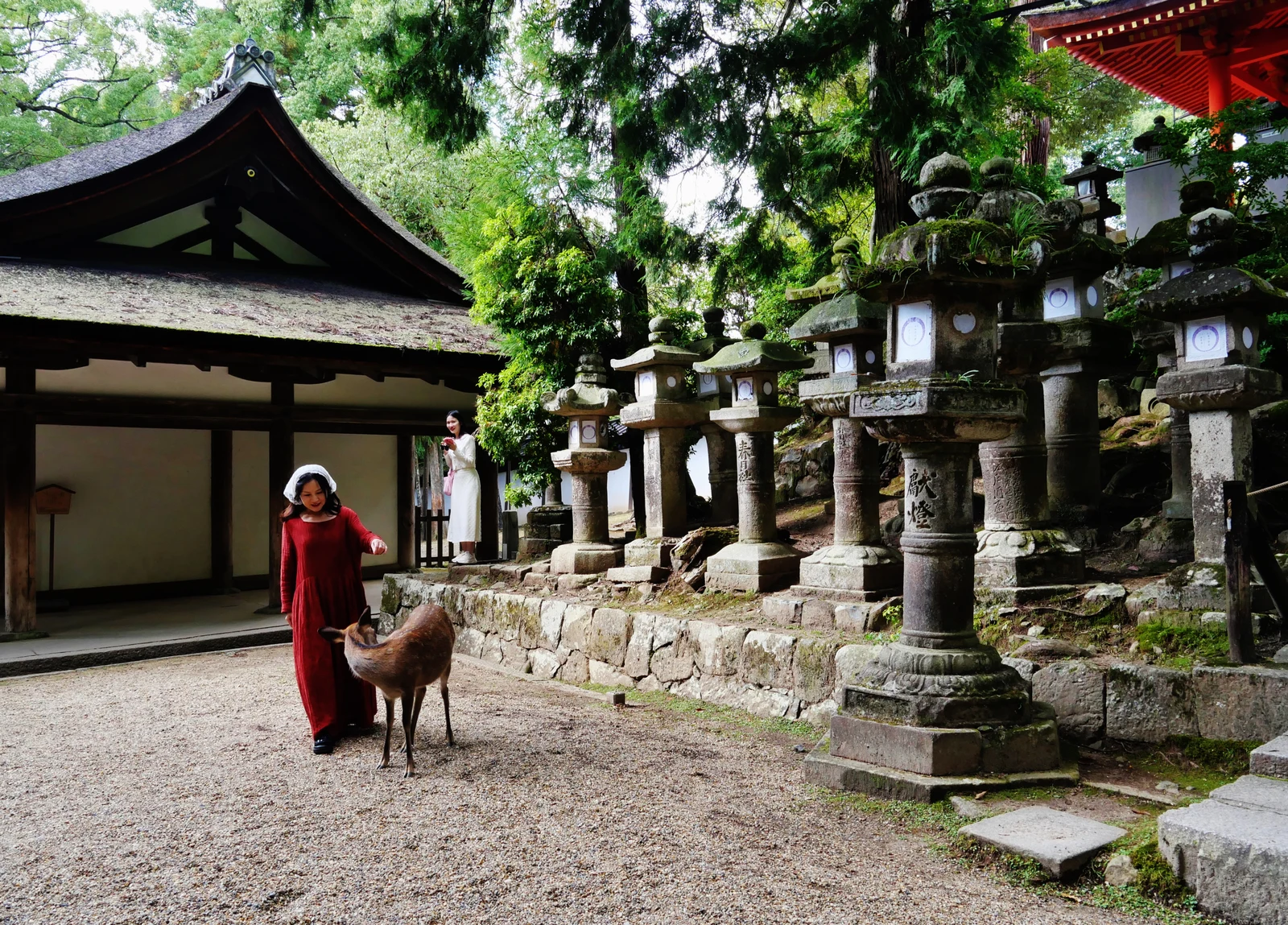
Separately, the shrine's National Treasure Hall (Kokuhokan), open 10:00 to 17:00 (last admission 16:30) for 700 yen, holds what Kasuga Taisha describes as 354 National Treasures and 2,528 Important Cultural Properties, a collection the shrine itself calls the "Shosoin of the Heian period," after the Imperial storehouse in Nara famous for preserving 8th-century treasures. Source: Kasuga Taisha, Main Sanctuary guidance and National Treasure Hall.
Three halls in one ticket at Kofukuji
Kofukuji's grounds hold three separate paid halls, and you can see all of them on a single 1,600-yen combined ticket instead of paying three times over: the National Treasure Museum (Kokuhokan, 900 yen alone), the Chukondo (Central Golden Hall, 500 yen alone) and the Tokondo (Eastern Golden Hall, 500 yen alone). All three keep the same hours, 9:00 to 17:00 with last admission at 16:45, every day of the year. Because Kofukuji sits right at Kintetsu Nara Station's east exit, it is often the first stop on a Nara day, before the walk to Todaiji or Kasuga Taisha.
Where Nara's own visitors eat and look for views
A few spots inside and near the park show up in Japanese review sites without appearing in any of the English-language search results we checked while researching this guide. Ukimido, a hexagonal pavilion set on Sagiike pond inside Nara Park, free to enter and an easy walk from both Todaiji and Kasuga Taisha, holds a 4.1 rating from 344 reviews on Jalan, a major Japanese booking site, as of September 22, 2026.
For food, Tabelog's Nara City rankings (same date, with the ranking itself last refreshed September 1, 2026) put a traditional Japanese sweets shop in the Naramachi district called Kashiya (樫舎) at the top of its cafe list, with 1,085 reviews and a 3.81 rating, ahead of four other cafes each carrying several hundred reviews of their own. Among udon shops, Harurin topped Tabelog's Nara City list with 306 reviews and a 3.56 rating. Source: Jalan, Ukimido; Tabelog, Nara City cafes and udon shops.
A different way to arrive: the Aoniyoshi sightseeing train
Kintetsu's sightseeing limited express, Aoniyoshi, connects Osaka Namba, Kyoto and Kintetsu Nara with twin seats, salon seats and a library car built into the train itself, so the ride there becomes part of the day rather than a wait before it. By Kintetsu's own schedule, it runs six days a week, typically resting on Thursdays: once a day through from Osaka Namba to Kyoto, plus three additional round trips between Kintetsu Nara and Kyoto. Its fare (see the note above) isn't listed here; check Kintetsu's official Aoniyoshi page if the train itself is part of what draws you to Nara.
A park that changes with the seasons
Nara Park is not a one-season place. In January, Wakakusayama hillside is set alight after a fireworks display; in March, Todaiji's monks carry blazing torches around a temple balcony at night; in August, around 20,000 candles light up nine spots across the park after dark. Details and dates for each are in the "When to go" section below.
Scenarios: four ways to spend the day
Adult, one person, as of September 22, 2026. Fares are JR West and Kintetsu list prices; the pass is Kintetsu's list price.
| Scenario | JR | Kintetsu | Pass | Number to note |
|---|---|---|---|---|
| S1: Osaka, the essentials (Todaiji and Kofukuji), walking only | 3,580 | 3,260 | 3,700 | Kintetsu is cheapest, 320 yen below JR |
| S2: Osaka, the full loop (Todaiji set, Kasuga Taisha special sanctuary, Kofukuji 3-building ticket), 1-Day bus pass | 5,780 | 5,460 | 5,300 | The pass is cheapest here |
| S3: Kyoto, using the Kintetsu Limited Express | 3,340 | 4,460 | 3,700 | JR is cheapest; the Limited Express surcharge tips it |
| S4: Kyoto, a longer day with the bus (paid per ride) and more temples | 6,540 | 6,620 | 5,900 | The pass is cheapest again |
If your day looks like one of these, the numbers below explain why.
Osaka, the essentials (Todaiji and Kofukuji)
This is the simplest plan: Kintetsu into Nara, a walk to Kofukuji, then on to Todaiji, no bus, plus one 200-yen pack of deer crackers. Kintetsu comes out 320 yen cheaper than JR here, mostly because the fare itself is lower and because this walking-only plan does not use the loop bus at all. This scenario is also where the station-distance gap matters most: our walking comparison in the "numbers" section above uses Kintetsu Nara Station's official times, because JR Nara Station has no official walking time to these temples. To reproduce this total in the calculator: Todaiji (800 yen), Kofukuji's National Treasure Museum (900 yen), no Kasuga Taisha, walking only, and 1 pack of deer crackers.
Osaka, the full loop with the bus day pass
Add the Daibutsuden + Museum set (1,200 yen), Kasuga Taisha's special sanctuary (700 yen) and Kofukuji's 3-building ticket (1,600 yen), and buy the 600-yen bus day pass to move between them, with no deer crackers added in this scenario, and the picture changes. Here the Nara World Heritage Pass comes out cheapest: it already bundles round-trip Kintetsu travel with unlimited local buses, so you are not paying separately for the day pass on top of the train fare. If your day includes several stops and bus rides, this is the shape of plan where the pass tends to win. To reproduce this total in the calculator: the admission choices above, the 1-Day bus pass, and 0 packs of deer crackers.
Kyoto, using the Limited Express
This scenario keeps the same admission choices as S1 (Todaiji's Daibutsuden and Kofukuji's National Treasure Museum) and the same 1 pack of deer crackers, walking only, but adds the Kintetsu Limited Express. From Kyoto, JR and Kintetsu's regular fares are close (720 versus 760 yen), so paying 520 yen each way for the Limited Express is what pushes Kintetsu's total above JR's here. Whether the extra speed and comfort of the Limited Express are worth 1,040 yen round trip is a judgment for the traveler, not something the fare comparison itself answers. To reproduce this total in the calculator: the same admission choices as S1, the Kintetsu Limited Express turned on, and 1 pack of deer crackers.
Kyoto, a longer day with the bus and more temples
Add the same full temple list as S2 (Daibutsuden + Museum, Kasuga Taisha's special sanctuary, Kofukuji's 3-building ticket), but pay for four bus rides one at a time instead of buying the day pass, and add 3 packs of deer crackers for a longer day spent around the deer. JR and Kintetsu end up close to each other while the pass pulls further ahead. As a general pattern: the more temples you visit and the more bus rides you take, the more the Nara World Heritage Pass tends to save, because its price is fixed while the other two options keep adding per-ride and per-ticket costs. To reproduce this total in the calculator: the same admission choices as S2, paying per ride for 4 bus rides instead of the day pass, and 3 packs of deer crackers.
How locals plan a Nara day trip
Kintetsu's own promotional pages, not a travel blog, are the clearest signal of how a Japanese traveler is expected to see Nara from Osaka or Kyoto. Kintetsu runs an official campaign page whose headline translates to "Nara, so close!!," built to push tickets like the Nara World Heritage Pass. The pitch is explicit: Nara is framed as a nearby day trip from Osaka or Kyoto, not a trip that needs its own overnight stay. Source: Kintetsu, "Nara, so close!!" campaign page (Japanese).
The station distances confirmed in the "numbers" section above also point to a logical route. Kofukuji sits right at Kintetsu Nara Station's exit, and Todaiji is an official 20-minute walk beyond it. Starting from Kintetsu Nara Station, walking to Kofukuji first, then Todaiji, then on to Kasuga Taisha follows the ground itself rather than doubling back, based on these official distances rather than a personal recommendation.
Domestic Japanese travel agencies also treat Nara as a package deal with Kyoto, not a standalone destination. VELTRA, Yomiuri Travel and Hankyu Travel all sell "Kyoto and Nara day trip" tours as a regular product category, commonly pairing Nara's temples with Kiyomizu-dera or Fushimi Inari Taisha in Kyoto on the same day. We did not use their prices or marketing copy here; the point is only that this pairing is a well-established, commercially normal itinerary shape in Japan's own domestic travel market.
When to go: Nara's festivals and opening hours
| When | What happens | Details | Source |
|---|---|---|---|
| Fourth Saturday of January (yearly) | Wakakusayama Yamayaki | 2026 was held on January 24: about 600 fireworks at 18:15, then the hillside is set alight at 18:30. A new paid viewing area was added in 2026 | Nara City Tourism Association |
| March 1 to 14 (yearly) | Todaiji's Shunie (Omizutori) | Torch processions most nights around 19:00 (19:30 and about 45 minutes with 11 torches on March 12 only); the main rite runs overnight from March 12 into March 13 | Todaiji official |
| Early August (yearly, dates vary) | Nara Toukae | 2026 ran August 5 to 14, 19:00 to 21:30, with about 20,000 candles across nine venues in and around Nara Park | Nara Toukae official |
| Year-round | Todaiji's opening hours change by season | Daibutsuden: 7:30 to 17:30 from April to October; 8:00 to 17:00 from November to March | Todaiji official |
As of September 22, 2026, the 2027 dates for Wakakusayama Yamayaki and Nara Toukae have not been announced. Some unofficial sites list a January 2027 date for the Yamayaki, but Nara Prefecture's own page doesn't confirm it, so we're leaving it out. The 2026 edition of Nara Toukae has already finished by the time of this check. Todaiji's 2027 Shunie schedule is expected in the usual March 1 to 14 window, with some viewing restrictions the temple says it will announce closer to the date.
We checked these dates on September 22, 2026, and plan to recheck Wakakusayama Yamayaki around December 1, 2026, Shunie around February 1, 2027, and Nara Toukae around June 1, 2027, as each event's official announcement window approaches.
Sources: Nara City Tourism Association, Wakakusayama Yamayaki; Todaiji, Shunie (Omizutori); Nara Toukae, official site.
How to buy: tickets, passes and tours
JR and Kintetsu regular tickets
Both railways sell their own tickets directly, with no discount version aimed only at overseas visitors on this route. Start at JR West's English-language site or Kintetsu's English-language site for routes, timetables and IC card guidance.
The Nara World Heritage Pass
This ticket is sold on Kintetsu's Japanese-language pages, with no English sales channel we could find. Start at Kintetsu's Nara World Heritage Pass page (Japanese) and confirm current sale conditions before you rely on it.
Guided tours
If you'd rather not plan the trains, temples and bus rides yourself, guided day tours to Nara from Osaka or Kyoto are sold by several operators, including GetYourGuide, KKday, Viator and Klook. We do not list prices or product details here, since they change by date and we do not copy tour listings; check each platform's current offerings and what is included (temple entry fees, lunch, transport) before comparing them with the do-it-yourself total from the calculator above.
Browse toursAffiliate link
For getting around the wider Kansai region beyond Nara, see Kansai Area Pass vs Kansai Railway Pass vs ICOCA. If you're still deciding where to base yourself, see Should You Stay in Kyoto or Osaka?. And if you're weighing another rail day trip from the same base, see Hiroshima Day Trip From Osaka.
However you get there, the fare is the smallest part of the day. Once you're standing under the Daibutsuden's roof or watching a deer nose through your empty hands for one more cracker, the 160-yen gap between Kintetsu and JR won't cross your mind.
Common questions
Is Nara worth a day trip from Osaka or Kyoto?
We don't judge that for you. What we can show is the fare and time from each city, the walking time from each station, and what each temple charges at the gate. The rest is a question of what you want to see and how much time you have.
Is the Nara World Heritage Pass worth it?
Again, it depends on your plan. In our full-day scenarios that add several temples and city loop bus rides, the pass came out cheapest. In simpler plans with only one or two temples and no bus, the regular Kintetsu fare was cheaper. Try your own combination in the calculator above.
How much time do I need in Nara?
We don't set a rule for that either. What we can tell you: Todaiji's Daibutsuden opens at 7:30 from April to October and at 8:00 from November to March, and getting between the station and the main temples takes 5 to 20 minutes on foot depending on your route. Build your own schedule from there.
Is it better to do Nara from Kyoto or Osaka?
Both cities reach Nara directly, and the fare and time differences are shown in the fares table above. We don't rank one city over the other; it comes down to where else you're going that day.
How much does it cost to feed the deer in Nara?
At the staffed stalls around the park, a 10-cracker pack of shika senbei costs 200 yen, per Nara City Tourism Association. Unstaffed vending machines near the deer enclosure and Kasuga Taisha's National Treasure Hall sell the same size pack for 500 yen, according to a 2022 newspaper report (not something the deer foundation itself confirmed to us directly). Official guidance says to give crackers one at a time and show empty hands when you're done.
What order should I visit Nara's temples?
From Kintetsu Nara Station, the shortest official distances put Kofukuji right at the exit and Todaiji about a 20-minute walk beyond it, with Kasuga Taisha a further short walk past Todaiji. Following that geography, Kofukuji, then Todaiji, then Kasuga Taisha is the route that avoids backtracking, based on the walking-time data above rather than a personal opinion.
Are there really eight UNESCO World Heritage Sites in Nara?
Not quite. UNESCO's listing "Historic Monuments of Ancient Nara" is one World Heritage registration, made in 1998, built from eight component assets: the Heijo Palace Site, Todaiji, Kofukuji, Yakushiji, Gangoji, Toshodaiji, Kasuga Taisha and the Kasugayama Primeval Forest. Calling it "eight World Heritage Sites" overstates what is, officially, a single listing.
Did the Nara city loop bus fare change?
Yes. The flat fare in the central loop rose from 220 yen to 250 yen on February 1, 2024, under a fare-cap change authorized by the Kinki District Transport Bureau. If you're reading an older source that quotes 220 yen, it predates that change.
Sources and data date
All fares were checked on September 22, 2026. Prices and timetables can change; check the operator's page before you travel.
- JR West: My Dia fare search; JR-Odekake Net timetable; English-language site
- Kintetsu: fare table, Osaka Namba–Nara; fare table, Kyoto–Nara; Nara World Heritage Pass, Nara-Ikaruga (Japanese); Nara World Heritage Pass, Nara-Ikaruga-Yoshino (Japanese); Aoniyoshi; "Nara, so close!!" campaign (Japanese); English-language site
- Todaiji: admission; access; Shunie (Omizutori)
- Kasuga Taisha: admission fee revision notice (Japanese); Main Sanctuary; National Treasure Hall
- Kofukuji: admission (Japanese)
- Nara Prefecture: Nara Park (Japanese)
- Nara City Tourism Association: Nara Park; deer feature page; Wakakusayama Yamayaki
- Nara Deer Preservation Foundation: 2026 population survey (Japanese)
- Nara Kotsu (Kintetsu Group Holdings): fare revision notice (Japanese, PDF); 1-Day Pass
- Nara Toukae: official site
- UNESCO World Heritage Centre: Historic Monuments of Ancient Nara
- Japan Tourism Agency: Consumption Trend Survey for Foreigners Visiting Japan, 2025 (final), PDF and Excel. Processed by Japan Trip Math.
- Nara Shimbun Digital: deer cracker vending machines (Japanese)
- Wikimedia Commons: Todaiji_Daibutsuden.JPG; Nara_deer_lounging_at_Todaiji.jpg; Nara_Kasuga-taisha_Lanterns_%26_Deer_05.jpg