Passes & tickets · Kanazawa · Tsuruga
Hokuriku Arch Pass Worth It at 35,000 Yen? Check Your Route
Prices checked October 27, 2026 against the official pages. Every figure links to its source.

Published: October 27, 2026
This page contains an affiliate link. If you book through it, we may earn a commission at no extra cost to you. It does not change our numbers. See our disclosure.
Prices as of October 27, 2026 for the pass and for Kanazawa to Kyoto and Osaka. Tokyo fares are as of September 2026.
Picture the Kagayaki bullet train pulling out of Tokyo and into Kanazawa in about 2 hours 31 minutes. On set evenings in November 2026, Kenrokuen garden is lit up and you walk in free.
Is the Hokuriku Arch Pass worth it? Not for a one-way trip. Tokyo to Kanazawa to Kyoto, plus the Haruka to Kansai Airport, adds up to 25,910 yen in separate fares. The pass costs 35,000 yen. It pays off only when your rides in 7 days add up to more than 35,000 yen, for example with a Tokyo to Nagano round trip (16,900 yen).
The price changed on March 14, 2026. The pass went from 30,000 yen to 35,000 yen, and passes bought on or before March 13 cover a different area. Some pages still show the old price.
Hokuriku Arch Pass worth it? Price and coverage of the 35,000 yen pass
You pay 35,000 yen per adult (12 and over) and 17,500 yen per child (6 to 11). The price depends on the day you buy the pass, not the day you exchange or use it. The pass runs for 7 consecutive days, from 0:00 on the first day to 24:00 on the last, and it cannot be extended.
It is sold to travelers holding a foreign passport who entered Japan as a "Temporary Visitor." Japanese nationals cannot buy it.
| Covered | Not covered, or paid separately |
|---|---|
| Hokuriku Shinkansen reserved seats, Tsuruga to Tokyo | Tokaido Shinkansen (Shin-Osaka to Tokyo) and Sanyo Shinkansen |
| Limited express reserved seats, such as HARUKA and THUNDERBIRD | Tohoku and Hokkaido Shinkansen "Hayabusa" and Akita Shinkansen "Komachi" need a separate limited express ticket |
| JR West and JR East Special Rapid, Rapid and local trains; Tokyo Monorail | Green Car and similar upgrades are an extra charge or not covered |
| IR Ishikawa Railway (Kanazawa to Tsubata), Ainokaze Toyama Railway (Toyama to Takaoka), Hapi-Line Fukui (Echizen-Hanado to Fukui) | Rides on these three railways outside those sections |
Source: JR West, Hokuriku Arch Pass.
Two details most pages skip:
- HARUKA is covered. You can ride the reserved-seat Haruka from Kyoto to Kansai Airport on the pass. For prices on that line, see Haruka from Kansai Airport to Kyoto.
- Reserve each seat before you board. From your 7th seat reservation, you go to a JR ticket window.
How to buy:
- Travel agents in Japan sell it from 1 month before your start date.
- Overseas agents issue an exchange voucher (MCO or e-ticket). Exchange it in Japan within 3 months of the issue date.
- JR West online reservation takes credit cards only (cards with no printed number are refused), from 1 month before you ride.
- Refund: 10% of the sales price (minimum 220 yen). After exchange, refunds are handled only where you exchanged.
The March 14, 2026 change
| Bought | Adult | Child | Coverage |
|---|---|---|---|
| On or after March 14, 2026 | 35,000 yen | 17,500 yen | The area in the table above |
| On or before March 13, 2026 | 30,000 yen | 15,000 yen | A different area |
Source: JR East press release of January 28, 2026 (PDF) and the JR West reservation page.
What makes Kanazawa worth the detour: Kenrokuen, the castle park and Higashi Chaya
Money is half the decision. The other half is what you do when the Kagayaki drops you in Kanazawa. Here is a first day that sits right on the pass's route.
Kenrokuen, in daylight and after dark
Start with Kenrokuen. Adults pay 320 yen, children (6 to under 18) pay 100 yen, and visitors aged 65 and over enter free with proof of age. It opens every day of the year. From March 1 to October 15, the garden is open 7:00 to 18:00 (last entry 17:30). From October 16 to the end of February, it is open 8:00 to 17:00 (last entry 16:30).
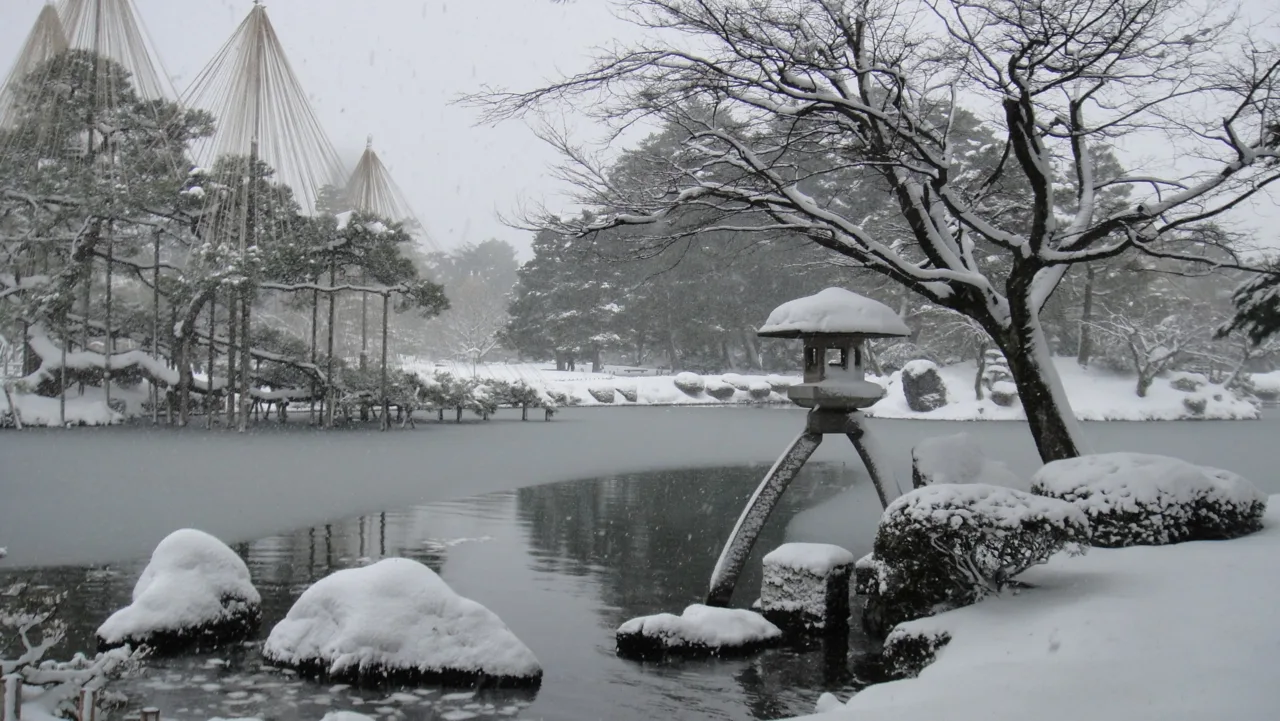
In November, snow ropes called yukitsuri are strung over about 800 trees. After dark, the Kotoji lantern, the Karasaki pine and the fountain are lit. On the light-up evenings (dates in the "When to go" section), you can enter from 18:00 to 20:45 and entry is free during the light-up hours. Tripods are banned, so leave yours at the hotel.
The castle park
Kanazawa Castle Park is lit on the same evenings. Ishikawa Gate, the Gyokusen'inmaru garden, Kahoku Gate, Hishi Yagura (a corner turret) and Nezumi Gate are all part of the light-up.
A museum you can enter for free
The 21st Century Museum of Contemporary Art, Kanazawa, has free entry to its indoor public zones, its permanent works and its outdoor exhibits. Special exhibitions are paid. It is open 10:00 to 18:00 (until 20:00 on Fridays and Saturdays) and closed on Mondays and over the New Year holiday.
Higashi Chaya and Omicho Market
Higashi Chaya is a district of old teahouses (ochaya). One of them, Kaikaro, opens to visitors in the daytime for a fee. Another, Shima, is a museum inside a former teahouse. In the evening, you can book an English-language geisha performance.
Omicho Market has about 170 shops and sits about a 15-minute walk from Kanazawa Station. It is a place to walk through hungry and decide what to eat when you get there.
Fitting it into one day
Put the hours side by side and the day sorts itself. From October 16, Kenrokuen opens at 8:00 and takes its last visitor at 16:30, so it is the first stop after you step off the train. The museum is open until 18:00 (20:00 on Fridays and Saturdays), so it takes the late afternoon, unless it is a Monday, when it is closed. For the evening you choose between two. On a November light-up date, go back to Kenrokuen between 18:00 and 20:45 and enter free. On any other night, book the English-language geisha performance in Higashi Chaya, and visit Kaikaro or Shima in daylight on another day.
If you want a different kind of day from Kanazawa, see Shirakawa-go by bus from Kanazawa.
Day one is Kenrokuen, the castle gates, the museum and a teahouse street. The Kagayaki ride from Tokyo is 14,600 yen. The next section shows what the pass does to that number.
Sources: Ishikawa Prefecture, Kenrokuen; Hot Ishikawa Tabinet, light-up; Ishikawa Travel, 21st Century Museum; Ishikawa Travel, Higashi Chaya. Checked October 27, 2026.
Hokuriku Arch Pass vs separate fares: Tokyo to Kanazawa, Kyoto and Osaka
These are the fares you would pay without the pass: one adult, reserved seat, regular season.
| Route (one way) | Fare | Date and source |
|---|---|---|
| Tokyo to Kanazawa, Kagayaki (ticket 7,700 + limited express 6,900) | 14,600 yen (about 2 hours 31 minutes) | September 2026, JR East fare search |
| Kanazawa to Kyoto, Tsurugi + Thunderbird, 1 change (ticket 3,740 + limited express 3,980) | 7,720 yen | October 27, 2026, JR West My Dia |
| Kanazawa to Osaka, same trains (ticket 4,840 + limited express 4,570) | 9,410 yen | October 27, 2026, JR West My Dia |
| Tokyo to Toyama, Kagayaki | 13,180 yen | September 2026, JR East |
| Tokyo to Nagano, Kagayaki, reserved seat (non-reserved is 7,920) | 8,450 yen | September 2026, JR East |
| Kyoto to Kansai Airport, Haruka reserved seat, regular season | 3,590 yen (the limited express part ranges 1,530 to 2,130 yen by date) | September 19, 2026, JR West |
| Osaka to Kyoto, Thunderbird reserved seat | 1,870 yen | September 19, 2026, JR West |
| Not covered by the pass: Tokyo to Shin-Osaka, Nozomi reserved seat, regular season | 14,720 yen | September 2026, JR Central |
JR East reserved-seat limited express fees move with the season: 200 yen less in quiet periods, 200 yen more in busy periods and 400 yen more in the busiest. The pass price never moves, but your separate-ticket total can shift by a few hundred yen. For the Tokaido line, see Tokyo to Kyoto and Osaka by Tokaido Shinkansen.
The Tsuruga change
The Hokuriku Shinkansen reaches Tsuruga. From there to Kyoto or Osaka you change to the Thunderbird.
On a JR West My Dia search on October 27, 2026, the Tsurugi No. 19 leaves Kanazawa at 11:05 and reaches Tsuruga at 12:02. The Thunderbird No. 20 leaves Tsuruga at 12:14, a 12-minute change. It arrives in Kyoto at 13:09 (2 hours 4 minutes door to door) or in Osaka at 13:36 (2 hours 31 minutes). Another train pair gives a different change time.
Hokuriku Arch Pass calculator: your rides vs 35,000 yen
Fill in the rides you plan, and the calculator shows the separate-ticket total beside the pass. See how the numbers are worked out.
How to fill it in:
- For each route, enter the number of one-way rides. A round trip is 2.
- Enter the number of days from your first ride to your last. The pass covers 7.
- If you ride the Tokaido Shinkansen Nozomi, enter it too. The pass does not cover it, so the fare is added to both options.
The calculator leaves these out:
- Child fares and non-reserved seats. The numbers are for one adult in a reserved seat.
- Season. Fares are regular-season. The pass price is the same all year.
- Transfer discounts. Totals are the sums of the fares in the table above.
- Rides on IR Ishikawa, Ainokaze Toyama and Hapi-Line Fukui beyond the covered sections. Look up the fare and enter it under "Other covered rides."
- Local spending, such as what you eat at Omicho Market.
Four routes through the Hokuriku Arch Pass: itinerary examples
One adult, reserved seats, regular-season fares. All amounts are in yen.
| Route | Separate fares | Pass | Pass difference |
|---|---|---|---|
| A. Tokyo to Kanazawa to Kyoto, then Kyoto to Kansai Airport by Haruka | 25,910 | 35,000 | Pass costs 9,090 more |
| B. Tokyo to Kanazawa to Osaka, Osaka to Kyoto by Thunderbird, Kyoto to Kansai Airport | 29,470 | 35,000 | Pass costs 5,530 more |
| C. Tokyo to Kanazawa and back only | 29,200 | 35,000 | Pass costs 5,800 more |
| D. Route B, plus a Tokyo to Nagano round trip in the first two days | 46,370 | 35,000 | Pass saves 11,370 |
The line between A and D is one trip. Route B needs 5,530 yen more of rides to reach 35,000 yen, and one Tokyo to Nagano round trip adds 16,900 yen in a single stroke. So whether the pass pays back is decided less by the way to Kanazawa than by the round trips you add on top. A route like D is where the Hokuriku Arch Pass pays back: (affiliate link) Check prices
One more number. Tokyo to Osaka by way of Kanazawa costs 24,010 yen in separate fares (14,600 + 9,410). The Tokaido Shinkansen Nozomi from Tokyo to Shin-Osaka is 14,720 yen, which is 9,290 yen less. With the pass, the same trip costs 35,000 yen. The Kanazawa route is a choice to add scenery, not a way to save money. (Osaka Station and Shin-Osaka Station are different stops, so check which one your hotel is closer to.)
When to go: Kenrokuen light-ups and snow ropes, 2026–27
Here is the Kenrokuen calendar around a Hokuriku trip, with the 2026 dates.
| When | What | Entry and fees |
|---|---|---|
| November 3, 2026 (Culture Day) | Kenrokuen free-admission day | Free (annual rule) |
| From early November | Snow ropes (yukitsuri) go up on about 800 trees | Regular admission |
| November 7, 14, 15, 21, 22, 28 and 29, 18:00 to 21:00 (last entry 20:45) | Kanazawa Castle and Kenrokuen Four Seasons Story, Autumn: evening light-up | Free during light-up hours; no tripods |
| November 7, 14, 21 and 28 | Light-up concerts at Uchihashi-tei, about 15 minutes, twice an evening | See below |
| December 31 to January 3 | Kenrokuen free-admission days | Free (annual rule) |
| February | Winter light-up. In 2026 it ran on four Saturdays in February | – |
| March to April | Cherry blossom season: about 7 free days and night light-ups | Free on the free days |
| All year | JR East reserved-seat limited express fee: 200 yen less (quiet), 200 yen more (busy), 400 yen more (busiest) | Fiscal 2026 calendar |
The concerts rotate by evening: string quartet on November 7 and 14, flute and koto on November 21, and shamisen on November 28. Sources: Ishikawa Prefecture and Hot Ishikawa Tabinet, checked October 27, 2026.
Heading on to Kyoto in late autumn? Our Kyoto autumn leaves 2026 forecast covers that side of the trip.
What to buy instead: separate tickets, the One-way Ticket, or the pass
To spend the least: buy separate tickets. On routes A, B and C, separate fares cost less than the pass. Between Kanazawa and Kyoto or Osaka only, the Hokuriku One-way Ticket for visitors is cheaper than the regular fare: 6,500 yen from Kyoto city and 8,000 yen from Osaka city, against 7,720 and 9,410 yen. That saves 1,220 and 1,410 yen. It includes the Thunderbird and the Shinkansen from Tsuruga to Toyama. The JR West page is dated February 5, 2025, and the ticket is sold by overseas agents only.
For the least hassle: the pass, but only if your rides add up to more than 35,000 yen, as in route D. One pass covers every reserved seat, and from the 7th reservation you book at a JR window.
Where the line sits: route B reaches 35,000 yen with 5,530 yen of extra rides, and one Nagano round trip (16,900 yen) clears it. The line is 35,000 yen per person, so two travelers each need their own 35,000 yen of rides.
If you plan a route like D, KKday sells the JR Hokuriku Arch Pass. Check the product page for how and where to exchange the voucher before you book. (affiliate link) Book here
Two details to know:
- Exchange: JR West says an overseas agent's voucher must be exchanged in Japan within 3 months of the issue date, and you reserve seats after exchange.
- Cancellation: KKday's free cancellation for an unused pass runs 90 days from booking. That is KKday's own rule, separate from JR West's 10% refund fee (minimum 220 yen).
To compare it with the national pass, see the JR Pass break-even guide.
Common questions about the Hokuriku Arch Pass
Does the Hokuriku Arch Pass cover the Haruka to Kansai Airport?
Yes. Reserved seats on the Haruka are covered, according to JR West.
I bought the pass before March 14, 2026. Is my coverage different?
Yes. Passes bought on or before March 13, 2026 cover a different area, and they were priced at 30,000 yen. Passes bought on or after March 14 cost 35,000 yen.
Can a Japanese citizen or a long-term resident use the Hokuriku Arch Pass?
No. It is for visitors with a foreign passport who entered as a "Temporary Visitor." Japanese nationals cannot buy it.
Can I get a refund on the Hokuriku Arch Pass?
Yes. The fee is 10% of the sales price, minimum 220 yen. After exchange, refunds are handled only where you exchanged the pass.
How does the Hokuriku Arch Pass compare with the JR Pass?
They are different passes with different areas and prices. Our JR Pass break-even guide runs the same kind of math for the national pass.
Whether you buy the pass or not, save one November evening for Kanazawa: the snow ropes are up on about 800 trees, the lantern and the pine are lit, and entry is free during the light-up hours.
Sources and data date
The pass price and the Kanazawa to Kyoto and Osaka fares were checked on October 27, 2026. Tokyo fares and the other fares were checked in September 2026 (September 19 to 25). Fares are for one adult in a reserved seat, regular season.
- JR West: Hokuriku Arch Pass, online reservation page, Hokuriku One-way Ticket, and the My Dia route search (JR Odekake Net), searched October 27, 2026 for reserved seats. My Dia fares are a guide.
- JR East: press release, January 28, 2026 (PDF) and the fare search for Tokyo to Kanazawa, Toyama and Nagano.
- Ishikawa Prefecture: Kenrokuen visitor information.
- Hot Ishikawa Tabinet: Kanazawa Castle and Kenrokuen Four Seasons Story, Autumn.
- Ishikawa Travel: 21st Century Museum and Higashi Chaya.